Yorkshire · York
Things to do in York, UK: the Minster, the walls, the Shambles and the stories behind them
What's worth your time in York, England, how long each place takes, and the people and books tied to the city. All of it on foot.
- Where
- North Yorkshire, England, about 175 miles north of London by rail
- Train from London
- About 1 hour 50 minutes from King's Cross on the fastest LNER trains
- City walls
- About 2.1 miles round; allow up to 2 hours
- Time needed
- One full day for the highlights; two days to add museums
- Car needed?
- No. The center is compact and walkable
- Our trip
- Thursday 7 October 2027: Castle Howard, then York
The short answer
The best things to do in York, UK, are York Minster, a walk on the medieval city walls (about 2 miles), the Shambles, York Castle Museum and its Victorian street, JORVIK Viking Centre, Clifford's Tower, the free National Railway Museum, and tea at Bettys. The old city is small and flat, so you can see most of it on foot in one or two days without a car.
York is a walled city in North Yorkshire with a Gothic cathedral, a medieval street plan and about 2,000 years of history packed into a small, flat center. Below are the things to do in York, UK, that are actually worth your time, how long each one takes, and the people, books and TV shows tied to them. I spent a day here in late October 2026 while scouting our trip (bus and train to Knaresborough in the morning, then York), and that day came to about 20,000 steps. The timings below come from that.
Everything here is inside or just outside the city walls. You won’t need a car. You will need shoes that can handle cobbles and worn stone steps.
Things to do in York, UK: the short list
| Place | What it is | Allow | Cost |
|---|---|---|---|
| York Minster | Gothic cathedral, built 1220–1472 | 1½–2 hours | Paid ticket |
| City walls | Medieval walls, about 2.1 miles round | 1–2 hours | Free |
| The Shambles | Medieval street of overhanging timber houses | 30 minutes | Free |
| York Castle Museum | Social history museum with a Victorian street | 2 hours | Paid ticket |
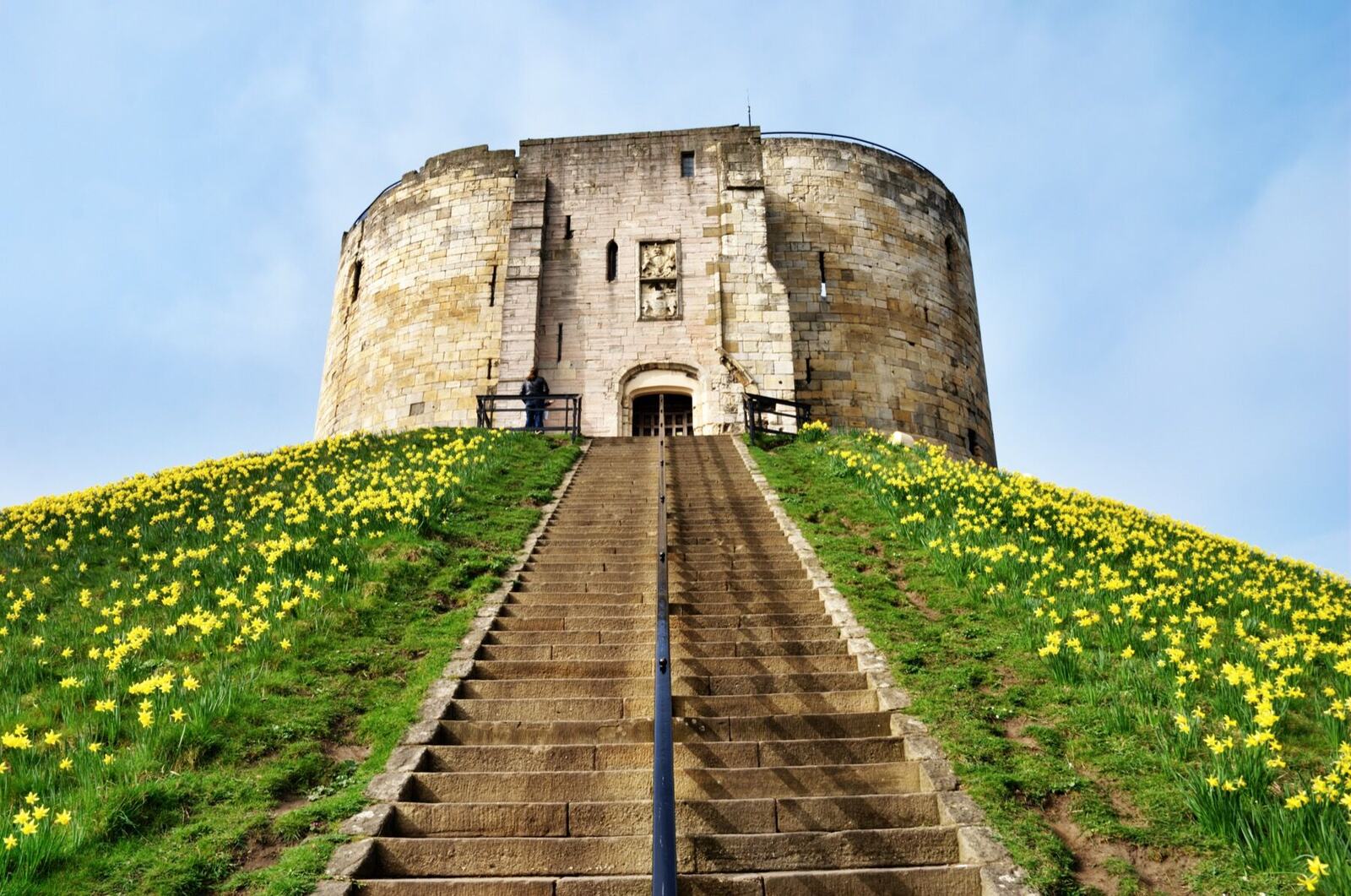
| Clifford’s Tower | 13th-century stone keep on a Norman mound | 45 minutes | Paid (English Heritage) |
| JORVIK Viking Centre | Viking-age York, on the site of the Coppergate dig | 1 hour | Paid ticket |
| National Railway Museum | National collection of locomotives, including Mallard | 2 hours | Free |
| Bettys, St Helen’s Square | Tea room open since 1937 | 1 hour | Pay as you go |
Check each official site for current hours and prices before you go. Several sights close around 5pm, so don’t save the big ones for late afternoon.
York Minster
York Minster is the reason most people come, and fair enough. Most of the building went up between 1220 and 1472, and it’s one of the largest Gothic cathedrals in northern Europe. Inside, look for two windows.
The Great East Window shows the Last Judgment. John Thornton was commissioned to make it in 1405, and it’s the largest expanse of medieval stained glass in the country. The Five Sisters window in the north transept is five tall lancets of grey-green grisaille glass, each over 53 feet high.
Charles Dickens built a story around that second one. In Nicholas Nickleby (1839), a traveler tells the tale of five sisters of York whose embroidery was copied into the glass:
Time has softened down the colours, but the same stream of light still falls upon the forgotten tomb, of which no trace remains; and, to this day, the stranger is shown in York Cathedral, an old window called the Five Sisters.
— Charles Dickens, Nicholas Nickleby, Chapter 6 (Project Gutenberg)
The tale is fiction. The window is real, and you can stand under it.
Anne Brontë loved the Minster. Her friend Ellen Nussey described taking her there in May 1849, days before Anne died at Scarborough. Elizabeth Gaskell printed the account in her Life of Charlotte Brontë:
By her request we went to the Minster, and to her it was an overpowering pleasure; not for its own imposing and impressive grandeur only, but because it brought to her susceptible nature a vital and overwhelming sense of omnipotence.
— Ellen Nussey, quoted in Elizabeth Gaskell, The Life of Charlotte Brontë, Vol. 2 (Project Gutenberg)
If the Brontës are part of why you’re in Yorkshire, our guide to the Brontë sisters and their books covers the rest of the family’s story.
A few practical things. It’s a working church, so services can close parts of it. In July 1984 a fire badly damaged the south transept; the roof you see there now is the rebuilt one. And the Undercroft holds Norman stonework from about 1160, if you want to see what came before.
Walking York’s city walls
York has the longest surviving medieval town walls in England. The full circuit is about 2.1 miles (3.4 km), and VisitEngland suggests allowing about two hours. There are five main gates, which York calls “bars”, plus towers and steps along the way.
If you only do one stretch, make it Bootham Bar (near the Minster) to Monk Bar. It’s one of the shortest sections, and it’s the one with the Minster view over the rooftops, which is why most people pick it. The steps up are steep and the stone is uneven, so check the council’s walls page for closures in bad weather.
Daniel Defoe saw the walls in a different state in the 1720s, after the Civil War defenses had been pulled down:
York is indeed a pleasant and beautiful city, and not at all the less beautiful for the works and lines about it being demolished, and the city, as it may be said, being laid open, for the beauty of peace is seen in the rubbish
— Daniel Defoe, A Tour thro’ the Whole Island of Great Britain, Letter IX (Internet Archive)
The Shambles
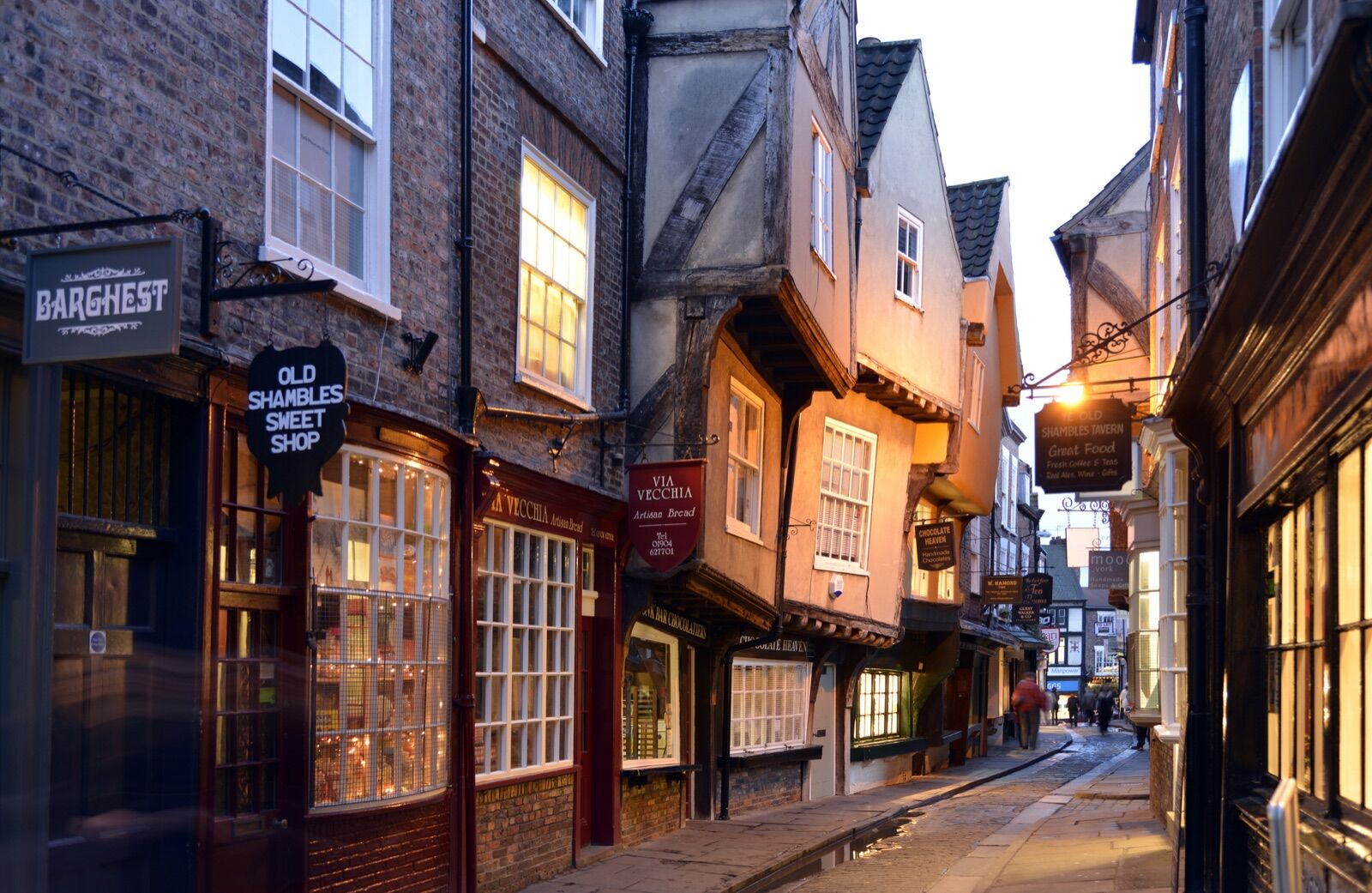
The Shambles is a short, narrow street of timber-framed houses whose upper floors lean out over the cobbles. It was York’s butchers’ street for centuries, and some shops still have the iron meat hooks outside. Many of the buildings date from about 1350 to 1475.
It’s also the street most people connect with Harry Potter, though J.K. Rowling has said she’s never been there. Our full guide to the Shambles in York covers its history, the shrine to Margaret Clitherow, the wizard shops and the best time to go. Short version: before 10am or after 5pm if you want photos without the crowds.
York Castle Museum and Clifford’s Tower
These two sit side by side on the site of York’s medieval castle, a 10-minute walk south of the Shambles.
York Castle Museum opened in 1938 in two former prison buildings: the 18th-century Debtors’ Prison and the Female Prison. Its founder, the doctor and collector John Kirk, gave it its best-known room: Kirkgate, a full-size Victorian street with shopfronts you can walk into. It was the first of its kind in Britain. The museum also has the cell where the highwayman Dick Turpin was held before his trial in 1739. He’s buried in St George’s churchyard, a short walk away.
The museum has a part in a well-known York novel. Kate Atkinson’s Behind the Scenes at the Museum (1995), which won the Whitbread Book of the Year, is narrated by Ruby Lennox, who grows up in York, and the title refers to this museum. I just read it, and it’s one of the books we’re considering for the Yorkshire trip’s reading months. It’s in copyright, so we’ll just say: read it before you go, then walk Kirkgate.
Clifford’s Tower stands on the mound next door. William the Conqueror built the first castle here in 1068. In March 1190 about 150 members of York’s Jewish community took refuge in the wooden tower on this mound during an attack; most died there, many by their own hand rather than face the mob. English Heritage, which runs the site, tells the story plainly inside. The stone tower you see was built for Henry III from the 1240s.
JORVIK and Viking York
Before it was York, the city was Eboracum to the Romans and Jorvik to the Vikings. Archaeologists from York Archaeological Trust dug the Coppergate site in the 1970s and early 1980s and found Viking-age houses, workshops and thousands of objects preserved in wet ground. JORVIK Viking Centre opened on the same spot on 14 April 1984. You ride through a reconstruction of the Viking street, then see the finds. Allow an hour, and book a timed ticket in school holidays.
The National Railway Museum
The National Railway Museum, just behind York station, holds the national collection of locomotives, including the steam locomotive Mallard. Admission is free. It’s a good pick on a wet afternoon, or if you’re traveling with someone who has had enough of cathedrals.
Bettys, bookshops and where to eat
Bettys in St Helen’s Square opened in 1937, eighteen years after the first Bettys in Harrogate. During the Second World War its basement bar was a favorite with RAF and Canadian bomber crews stationed around York. Airmen scratched their names into a mirror there, and by the end of the war it held almost six hundred signatures. Sections of that mirror now hang in the downstairs Oak Room. Expect a line for the main café; you can book some rooms.
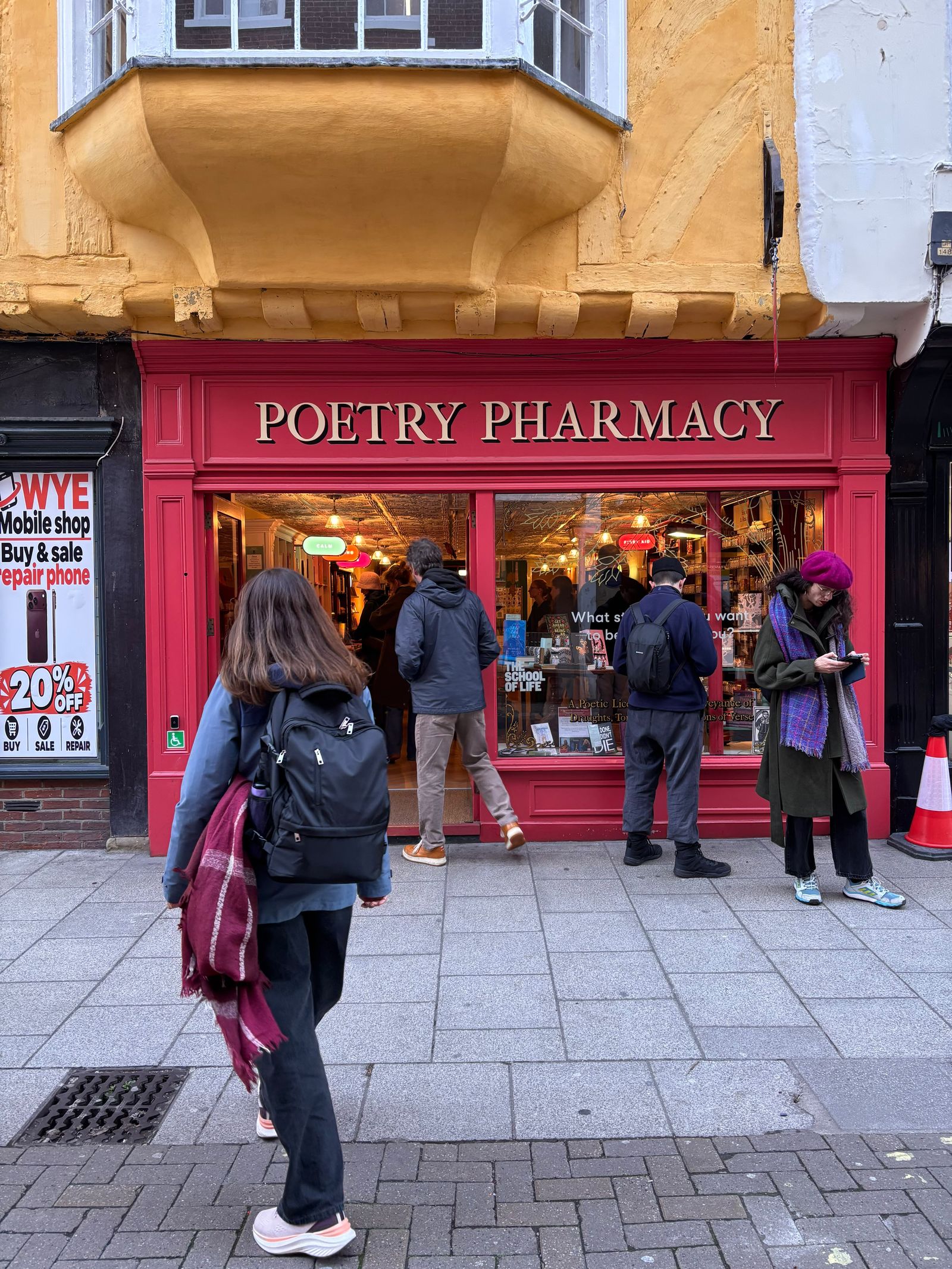
For books, York has several good independent shops a few minutes from the Minster. Minster Gate Bookshop sits right by the Minster. The Poetry Pharmacy opened on Coney Street in March 2026, selling poetry and wellbeing books in a listed building opposite Waterstones.
I found it by accident while wandering York in October 2026: a very cute little shop that prescribes poetry for what ails you. I also found a book called 365 Days of Brontë, and across the street another, Yorkshire Literary Landscapes, which is chock-full of writers who either came from Yorkshire or were inspired by it. If you like a souvenir you can read on the train home, this is the corner of York for it.
People who lived here
York has more famous former residents than most cities its size. A few worth knowing before you walk around:
- Guy Fawkes was born in Stonegate in 1570 and baptized at St Michael le Belfrey, the small church beside the Minster.
- Dick Turpin, the highwayman, was tried and hanged at York in 1739.
- Margaret Clitherow, a butcher’s wife on the Shambles, was executed in 1586 for hiding Catholic priests and was later made a saint.
- Anne Lister, the Halifax diarist, took communion with Ann Walker at Holy Trinity Church, Goodramgate, on Easter Sunday 1834. The two regarded it as their marriage. Her full story is in our guide to Anne Lister and Gentleman Jack.
- Anne Brontë visited the Minster in her last week of life, in May 1849.
Holy Trinity, Goodramgate
This small church on Goodramgate is about five minutes’ walk from the Minster, and it’s easy to walk right past. Parts of it date from the 12th century, and inside it still has its old wooden box pews. It stopped being used for regular worship in 1971 and has been cared for by the Churches Conservation Trust since 1972.
Its fame now comes from Anne Lister. On Easter Sunday, 30 March 1834, Lister and Ann Walker took communion here together, and both regarded it as their wedding. York Civic Trust put up a rainbow-edged plaque outside in 2018. People objected that its first wording didn’t say Lister was a lesbian, and in 2019 it was replaced with one that reads, in part, “Lesbian and Diarist; took sacrament here to seal her union with Ann Walker.”
York in old travel writing
People have been writing about York for centuries, and the early accounts are worth reading because so much of what they describe is still standing. Celia Fiennes rode through in 1697 and noticed what every visitor arriving by road still notices:
There are a Great Many pretty Churches 16 in Number, but the minster is a noble building and holds in view at Least 30 miles before you Come to it.
— Celia Fiennes, Through England on a Side Saddle (Project Gutenberg)
Defoe, in the 1720s, singled out the west front, the side you face as you walk up from Duncombe Place:
it is now the beautifullest church of the old building that is in Britain. In a word, the west end is a picture
— Daniel Defoe, A Tour thro’ the Whole Island of Great Britain, Letter IX (Internet Archive)
Day trips from York, England
York makes a good base for seeing more of Yorkshire. These are the trips that work best from the city:
| Day trip | Distance or time | What’s there |
|---|---|---|
| Castle Howard | 15 miles north-east; route 81 bus | Baroque house, Brideshead Revisited and Bridgerton |
| Harrogate | About 35–40 minutes by train | Spa town, Bettys, the Turkish Baths |
| Knaresborough | On the same line as Harrogate | Castle, river gorge, railway viaduct |
| Fountains Abbey | 12 miles north of Harrogate | Abbey ruins and Studley Royal water garden |
| The North York Moors | By car or a day tour from York | Moorland, Helmsley, the steam railway |
I did Knaresborough and York on the same day by bus and train. It works, but it’s a long one.
When to visit York
York is busy all year. My scouting week in late October 2026 fell in the English school half-term holiday, when the city’s main streets are at their busiest. (Half-term also sold me out of a booking that week, which is how I ended up on the bus and train to Knaresborough and York instead. Lesson learned: book ahead.) If you can, avoid UK school holidays, go on a weekday, start early, and leave the Shambles for the end of the afternoon, after the day-trippers leave.
York on TV: Gentleman Jack and more
York’s old streets turn up on screen a lot. The BBC and HBO series Gentleman Jack (2019–2022), about Anne Lister, filmed in Goodramgate, Precentor’s Court, Duncombe Place, Minster Yard and inside Holy Trinity Church. Walk from the Minster’s west front to Goodramgate and you pass most of them in ten minutes.
Things to do in York without a car
York is one of the easiest cities in England to do without driving. The station is just outside the walls, and from there, at an easy pace, it’s roughly:
- Minster: about 15 minutes’ walk.
- Shambles: about 15 minutes.
- Castle Museum and Clifford’s Tower: about 15–20 minutes.
- National Railway Museum: about 5 minutes, behind the station.
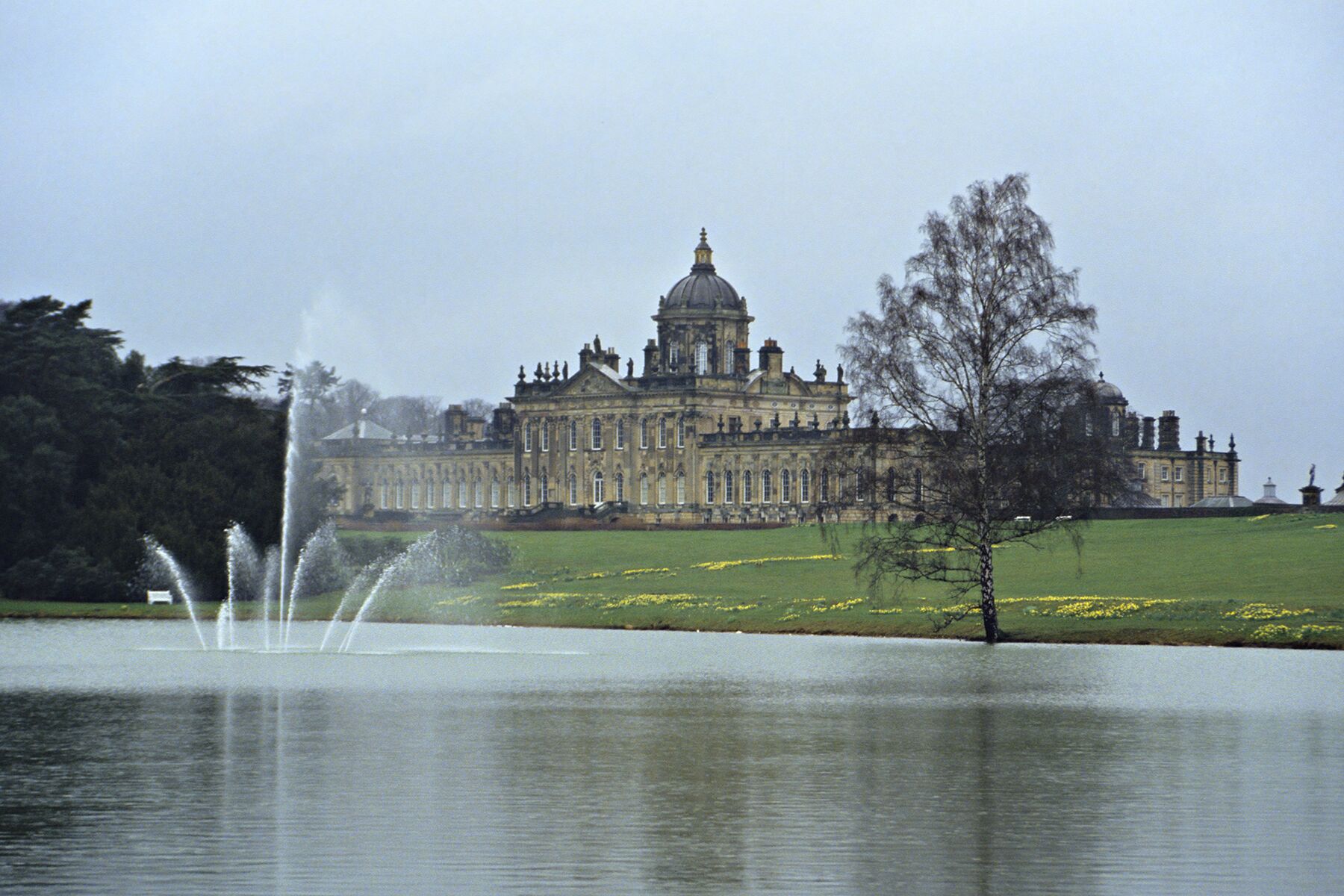
For trips out, trains to Harrogate take about 35–40 minutes (see our guide to Harrogate), and the route 81 bus runs from York to Castle Howard, 15 miles north-east, where Brideshead Revisited and Bridgerton were filmed.
York on a wet day
York gets its share of rain, and some of the best things to do in York are indoors anyway. The National Railway Museum is free and almost entirely under cover. York Castle Museum takes a couple of hours and is mostly indoors, Kirkgate included. JORVIK is underground. The Minster can fill a whole morning on its own. And Bettys is the obvious place to wait out a shower, though everyone else has the same idea, so expect a line.
A one-day plan for York
If you only have one day, this order keeps the walking short and saves the busiest street for last:
- 9:00 Walk the walls from Bootham Bar to Monk Bar for the Minster view.
- 9:45 York Minster. Allow until about 11:30.
- 11:45 Holy Trinity, Goodramgate, five minutes away, and its box pews.
- 12:30 Lunch, then the bookshops around Minster Gate.
- 14:00 York Castle Museum and Kirkgate. Clifford’s Tower next door if you’ve got the energy.
- 16:30 Tea at Bettys.
- 17:30 The Shambles, once the day-trippers have gone.
How we spend the day in York on our trip
On our October 2027 Yorkshire trip, Thursday 7 October starts with a private tour of Castle Howard before it opens, then we drive into York. We have an early lunch together at Bettys, walk through the Shambles to York Castle Museum and go round it as a group. From about 2:30 to 5:30 the afternoon is yours: the Minster, the walls, JORVIK, the bookshops or Holy Trinity are all a short walk away. Then we meet for dinner together before driving back to our house in North Yorkshire. Entry to the Minster isn’t included; it’s one of the free-time choices, at your own cost.
York's story: what else was happening
York has been a city for nearly 2,000 years, so this one's the long view: Romans, Vikings, the Minster builders, Tudor York and the Victorians who brought the railway. The Minster took 250 years to build, long enough to span the Black Death and the Wars of the Roses, and when Anne Brontë came to see it in 1849, Dickens was just starting David Copperfield.
- Roman Eboracum 71–410
- Viking Jorvik 866–954
- Tudor 1485–1603
- Georgian 1714–1837
- Victorian 1837–1901
The story Britain The wider world Other writers
- 71 The story The Romans build a fortress here and call it Eboracum.
- 306 The story Constantine is proclaimed Roman emperor at York.
- 866 The story A Viking army captures York, and it becomes Jorvik.
- 1066 Britain King Harold beats a Norwegian invasion at Stamford Bridge, near York, then loses at Hastings three weeks later.
- 1068 The story William the Conqueror builds York's first castle, on the mound where Clifford's Tower stands.
- 1190 The story About 150 of York's Jewish community die in the castle's wooden tower during an attack.
- 1220 The story Work begins on the Minster you see today.
- 1348 Britain The Black Death reaches England.
- 1405 The story John Thornton is commissioned to make the Minster's Great East Window.
- 1472 The story The Minster is finished and consecrated.
- 1476 Other writers William Caxton sets up England's first printing press, at Westminster.
- 1492 The wider world Columbus reaches the Caribbean.
- 1570 The story Guy Fawkes is born in Stonegate.
- 1586 The story Margaret Clitherow, a butcher's wife from the Shambles, is executed in York.
- 1605 Britain The Gunpowder Plot: Guy Fawkes is caught under Parliament in November.
- 1644 Britain Parliament's armies besiege York and win the Battle of Marston Moor, west of the city.
- 1697 Other writers Celia Fiennes rides through and notes the Minster can be seen 30 miles off.
- 1724 Other writers Daniel Defoe's Tour thro' the Whole Island of Great Britain starts coming out.
- 1739 The story The highwayman Dick Turpin is tried and hanged at York.
- 1834 The story Anne Lister and Ann Walker take communion together at Holy Trinity, Goodramgate, on Easter Sunday.
- 1839 Britain The railway reaches York.
- 1839 Other writers Dickens's Nicholas Nickleby, with its tale of the Five Sisters window, comes out as a book.
- 1849 The story Anne Brontë visits the Minster in May, days before she dies at Scarborough.
- 1849 Other writers Dickens's David Copperfield begins in monthly parts.
- 1937 The story Bettys opens in St Helen's Square.
- 1938 The story York Castle Museum opens in the old prison buildings.
- 1942 Britain A German air raid hits York on 29 April; the Guildhall burns.
- 1975 The story The National Railway Museum opens.
- 1984 The story JORVIK opens in April; in July, fire badly damages the Minster's south transept.
- 1995 Other writers Kate Atkinson publishes Behind the Scenes at the Museum, set in York.
Questions people ask
What are the top things to do in York, UK?
York Minster, the city walls, the Shambles, York Castle Museum, JORVIK Viking Centre, Clifford's Tower and the National Railway Museum are the main sights. Add afternoon tea at Bettys and an hour in the bookshops around Minster Gate.
Is York, England worth a day trip from London?
Yes. The fastest LNER trains from King's Cross take about 1 hour 50 minutes, and the station is a 10-minute walk from the walls. A day covers the Minster, the walls and the Shambles; stay a night if you want the museums too.
Can you do York without a car?
Easily. The old city inside the walls is small and mostly flat, and the main sights are within a 15-minute walk of each other. Buses run to places outside the walls, including Castle Howard (route 81).
How long does it take to walk York's city walls?
The full circuit is about 2.1 miles (3.4 km), and most people take an hour and a half to two hours with stops. You can join or leave at any of the main gates, which York calls bars.
Is the National Railway Museum in York free?
Yes, general admission is free. It's worth booking a free timed ticket in busy periods; check the museum's own site before you go.
What is York famous for?
York is known for its Gothic Minster, the longest medieval town walls in England, its Viking past as Jorvik, the Shambles, and as the birthplace of Guy Fawkes.
In this guide
 Yorkshire · YorkThe Shambles, YorkA 400-foot medieval street in the middle of York: what's actually old about it, who lived here, and when to go if you don't like crowds.
- Yorkshire · Anne ListerAnne ListerThe Halifax landowner who wrote five million words, a sixth of them in code, and married a woman in a York church in 1834. Here's her story, and where you can still follow it.
- Yorkshire · York · BooksBehind the Scenes at the MuseumWho's who in Ruby Lennox's family, generation by generation, how the chapters and footnotes fit together, and the York streets you can still walk. Spoilers are tucked away until you click.
 Yorkshire · Castle HowardCastle HowardWhere Castle Howard is, how to get there from York without a car, and the books, films and people behind the house you've probably already seen on screen.
Read next
- Yorkshire · YorkThe Shambles, YorkA 400-foot medieval street in the middle of York: what's actually old about it, who lived here, and when to go if you don't like crowds.
- Yorkshire · Anne ListerAnne ListerThe Halifax landowner who wrote five million words, a sixth of them in code, and married a woman in a York church in 1834. Here's her story, and where you can still follow it.
- Yorkshire · Castle HowardCastle HowardWhere Castle Howard is, how to get there from York without a car, and the books, films and people behind the house you've probably already seen on screen.
 Yorkshire · HarrogateHarrogate, EnglandWhat to do in the North Yorkshire spa town, from someone who lived just outside it for three years and went back to scout it in 2026.
 Yorkshire · The BrontësBooks by the Brontë sistersCharlotte, Emily and Anne Brontë wrote seven novels between them, all at one house in Haworth, West Yorkshire. Here's every book in order, who wrote which, and the story behind them, including what Charlotte really thought of Jane Austen.
Sources
- Wikipedia: York Minster (construction 1220–1472, Great East Window, Five Sisters, 1984 fire)
- Wikipedia: York city walls (2.11 miles, bars)
- VisitEngland: England's longest medieval city walls
- English Heritage: Clifford's Tower history (1068 castle, 1190 massacre, Henry III tower)
- Wikipedia: York Castle Museum (opened 1938, Kirkgate, Turpin's cell)
- York Archaeological Trust: JORVIK opened 14 April 1984
- Wikipedia: National Railway Museum (free admission)
- Wikipedia: Bettys and Taylors of Harrogate (York café 1937)
- Bomber Command Museum of Canada: Bettys Bar and the mirror
- Wikipedia: Behind the Scenes at the Museum (Kate Atkinson, 1995 Whitbread)
- Wikipedia: Guy Fawkes (born Stonegate 1570, baptised St Michael le Belfrey)
- Historic England: Turpin's grave, St George's churchyard
- York Calling: the Poetry Pharmacy opens on Coney Street (March 2026)
- Wikipedia: Gentleman Jack (York filming locations)
- Castle Howard: finding us (route 81 bus from York, 15 miles)
- Trainline: York to London King's Cross journey times
- Project Gutenberg: Dickens, Nicholas Nickleby (The Five Sisters of York)
- Internet Archive: Defoe, A Tour thro' the Whole Island of Great Britain
- Project Gutenberg: Gaskell, The Life of Charlotte Brontë, Vol. 2
- Project Gutenberg: Celia Fiennes, Through England on a Side Saddle
- National Railway Museum: Plan your visit
- York Minster: Plan your visit (opening times, admission)
- York Castle Museum: Visitor information
- JORVIK Viking Centre (official site)
- Bettys: York café, St Helen's Square
- City of York Council: City walls
- Wikipedia: History of York (Eboracum AD 71, Constantine 306, Viking capture 866, Marston Moor 1644)
- Wikipedia: Battle of Stamford Bridge (25 September 1066)
- Wikipedia: York railway station (first station 1839)
- Wikipedia: Baedeker Blitz (York raid, 29 April 1942)
- Wikipedia: David Copperfield (serialised from May 1849)
Get the reading list first.
Trip announcements, curated reading lists, and the occasional dispatch — before anyone else.