Yorkshire · Fountains Abbey
Fountains Abbey, Yorkshire: the ruins, Studley Royal and Fountains by Floodlight
England's great Cistercian ruin and its Georgian water garden, near Ripon and Harrogate. Go by day for the garden, and come back after dark in October for the floodlights.
- Address
- Fountains, Ripon, North Yorkshire HG4 3DY
- From Harrogate
- 12 miles north, off the A61 and B6265
- Founded
- 1132; dissolved 1539
- World Heritage
- UNESCO, 1986, with Studley Royal Park
- Run by
- National Trust (abbey maintained by English Heritage)
- Time needed
- 3 hours; a full day with the deer park
- Winter
- Estate closed on Fridays from November until February (2026–27)
The short answer
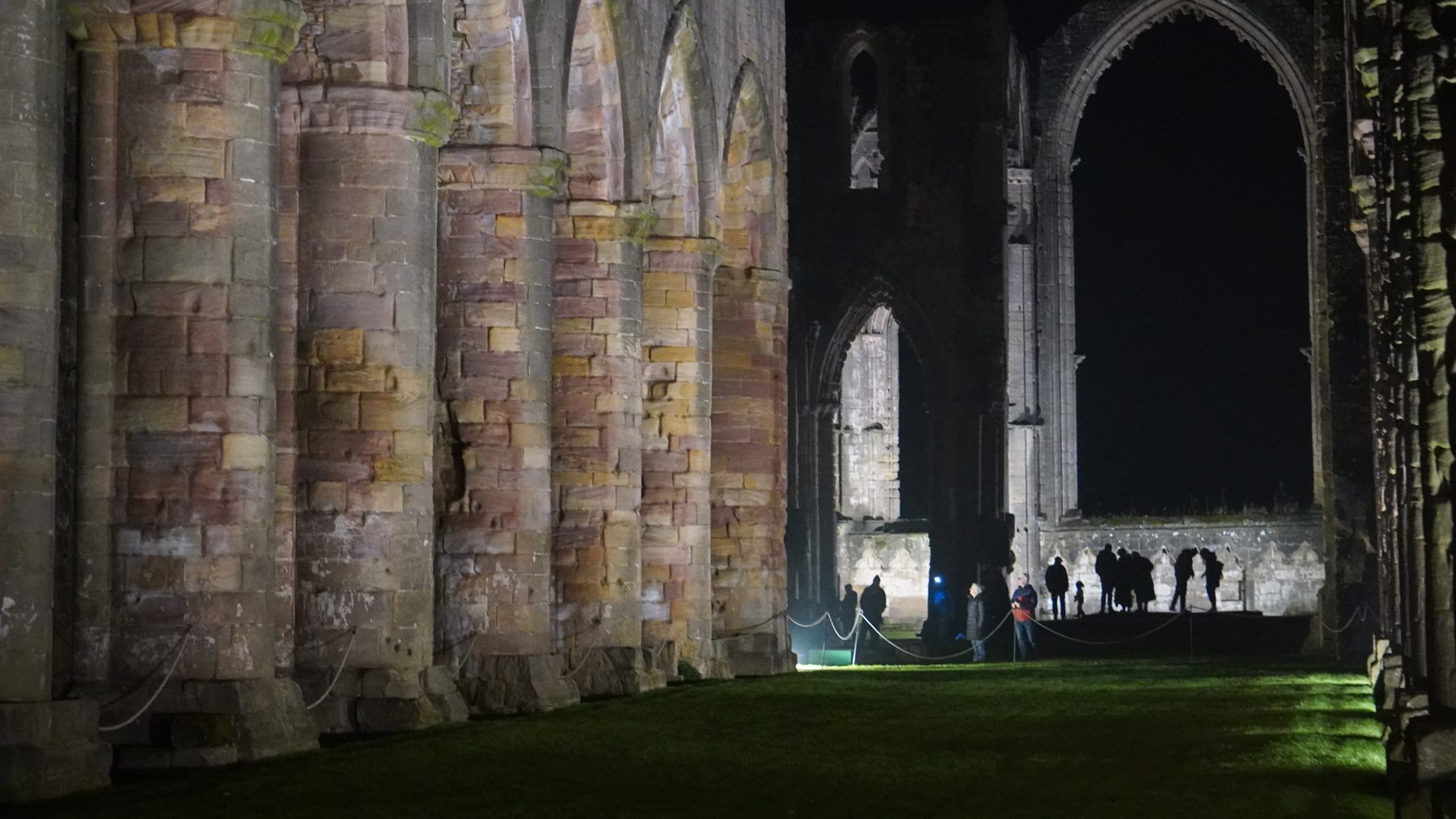
Fountains Abbey is the ruin of a Cistercian monastery founded in 1132, near Ripon in North Yorkshire, UK, about 12 miles north of Harrogate. With the 18th-century Studley Royal water garden next to it, it has been a UNESCO World Heritage Site since 1986 and is owned by the National Trust. Allow at least three hours, and in October look for Fountains by Floodlight, when the ruins are lit up on selected evenings.
Fountains Abbey is often called the largest set of monastic ruins in England: a roofless church, a 160-foot tower and the long stone buildings of a medieval monastery, in a wooded valley near Ripon. Next to it is Studley Royal, a Georgian water garden of still ponds, lawns and temples. Together they’re a UNESCO World Heritage Site. Below: the history, what to see, and Fountains by Floodlight. I was there in October 2026, by day and by floodlight.
I have my own reason for loving it. In the summer of 1994 I sat on the grass here one evening with friends and a picnic, listening to a choir. It’s still one of my clearest memories, and a big part of why our Yorkshire trip exists.
Fountains Abbey, Harrogate and Ripon: where it is
Fountains Abbey is in North Yorkshire, UK, on the edge of Nidderdale. The address is Fountains, Ripon HG4 3DY. The National Trust describes it as 12 miles north of Harrogate, by the A61; from Ripon you take the B6265 towards Pateley Bridge. There are two entrances: the main visitor center, and the West Gate, which has an accessible car park (sat nav HG4 3DZ).
| From | Distance or time | How |
|---|---|---|
| Harrogate | 12 miles | By car via the A61, or taxi |
| Ripon | A short drive west | B6265 towards Pateley Bridge |
| Brimham Rocks | A short drive across Nidderdale | By car |
| York | Via Ripon or Harrogate | By car or tour; no direct train |
No car? A taxi from Harrogate or Ripon is the simple answer.
A short history of Fountains Abbey
In 1132 a group of thirteen monks left St Mary’s Abbey in York after a dispute over how strictly they should live. Thurstan, Archbishop of York, gave them land in this valley. After a hard first winter they joined the Cistercian order, and by 1135 Fountains was a Cistercian house.
By 1535 it was the richest Cistercian monastery in England. Four years later, in 1539, Henry VIII’s dissolution of the monasteries closed it, and the buildings were stripped and left to decay. (From richest to roofless in four years.)
What survives is unusually complete:
- Huby’s Tower, 160 feet high, added by Abbot Marmaduke Huby (abbot 1495–1526). His motto, Soli Deo Honor et Gloria, is carved on it.
- The church, whose great empty windows frame the sky.
- The cellarium, an immense vaulted undercroft. You’ll see it lit up in the Floodlight photos below.
- The great hall, once one of the largest aisled halls in medieval England.
Historic England calls Fountains “the best preserved of English abbeys”.
Studley Royal water garden
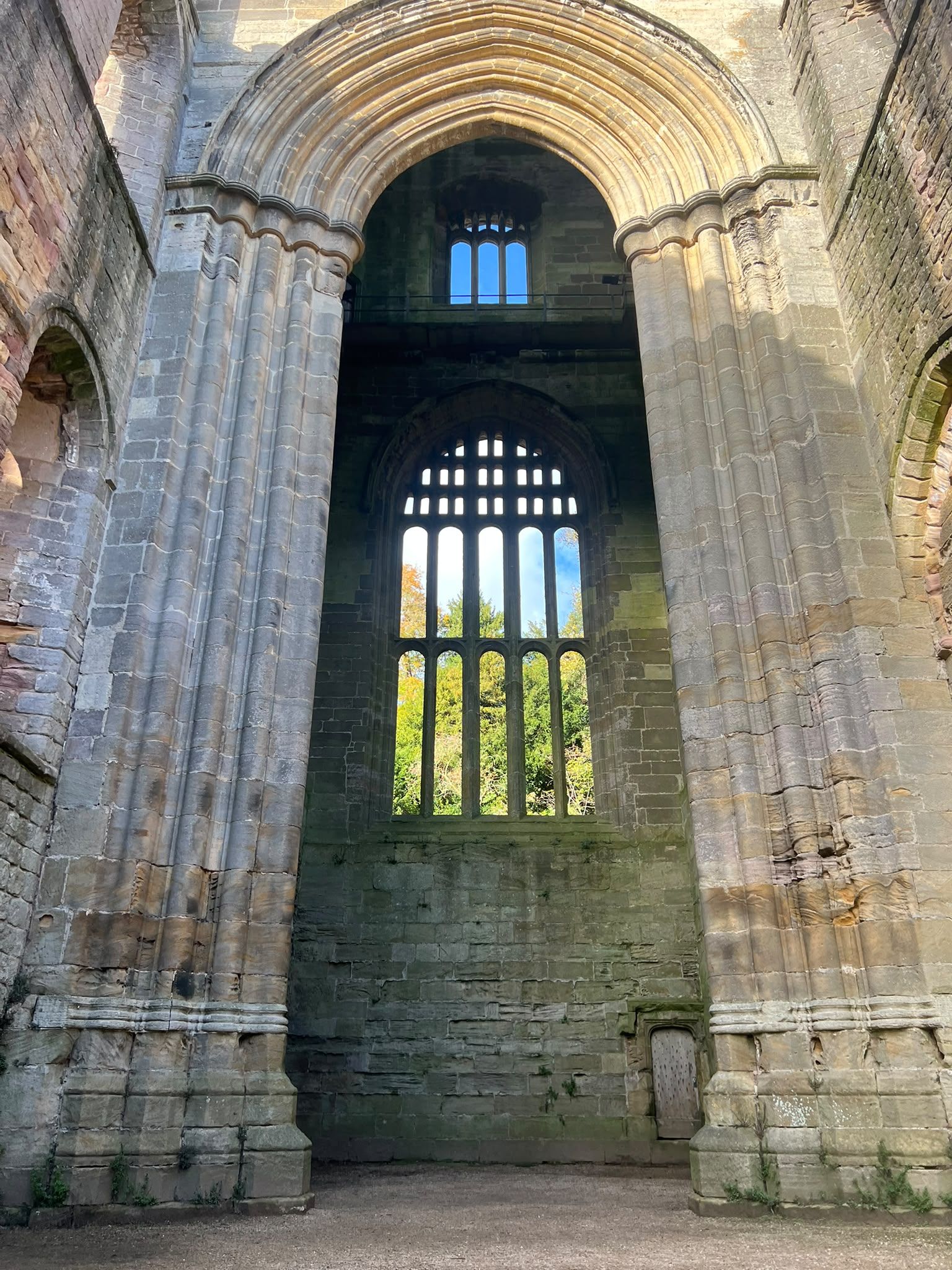
When John Aislabie inherited the Studley Royal estate, he set about making a water garden of mirror-like ponds. He started in 1718. He was a politician caught up in the South Sea Bubble, the financial crash of 1720, and work on the garden stopped from 1721 to 1723 while he was embroiled in the scandal, then carried on. By 1730 the core of the garden had taken shape.
His son, William Aislabie, bought the abbey ruins and Fountains Hall in 1767 and joined them to the garden, so the ruins became part of the garden’s view. That pairing of medieval ruin and Georgian garden is the heart of the UNESCO listing of 1986, and it’s why you shouldn’t skip the garden half.
Also on the estate:
- Fountains Hall, built by Sir Stephen Proctor after he acquired the site in 1597.
- St Mary’s Church, a high Victorian Gothic church designed by William Burges in the deer park.
- The deer park, home to more than 300 red, sika and fallow deer.
Fountains by Floodlight
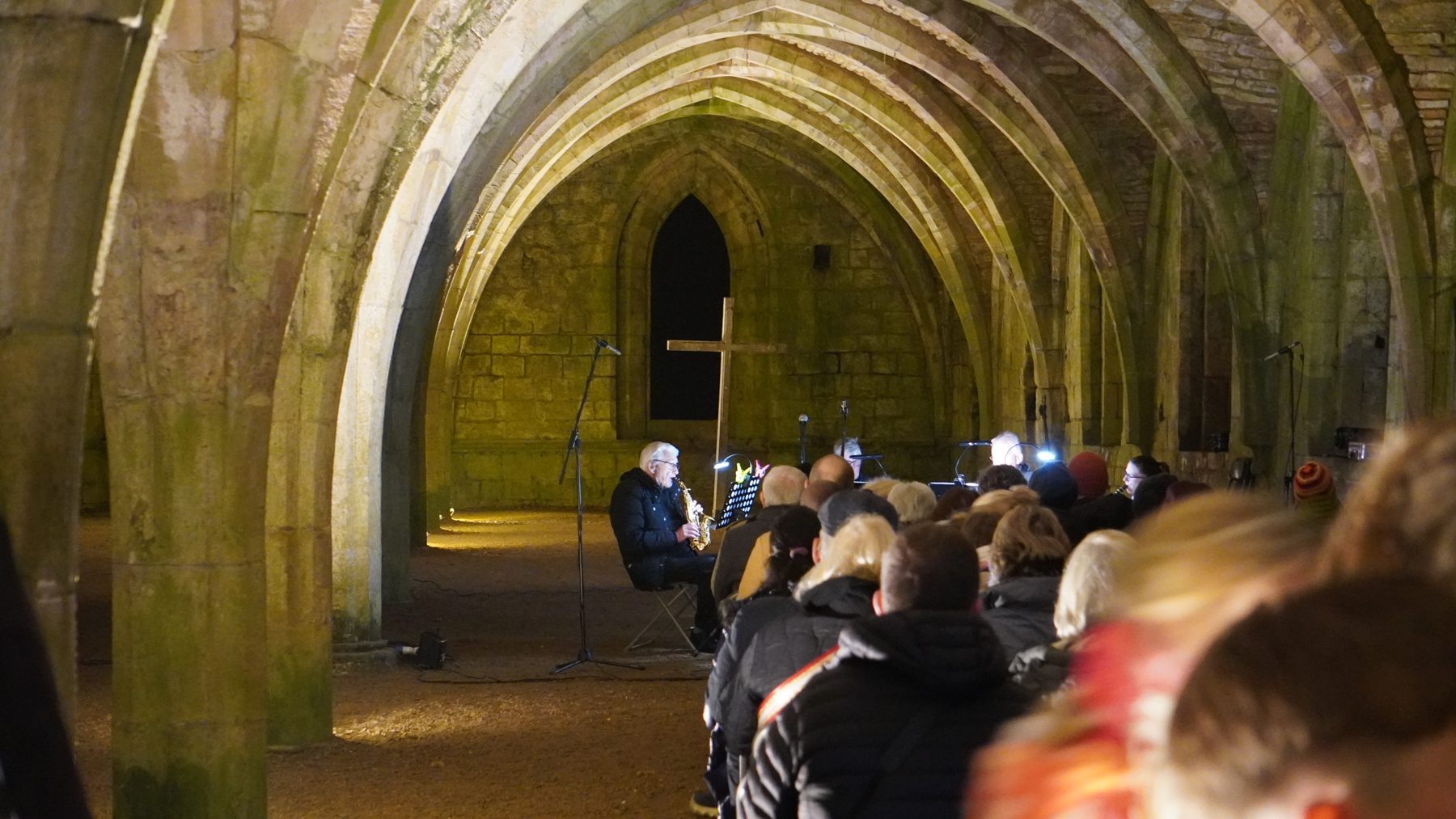
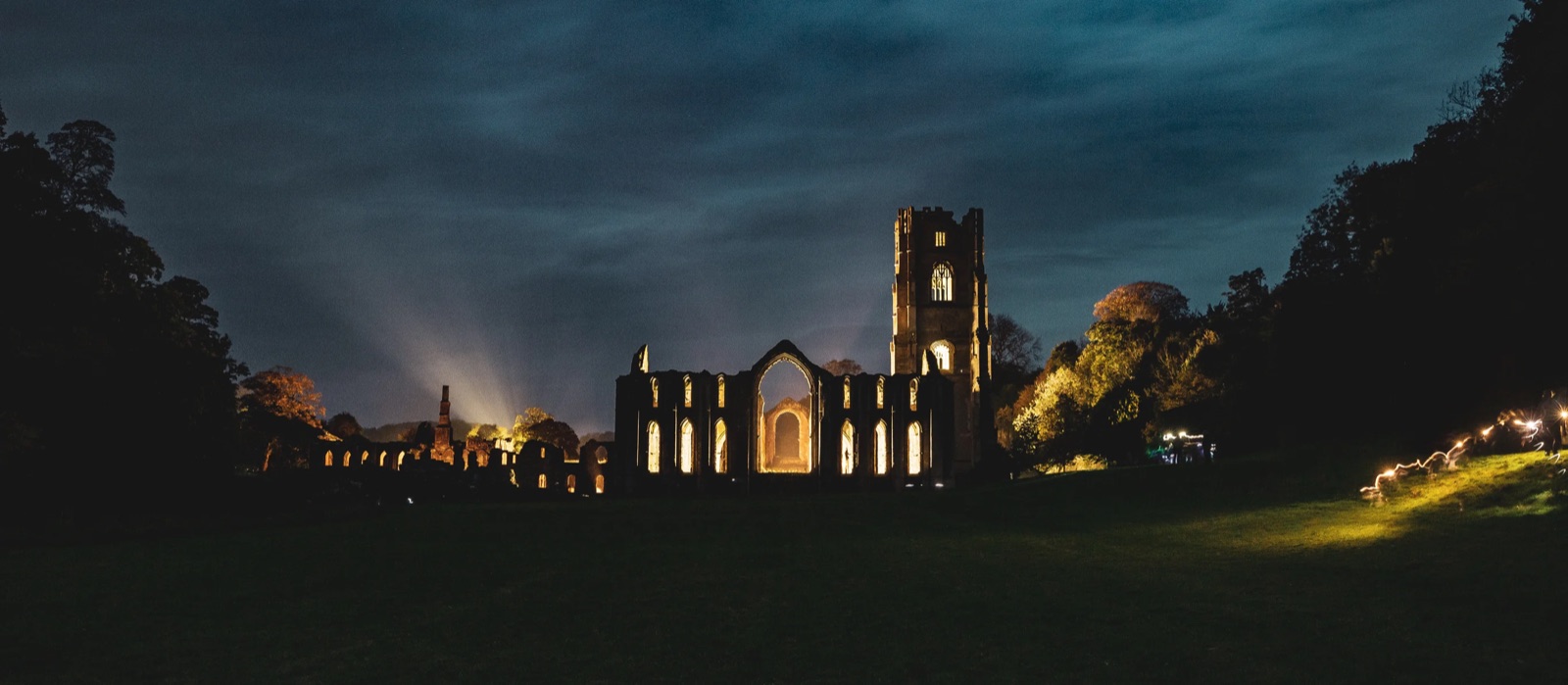
For a few weeks each October the National Trust opens the abbey after dark and lights up the ruins. In 2026 Fountains by Floodlight ran on evenings from 9 to 30 October, and ticket holders could enter until 8pm. Tickets went on sale in late August, and booking is essential, including for National Trust members.
We went on 30 October 2026 and ate from the food trucks on site. There’s live music in the cellarium, the long vaulted undercroft in the picture above: choirs, local groups such as Yorkshire Voices, and small bands and orchestras. In another part of the abbey there’s a recording of monks singing Gregorian chant (also called plainchant), the unaccompanied Latin singing that the Cistercian monks here would have used in their services. Honestly, it will send chills up your spine and move you to tears as you think about the lives that were lived here. Outside, there’s a light show projected onto the abbey walls, set to music.
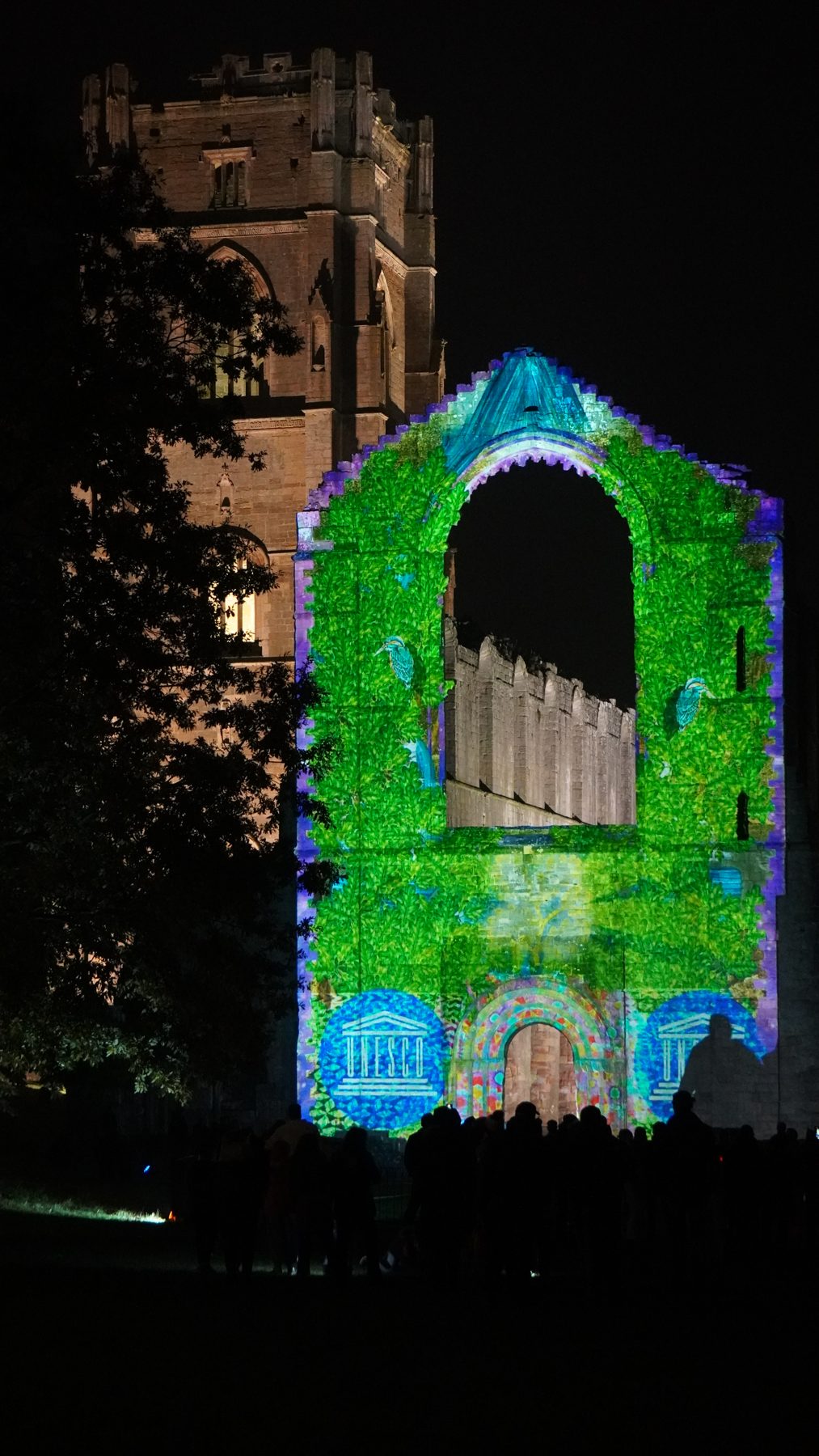
The line-up changes from year to year, so check the Trust’s page for what’s on when you go.
Films, TV and music at Fountains Abbey
The ruins have been on screen for more than fifty years:
| Title | Type | Notes |
|---|---|---|
| A Day Out (1972) | TV | Alan Bennett’s first televised play |
| Omen III: The Final Conflict (1980) | Film | The final scenes |
| ”Maid of Orleans” (1981) | Music video | Orchestral Manoeuvres in the Dark, filmed in December 1981 |
| The Secret Garden (1993) | Film | |
| The History Boys | Film | |
| The Secret Garden (2020) | Film | |
| The Witcher, season 2 | TV | |
| 28 Years Later | Film |
The Secret Garden is a good fit. Frances Hodgson Burnett set her 1911 novel on a Yorkshire estate, and her description of the garden in autumn suits this valley in October:
The place was a wilderness of autumn gold and purple and violet blue and flaming scarlet and on every side were sheaves of late lilies standing together—lilies which were white or white and ruby.
— Frances Hodgson Burnett, The Secret Garden (Project Gutenberg)
Brimham Rocks nearby
Brimham Rocks, the National Trust’s moor of giant gritstone stacks in Nidderdale, is a short drive away and easy to add to a Fountains day by car.
Tips for visiting Fountains Abbey
- Arrive at opening. The car park and visitor-center restaurant open before the abbey gate, so you can have coffee first.
- See both halves. Leave time for the Studley Royal water garden as well as the abbey. It’s all on foot, with some slopes.
- Check winter days. From November to February 2026–27 the estate and visitor center are closed on Fridays; the deer park stays open.
- Book Floodlight early. October evenings sell out.
- Wear proper shoes. Paths are gravel and grass, and they get muddy. Darker shoes are your friend.
Fountains Abbey on our trip
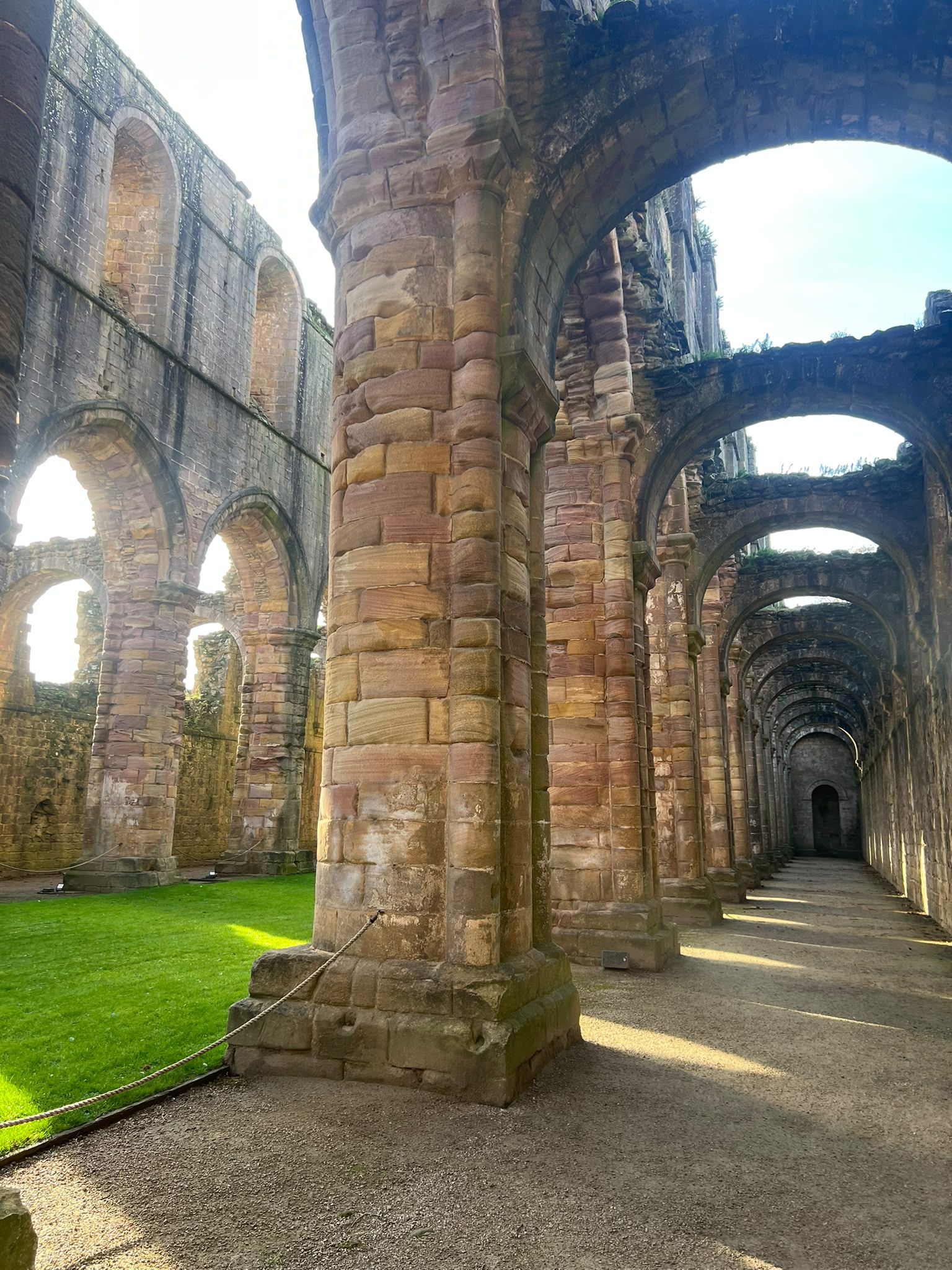
Our October 2027 Yorkshire trip visits Fountains Abbey twice, because once isn’t enough. On Sunday 3 October we’re there in daylight for opening, with about three hours in the abbey and the water garden. On Friday 8 October we come back in the evening for Fountains by Floodlight, with dinner from the food trucks, assuming the 2027 dates follow the 2026 pattern; the Trust hasn’t published them yet. Earlier that Friday, on the way back from Saltaire, we stop for about half an hour at Brimham Rocks.
On the Tuesday of the same week we spend the day in Knaresborough and Harrogate. For another great house and garden, read our guide to Castle Howard, and for the wider landscape, the North York Moors.
Fountains' world: what else was happening
There are two Fountains. The monks' abbey is medieval: founded in 1132, under Henry I, and closed by Henry VIII in 1539, the same decade Thomas More and Anne Boleyn were executed. The water garden is Georgian, begun in 1718, the year before Robinson Crusoe, by a politician about to be caught up in the South Sea Bubble.
- Middle Ages 1066–1485
- Tudor 1485–1603
- Georgian 1714–1837
The story Britain The wider world Other writers
- 1132 The story Thirteen monks leave St Mary's Abbey in York after a dispute; Archbishop Thurstan gives them land in this valley.
- 1135 The story After a hard first winter, Fountains joins the Cistercian order.
- 1170 Britain Thomas Becket is murdered in Canterbury Cathedral.
- 1215 Britain King John seals Magna Carta.
- 1348 Britain The Black Death reaches England.
- 1476 Other writers William Caxton sets up England's first printing press, at Westminster.
- 1485 Britain Henry Tudor wins at Bosworth and becomes Henry VII.
- 1492 The wider world Columbus reaches the Caribbean.
- 1495 The story Marmaduke Huby becomes abbot (to 1526) and adds the 160-foot tower.
- 1516 Other writers Thomas More publishes Utopia.
- 1535 The story Fountains is the richest Cistercian monastery in England.
- 1535 Britain Thomas More is executed for refusing to accept Henry VIII as head of the Church.
- 1536 Britain Anne Boleyn is executed; the smaller monasteries close, and the north rises in the Pilgrimage of Grace.
- 1539 The story Henry VIII's Dissolution closes Fountains; the buildings are stripped and left to decay.
- 1597 The story Sir Stephen Proctor acquires the site and builds Fountains Hall.
- 1718 The story John Aislabie starts the Studley Royal water garden.
- 1719 Other writers Daniel Defoe publishes Robinson Crusoe.
- 1720 Britain The South Sea Bubble bursts.
- 1721 The story Work on the garden stops until 1723 while Aislabie is caught up in the scandal.
- 1767 The story His son William buys the abbey ruins and Fountains Hall and joins them to the garden.
- 1776 The wider world The American colonies declare independence.
- 1911 Other writers Frances Hodgson Burnett publishes The Secret Garden, set in Yorkshire.
- 1983 The story The National Trust takes over the estate.
- 1986 The story Fountains and Studley Royal become a UNESCO World Heritage Site.
- 1993 The story The Secret Garden film shoots here; the 2020 version does too.
Questions people ask
How far is Fountains Abbey from Harrogate?
About 12 miles north, by the A61 towards Ripon and then the B6265 towards Pateley Bridge. From Ripon it's a short drive west.
How long do you need at Fountains Abbey?
At least three hours to see the abbey ruins and walk through the Studley Royal water garden. Add an hour or two for the deer park, St Mary's Church and Fountains Hall.
What is Fountains by Floodlight?
On selected October evenings the National Trust lights up the abbey ruins after dark. In 2026 it ran on evenings from 9 to 30 October, and tickets went on sale in late August. Booking is essential, including for National Trust members. Musical guests play in the cellarium, including choirs, local groups such as Yorkshire Voices, and small bands and orchestras, elsewhere in the abbey you hear recorded Gregorian chant, and outside there's a light show on the abbey walls set to music.
Who built Studley Royal water garden?
John Aislabie began the water garden in 1718 after inheriting the Studley Royal estate. Work paused while he was caught up in the South Sea Bubble scandal of 1720, then resumed. His son William bought the abbey ruins in 1767 and joined them to the garden.
Was The Secret Garden filmed at Fountains Abbey?
Yes. Fountains Abbey appears in both the 1993 and 2020 films of The Secret Garden. Other productions filmed there include Omen III: The Final Conflict, The History Boys, 28 Years Later and the second season of The Witcher.
Are there hotels near Fountains Abbey?
The National Trust lets holiday apartments inside Fountains Hall on the estate. Otherwise the nearest choice of hotels and inns is in Ripon, a short drive east, or in Harrogate, 12 miles south.
How far is Brimham Rocks from Fountains Abbey?
Brimham Rocks is in Nidderdale, about 8 miles north-west of Harrogate and 3 miles east of Pateley Bridge, so it's easy to combine with Fountains in one day by car.
Read next
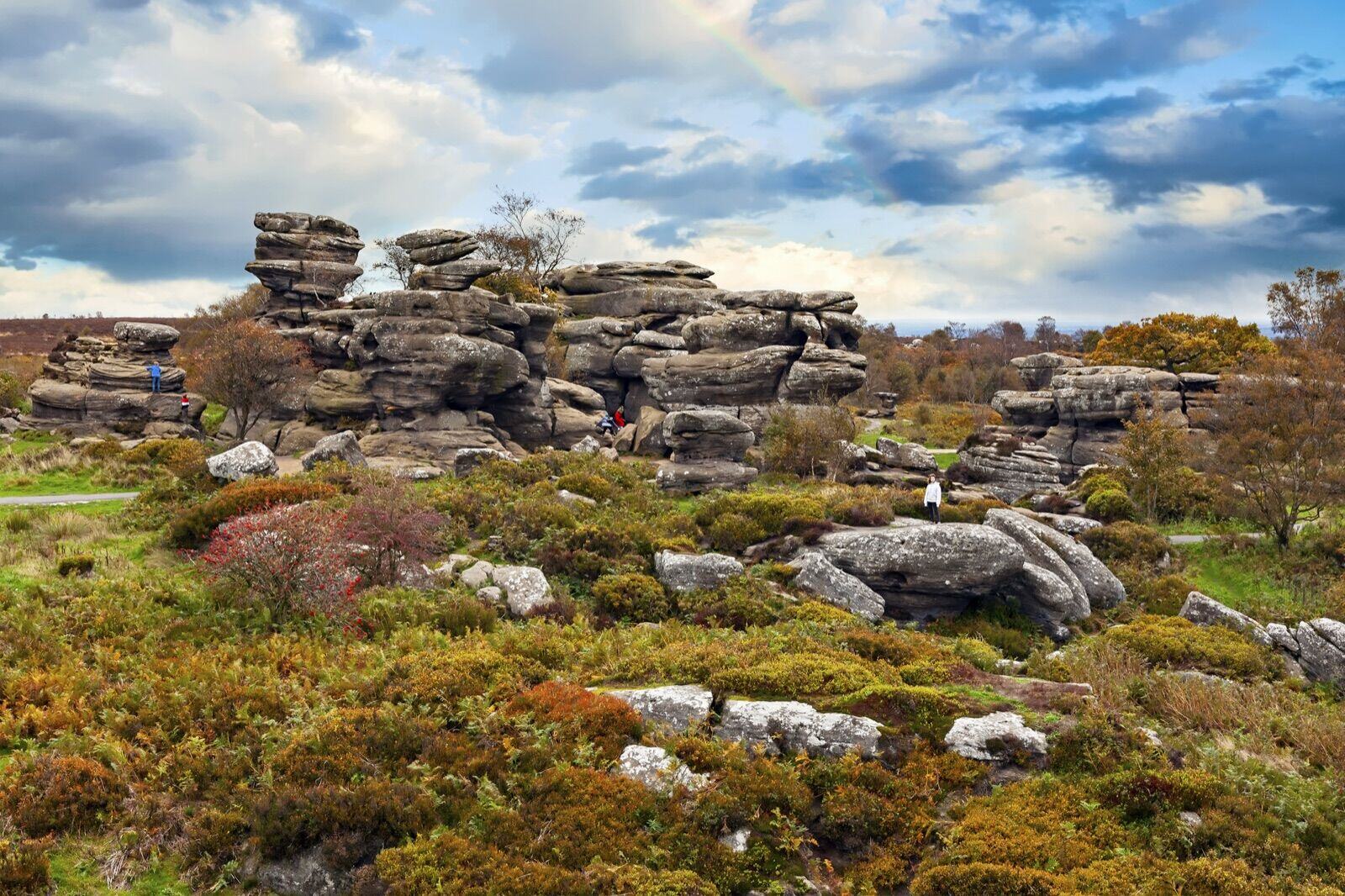 Yorkshire · NidderdaleBrimham Rocks, YorkshireHuge, oddly shaped sandstone stacks on a heather moor above Nidderdale. Free to walk among, run by the National Trust, and worth a stop even if you've only got half an hour.
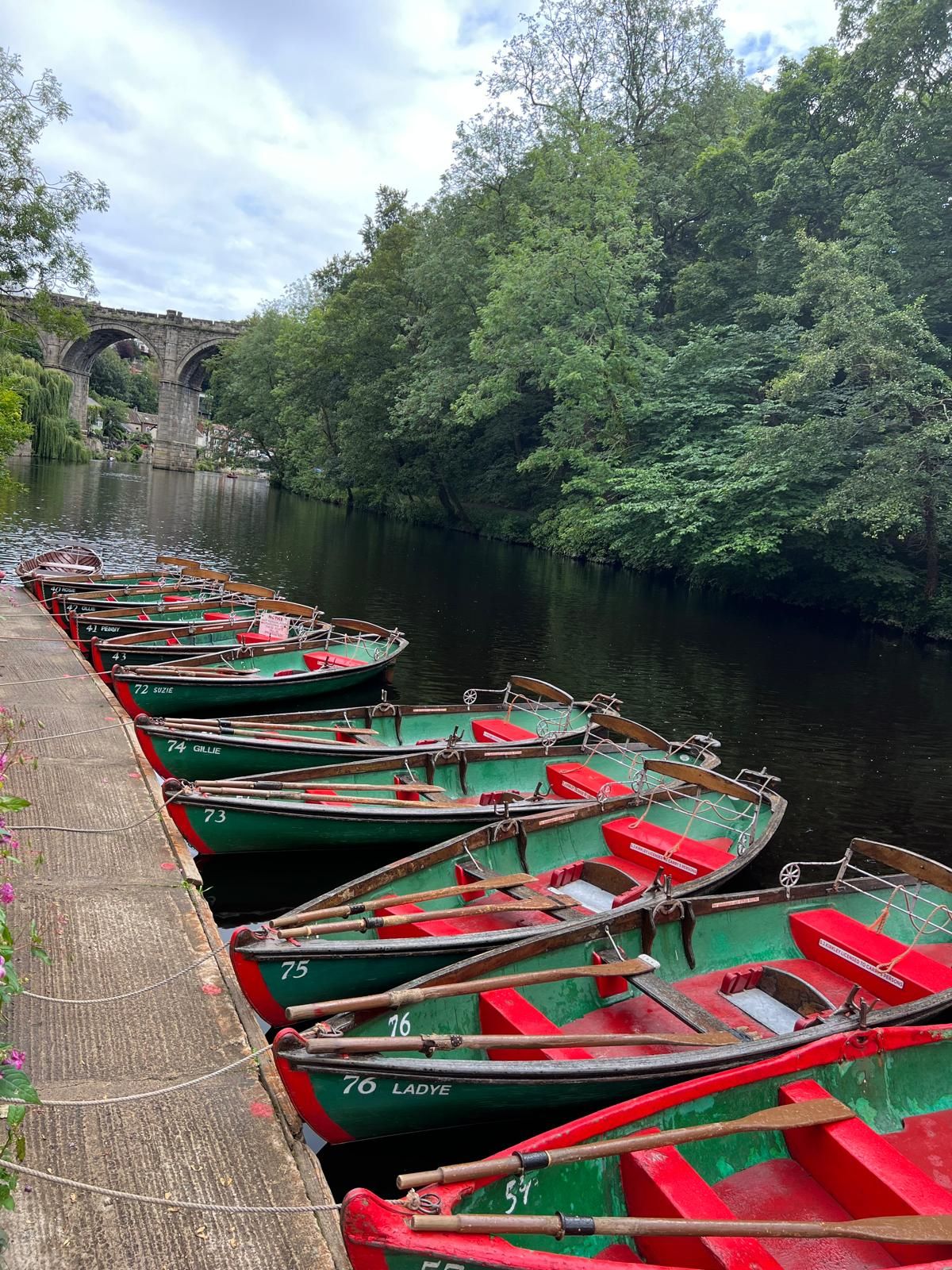 Yorkshire · KnaresboroughKnaresborough, EnglandA small market town on a cliff above the River Nidd, three miles from Harrogate, and how to spend a morning there on foot. Bring shoes with grip: it's steps all the way down.
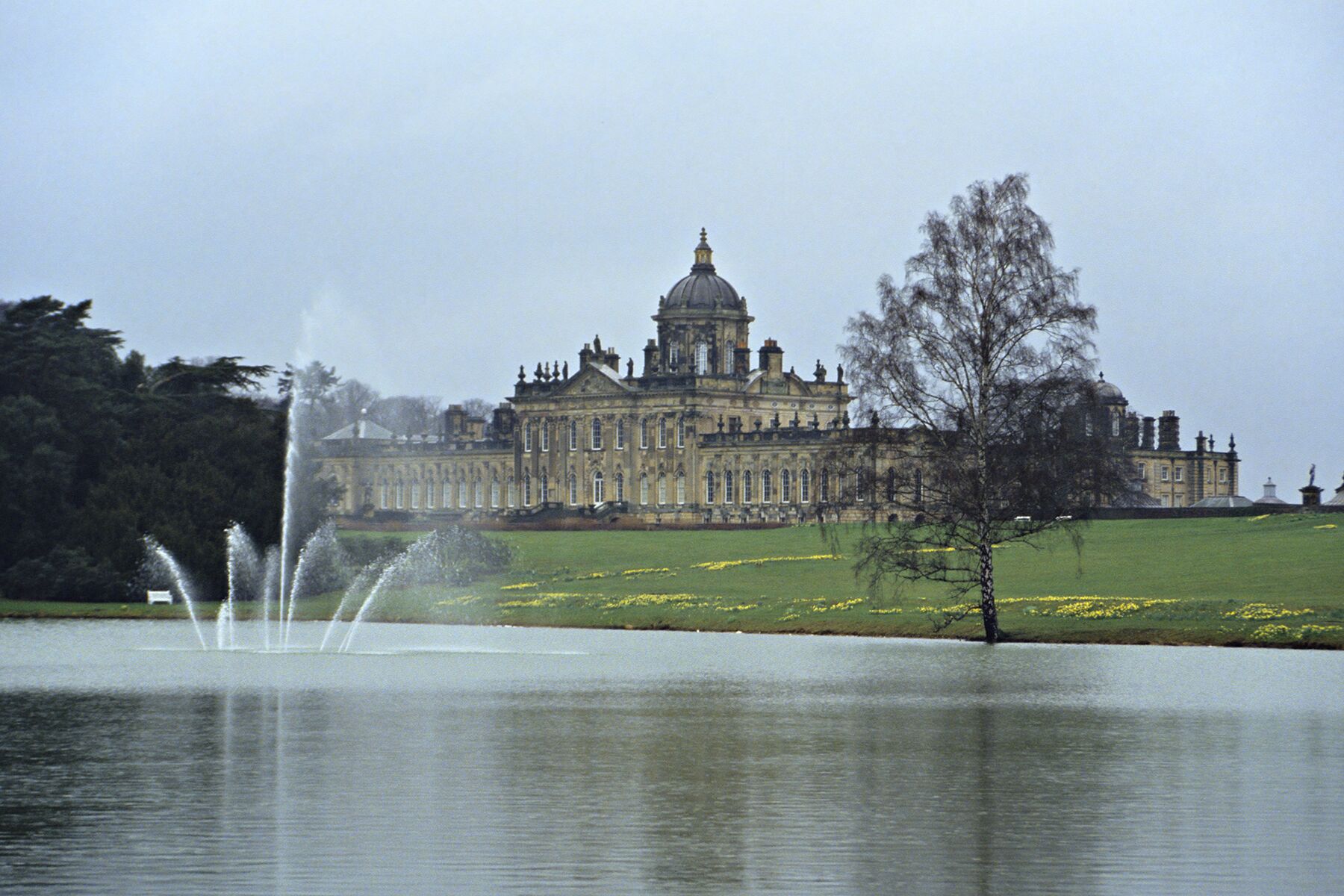 Yorkshire · Castle HowardCastle HowardWhere Castle Howard is, how to get there from York without a car, and the books, films and people behind the house you've probably already seen on screen.
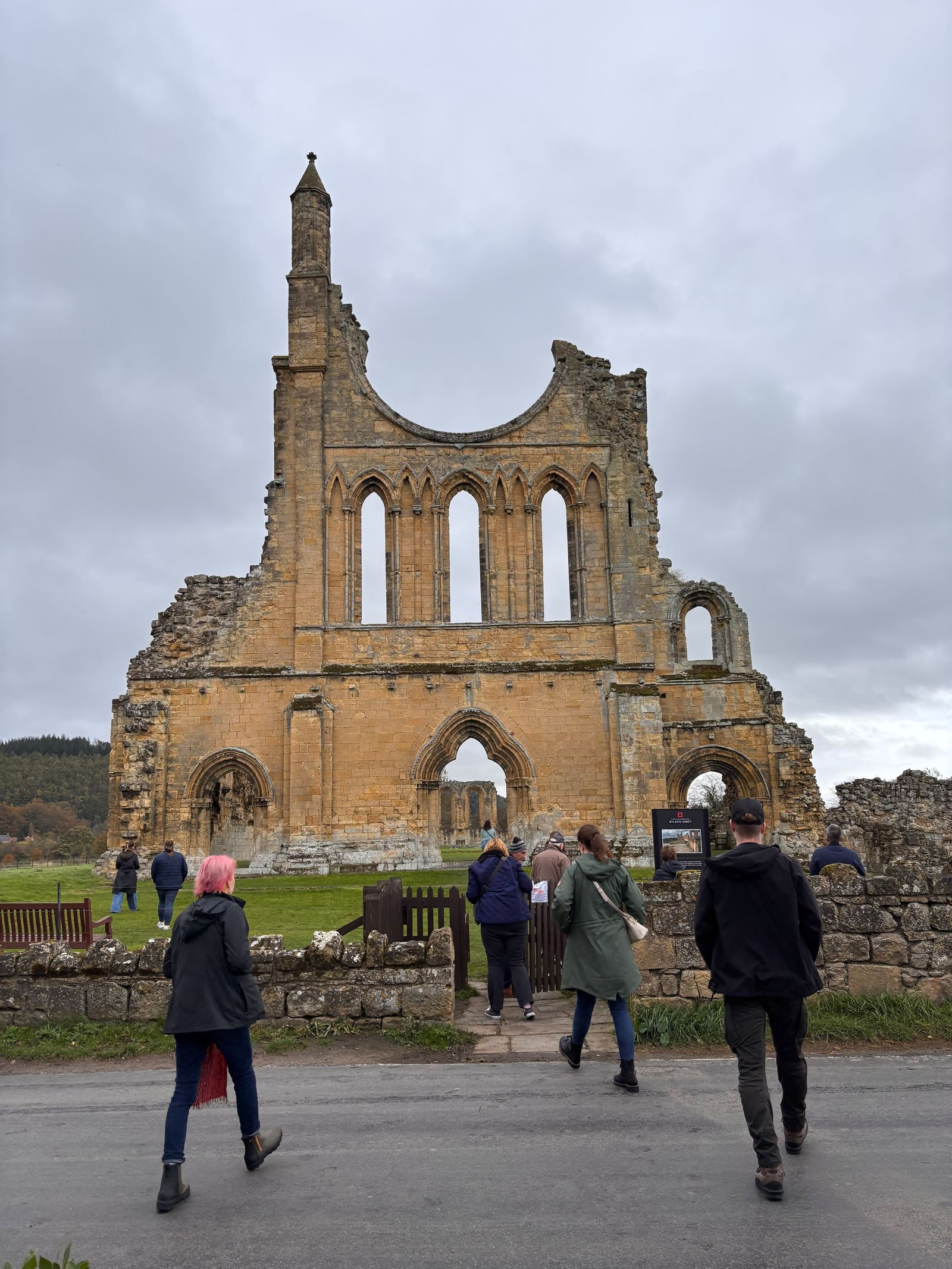 Yorkshire · The moors and the coastNorth York Moors National ParkThe North York Moors are a high plateau of heather between the Vale of York and the North Sea. You can see the best of them in a day. Here's where to stop, and what you can skip.
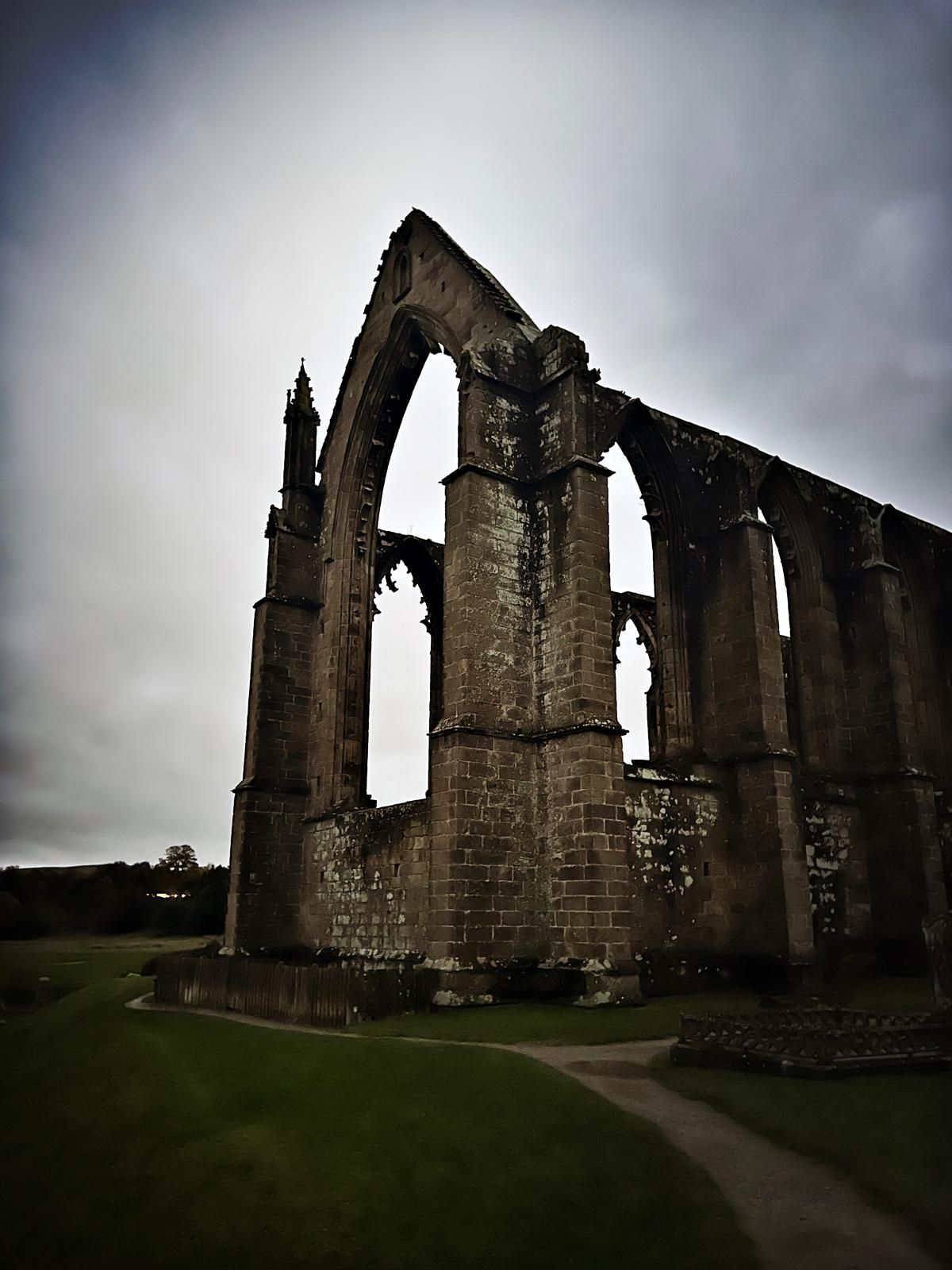 Yorkshire · The DalesBolton Abbey to SkiptonA ruined priory on the River Wharfe and one of England's most complete medieval castles, a few miles apart at the bottom edge of the Yorkshire Dales. Easy to pair, and easy to pair with Haworth too.
Sources
- National Trust: Fountains Abbey and Studley Royal Water Garden (address, 12 miles north of Harrogate, Aislabie, deer, Burges church, winter Fridays, Floodlight entry)
- National Trust: Fountains by Floodlight
- The Stray Ferret: Fountains by Floodlight listing
- Wikipedia: Fountains Abbey (1132, Cistercian 1135, 1539, Huby's Tower, Fountains Hall, NT 1983, films)
- Historic England: Studley Royal register entry (Aislabie, 1718, 1721–3 pause)
- UNESCO: Studley Royal Park including the Ruins of Fountains Abbey (1986, ref. 372)
- History Hit: Fountains Abbey (largest monastic ruins in England)
- Wikipedia: Brimham Rocks (8 miles NW of Harrogate, Millstone Grit, Idol Rock, 454 acres, SSSI)
- Project Gutenberg: Frances Hodgson Burnett, The Secret Garden
- Yorkshire Voices
- Wikipedia: Dissolution of the Monasteries (smaller houses 1536, Pilgrimage of Grace)
- Wikipedia: South Sea Company (the 1720 Bubble)
Get the reading list first.
Trip announcements, curated reading lists, and the occasional dispatch — before anyone else.