Yorkshire · York · Books
Behind the Scenes at the Museum: a reader's guide to the characters, the family tree and the York places in Kate Atkinson's novel
Who's who in Ruby Lennox's family, generation by generation, how the chapters and footnotes fit together, and the York streets you can still walk. Spoilers are tucked away until you click.
- Author
- Kate Atkinson (born in York, 1951)
- Published
- 2 March 1995 (Doubleday); her first novel
- Award
- 1995 Whitbread Book of the Year
- Narrator
- Ruby Lennox, born 1952
- Setting
- York, 1951–1992, with footnotes reaching back to the late 1800s
- Structure
- 13 dated chapters, each followed by a footnote about an earlier generation
- The museum
- York Castle Museum
- Our trip
- Thursday 7 October 2027: York Castle Museum together
The short answer
Behind the Scenes at the Museum is Kate Atkinson's 1995 debut novel, and it won the Whitbread Book of the Year. Ruby Lennox narrates her own life in York from 1951 to 1992, starting in the flat above her parents' pet shop near York Minster, while 'footnotes' between her chapters jump back to earlier generations of her family. That back-and-forth is why so many readers lose track of the characters. The museum of the title is York Castle Museum.
Behind the Scenes at the Museum is Kate Atkinson’s first novel, and it’s narrated by Ruby Lennox, who grows up above her parents’ pet shop in the shadow of York Minster. I just read it. It was absolutely lovely, and the writing was done in a different style than I’ve seen before. I did have a little bit of trouble keeping up with the character names, which is exactly why this page exists. It’s also one of the books we’re considering for the reading months before our Yorkshire trip.
Below: how the book is built, a family tree with every main character (spoilers hidden until you click), the York places in the book and what they are today, and some questions for your book club.
Is Behind the Scenes at the Museum about a museum?
Here’s what surprised me. I thought from the title that the book would be heavily focused on the museum. It’s not. It’s focused on the places around the museum and everyday life in York and Yorkshire. There is a tie-in, it’s just not as extensive as I first thought when I read the opening lines.
The museum of the title is York Castle Museum, the social history museum in York’s two old prisons, best known for Kirkgate, a full-size Victorian street you can walk into. Atkinson explained the tie-in herself in a 2008 piece for the Guardian. The title came to her in a dream of being alone in the Castle Museum in the middle of the night. As a child she’d walked there regularly with her father from the family shop in Stonegate, and she came to see the novel as doing what the museum does: keeping ordinary things safe. She also said this:
Looking at Behind the Scenes now, I can see that York, not Ruby, is the all-pervading main character of this book.
— Kate Atkinson, “Night in the museum,” The Guardian, 1 November 2008 (read it)
So think of the “museum” as the whole family’s life on display: the button box, the clock on the mantelpiece, the photographs. The real building is the frame. The streets are the story.
How the book is built (read this first)
This is the bit that trips people up, so it’s worth two minutes before you start.
The chapters are Ruby’s. There are 13 of them, each headed with a year, running from 1951 to 1992. Ruby narrates in the first person, and she starts before she’s even born:
I exist! I am conceived to the chimes of midnight on the clock on the mantelpiece in the room across the hall.
— Kate Atkinson, Behind the Scenes at the Museum (1995), opening line (author’s excerpt)
The footnotes are everyone else’s. After each chapter comes a “footnote,” and it isn’t a footnote in the usual sense. It’s a full story from an earlier generation: Ruby’s great-grandmother Alice, her grandmother Nell and Nell’s brothers and sisters, her mother Bunty, and the men in the family in both World Wars. Each one hangs off a small object from the chapter before. In Chapter One, Ruby’s sister swallows a pink glass button from Nell’s button box, and the text says “see Footnote (i).”
The footnotes aren’t in date order. That’s the part that loses people. You’ll jump from the 1950s to the First World War, back to the 1950s, then to the 1890s. Ruby also tells you some things long before they happen and keeps other things back until the end, on purpose.
Three tips that help:
- Keep the family tree below open while you read. Every footnote has new names, and most of them are Nell’s siblings or Bunty’s.
- Note the object. Each footnote picks up something from the chapter before it (a button, a clock, a photograph). Spot the object and you’ll know whose story you’re in.
- Don’t skip the footnotes. The chapters make much less sense without them, and the big reveals are hidden in both.
Behind the Scenes at the Museum characters: the family tree
- Alicegreat-grandmotherm.Frederick Barkergreat-grandfatherlater m.RachelNell's stepmother
- Ada, Lawrence, Tom, AlbertNell's siblings
- Lilliangreat-aunt
- EdmundBunty's cousin
- Nellm. Frankgrandmother
- Cliffordm. Gladysuncle
- Adriancousin
- Babsm. Sidneyaunt
- Daisy & Rosetwin cousins
- Buntym. Georgemother
- Patriciasister
- Gilliansister
- Rubynarrator
- Bettyaunt
- Hopecousin
- Teduncle
- Cliffordm. Gladysuncle
Here’s the family by generation, counted from Ruby. Everything in the tables is spoiler-free: who the person is and how they fit. What happens to them is in the click-to-open boxes underneath each table.
Generation 1: Ruby’s great-grandparents
| Name | Who they are to Ruby | Spoiler-free note |
|---|---|---|
| Alice Barker | Great-grandmother (Nell’s mother) | The clock on the mantelpiece in the first line was hers. Her story opens the family history. |
| Frederick Barker | Great-grandfather | Alice’s husband. |
| Rachel | Nell’s stepmother | She runs the household Nell grows up in. |
| The French photographer | No relation | A traveling photographer who photographs Alice and her children at the end of the 19th century. |
Spoilers: what happens to Alice and the great-grandparents
The family believes Alice died giving birth to Nell, her youngest. She didn't. She ran away with the traveling French photographer (named Jean-Paul Armand in the character lists) to escape a life she couldn't bear, and left all her children behind. She spent her last years back in York, looking for them, and died without finding them. The photographer later dies in Grimsby. Rachel marries Frederick after Alice is gone, and their son Samuel, Nell's half-brother, dies as a small child.
Generation 2: Ruby’s grandmother Nell and her brothers and sisters
In Chapter One, Atkinson gives you Nell’s whole family in one list, which is worth bookmarking: mother to Clifford, Babs, Bunty, Betty and Ted; daughter to Alice; stepdaughter to Rachel; sister to Ada, Lawrence, Tom, Albert and Lillian; wife to Frank.
| Name | Who they are to Ruby | Spoiler-free note |
|---|---|---|
| Nell | Grandmother (Bunty’s mother) | Alice’s youngest. By 1951 she lives in a small terraced house on Lowther Street. |
| Frank | Grandfather | Nell’s husband. Already dead when the book opens. |
| Ada | Great-aunt | Nell’s eldest sister. |
| Lawrence | Great-uncle | Nell’s brother. “Presumed dead” by 1951. |
| Tom | Great-uncle | Nell’s brother. |
| Albert | Great-uncle | Nell’s youngest brother, the golden-haired favorite. |
| Lillian (Lily) | Great-aunt | Nell’s closest sister. “As good as dead” to the family by 1951. |
| Jack Keech | No relation | Albert’s best friend. |
| Percy Sievewright | No relation | An early boyfriend of Nell’s. |
Spoilers: what happens to Nell's generation
Ada dies in childhood. Albert is killed on the first day of the Battle of the Somme, and so is Jack, who was the man Nell meant to marry. Jack is also the father of Lillian's son, Edmund. Lillian never names him, and you only find out on the last page of the footnote before Chapter 11. Lillian leaves for Canada with Edmund and later marries a farmer, Pete Donner. Lawrence runs away to the Amazon. Nell marries Frank instead, and by the time Ruby knows her she's a small, faded woman with very little of the girl from the footnotes left in her.
Generation 3: Ruby’s parents, aunts and uncles
| Name | Who they are to Ruby | Spoiler-free note |
|---|---|---|
| Bunty (Berenice) Lennox | Mother | Nell’s daughter. Never wanted to marry George, hates the shop and daydreams about being a film star. |
| George Lennox | Father | About ten years older than Bunty. Runs the pet shop he took over from his father in 1945. |
| Clifford | Uncle | Bunty’s brother. |
| Gladys | Aunt | Clifford’s wife. |
| Babs (Barbara) | Aunt | Bunty’s sister. |
| Sidney | Uncle | Babs’s husband. |
| Betty | Aunt | Bunty’s sister. |
| Ted | Uncle | Bunty’s youngest brother. In the Merchant Navy in 1951. |
| Edmund | Bunty’s cousin | Lillian’s son, raised in Canada. Comes back to England with the air force in the Second World War. |
| Bill and Eliza | Uncle and aunt | George’s side of the family. |
| Buck | No relation | The American sergeant Bunty wanted before George. |
| Walter and Bernard Belling | No relation | George’s shopkeeper friends: a loud butcher and a plumbing-supplies man. |
Spoilers: what happens to Bunty, George and their generation
George has affairs, one with Doreen, an Irish nurse. At Uncle Ted's 1966 wedding, Ruby catches George with a waitress, and he dies of a heart attack straight afterwards. Bernard Belling later becomes Bunty's boyfriend. Edmund dies in a bombing raid on Dresden, leaving Doreen pregnant; she gives the baby up for adoption. In the last chapter Bunty has dementia, and she dies after a stroke in 1992. Clues suggest the nurse with her at the end is Doreen and Edmund's daughter. Before she dies, Ruby finally sees that her mother did love her, in her way.
Generation 4: Ruby, her sisters and cousins
| Name | Who they are to Ruby | Spoiler-free note |
|---|---|---|
| Ruby Lennox | Herself | The narrator, born 1952. Quiet, watchful, and the youngest. |
| Patricia Lennox | Eldest sister | Five in 1951. Clever, serious and lonely at school. |
| Gillian Lennox | Middle sister | Nearly three in 1951. Golden curls, loud, the favorite. |
| Adrian | Cousin | Clifford and Gladys’s son. |
| Daisy and Rose | Cousins | Babs’s twin daughters. Ruby shares their attic bedroom when she’s sent to stay. |
| Hope | Cousin | Betty’s daughter. |
| Lucy-Vida | Cousin | Bill and Eliza’s daughter. |
| Kathleen Gorman | Friend | Ruby’s best friend through school. |
Spoilers: what happens to Ruby, Patricia and Gillian
Gillian is killed by a car on Christmas Eve 1959, aged 11. (Ruby tells you this in Chapter One, years before it happens.) The book's biggest secret: Ruby had an identical twin, Pearl. Gillian dared Pearl out onto a frozen pond, Pearl went through the ice shortly before the twins' fourth birthday, and Patricia couldn't pull her out. Gillian said Ruby pushed her, Bunty half believed it, and Ruby lost every memory of her twin. She only learns about Pearl as a teenager, when Bernard Belling throws it at her, and remembers what really happened under hypnotherapy at 18. Patricia has a baby that is given up for adoption and leaves home. Ruby goes to Scotland for a summer job and never comes back to live in York; she marries a man who needs to stay in the country, has two daughters and later divorces. The sisters come back together when Bunty is dying.
If you keep losing track, the people who matter most are only eight: Alice, Nell, Lillian, Bunty, George, Patricia, Gillian and Ruby. Everyone else orbits them.
Places in Behind the Scenes at the Museum
Almost all of the book happens in a few streets inside and just outside York’s walls. Atkinson opens with the family’s home:
The Shop (a pet shop) is in one of the ancient streets that cower beneath the looming dominance of York Minster.
— Kate Atkinson, Behind the Scenes at the Museum (1995), Chapter One (author’s excerpt)
On Ruby’s first day, Bunty walks Gillian down Blake Street to the Museum Gardens, shops at the butcher’s and baker’s, then goes up Gillygate and along Clarence Street to Nell’s house on Lowther Street. You can walk that whole route in under half an hour.
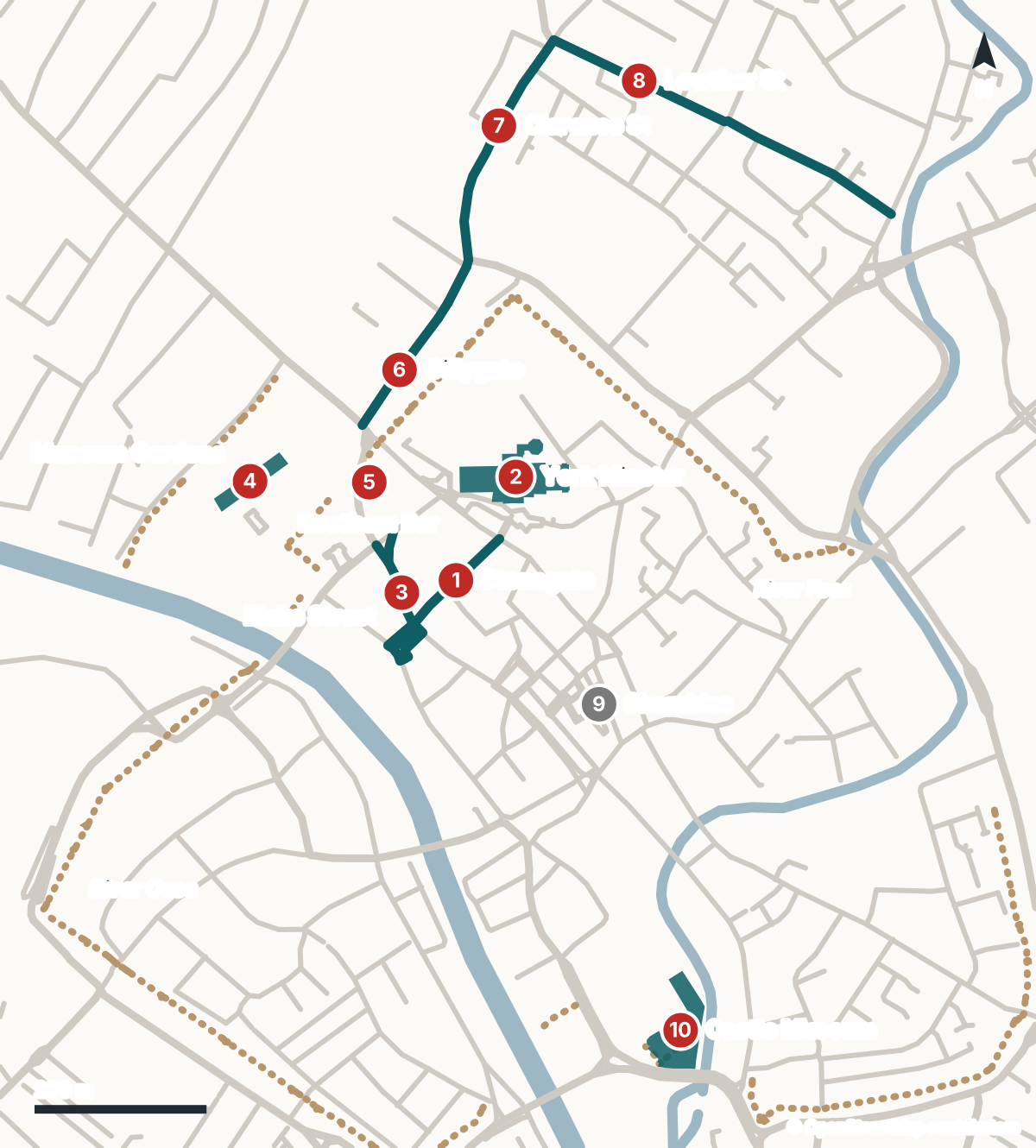
- Stonegate: the Shop
- York Minster
- Blake Street and the Assembly Rooms
- Museum Gardens and St Mary's Abbey
- Bootham Bar, a gate in the walls
- Gillygate
- Clarence Street
- Lowther Street: Nell's house
- The Shambles (not in the book; grey pin)
- York Castle Museum, the museum of the title
York places in the book
| Place in the book | What it is today | Can you visit? |
|---|---|---|
| ”Above the Shop”, the pet shop beneath the Minster | Atkinson’s own parents’ shop was in Stonegate, and she wrote that the Lennoxes’ shop was there too. It’s a pedestrian street of shops running toward the Minster. Guy Fawkes was born on it. | Yes, it’s a public street. The Lennoxes’ shop is fiction, so there’s no plaque. |
| York Minster | The Gothic cathedral the shop sits beneath, built 1220–1472. | Yes, paid entry. Plan your visit |
| Blake Street and the Assembly Rooms | A short street near St Helen’s Square, on the way to the Museum Gardens. The book’s ghosts include dancers at an Assembly Rooms ball. | Yes, on foot. |
| Museum Gardens and St Mary’s Abbey | Ten acres of botanical gardens by the River Ouse, with the ruins of St Mary’s Abbey. Bunty pays sixpence at the gate. | Yes. Open daily, 9am to 6pm, per the gardens’ visitor page. About the abbey |
| The Bar Walls | York’s medieval city walls. A peacock flies off them in Chapter One. | Yes, free. Check the council’s walls page for closures. |
| Gillygate, Clarence Street, Lowther Street | Ordinary streets just north of the walls. Nell lives in a terraced house on Lowther Street. | You can walk past. These are homes, so be polite. |
| York Castle Museum | The museum of the title, in the old Debtors’ Prison and Female Prison, opened 1938. Its Kirkgate street is what Atkinson loved as a child. | Yes, paid entry. Visitor information |
The book’s first chapter also name-checks the city’s famous residents, real and not: Guy Fawkes, Dick Turpin, Robinson Crusoe and “the Reverend Sterne,” author of Tristram Shandy, which Atkinson notes was written in York and first sold in Stonegate. (Crusoe was born in York, according to Defoe. Atkinson asks which of them is real and which a fiction, and that’s the point.) The opening of the novel is her nod to Tristram Shandy, which also starts with its narrator’s conception.
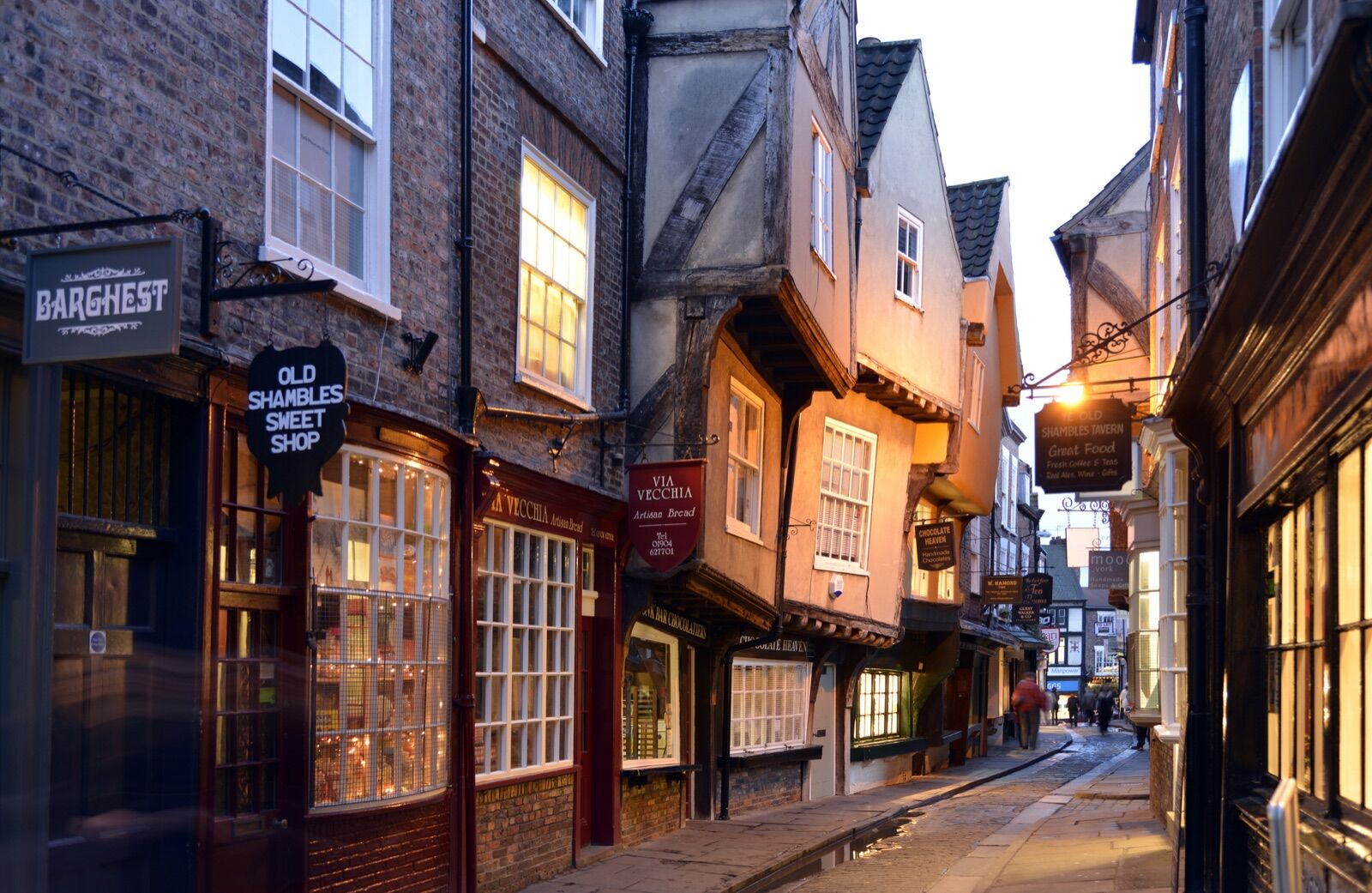
The Shambles isn’t one of the streets named in the opening chapter, but it’s a five-minute walk from Stonegate, and it’s the closest you’ll get today to the tilting, centuries-old building Ruby describes. Our guide to the Shambles in York has the history and the best time to go. For everything else in the city, see our guide to things to do in York.
Places outside York
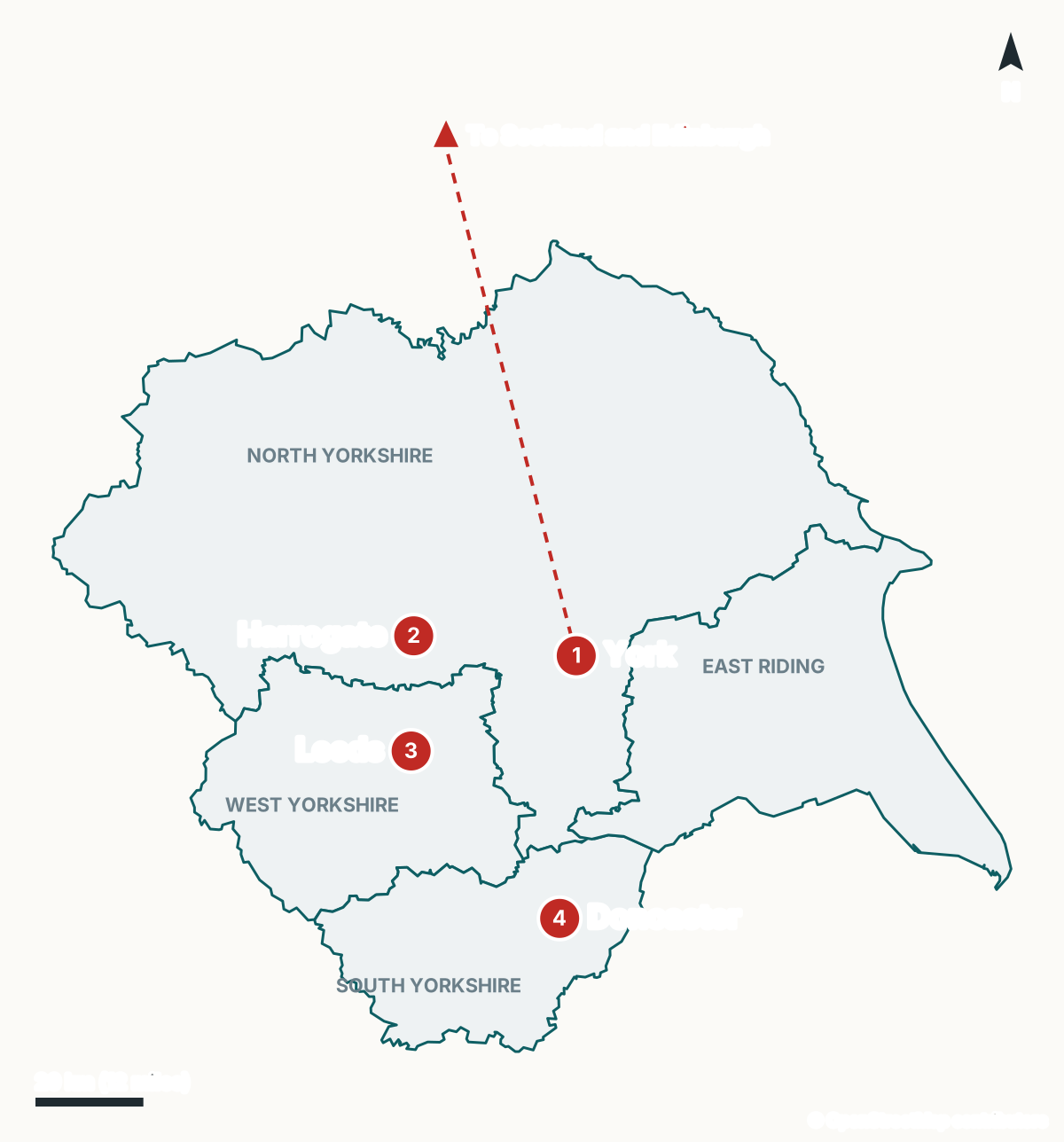
- York, where nearly all of it happens
- Harrogate
- Leeds
- Doncaster
| Place | Who goes there | Today |
|---|---|---|
| Harrogate | Only as a ghost: the old Harrogate Tally-Ho coach rattling over the cobbles in Chapter One. | A spa town about 35–40 minutes from York by train. See our Harrogate guide. |
| Leeds | George’s father dies on a day trip there in 1945. | West Yorkshire’s big city, an easy train ride from York. |
| Doncaster | George is in a Doncaster pub when Ruby is born. | A South Yorkshire town on the main line south. |
| Scotland | The Lennoxes go on holiday there with their neighbors, and Ruby goes back later. | Edinburgh, where Atkinson lives, is on the same main line north from York. |
| Canada | Lillian’s footnotes, and Edmund’s childhood. | |
| The Western Front | The First World War footnotes. | The Somme battlefields in northern France can be visited. |
| Kansas | Where Buck, the American sergeant, went home to. Bunty’s road not taken. |
About Kate Atkinson
Kate Atkinson was born in York on 20 December 1951, a few months before her narrator. She studied at the University of Dundee and lives in Edinburgh. Behind the Scenes at the Museum was her first novel, and it won the 1995 Whitbread Book of the Year, beating Salman Rushdie’s The Moor’s Last Sigh. She later won the Costa Novel Award twice, for Life After Life (2013) and A God in Ruins (2015).
Is it autobiographical? Partly, and she’s been open about it. Like the Lennoxes, her family had a shop in Stonegate, though hers sold medical and surgical supplies. Like Ruby, her first book was a Ladybird book about puppies and kittens. Her family watched the coronation on TV, just like the Lennoxes, and she’s kept her coronation mug. She put it this way in the Guardian: she is not Ruby Lennox, “but she is me.”
Adaptations. We couldn’t find a film or TV version. Her Wikipedia entry notes radio and stage adaptations. Her other books have done well on screen: the Jackson Brodie novels became the BBC One series Case Histories, and Life After Life became a BBC series in 2022.
Book club questions for Behind the Scenes at the Museum
These are ours. The first six are safe for anyone. The last four are in a spoiler box, for when everyone’s finished.
- Ruby narrates things she couldn’t possibly know, starting with her own conception. Did that bother you, or did you go along with it?
- Why do you think Atkinson called the family stories “footnotes” when they take up so much of the book?
- The book is full of objects: a clock, a button, photographs. Which one stuck with you, and why?
- Atkinson said York, not Ruby, is the main character. Do you agree? What did you learn about the city?
- Bunty, Nell and Alice all marry men they aren’t sure about. What choices did these women really have?
- Ruby tells us about some events long before they happen. Did knowing in advance make them easier or harder to read?
Spoilers: four questions for after you finish
7. Looking back, which clues to Pearl did you spot, and which did you miss? (The doctor's surprise at Ruby's birth, the midwife saying "Snap," twice as many photographs of Ruby.)
8. Is Gillian a villain, or just a frightened child who told a lie?
9. Alice and Lillian both disappear from the family. Were they wrong to go?
10. By the end, do you forgive Bunty? Does Ruby?
What to read next
If you liked it, these are the natural next steps:
| Book | Year | Why |
|---|---|---|
| Life After Life | 2013 | Another English family across the World Wars, with a heroine who keeps getting another go at life. Costa Novel Award. |
| A God in Ruins | 2015 | The companion to Life After Life. It turns a bomber-crew story first told in a footnote here into a whole novel. Costa Novel Award. |
| Case Histories | 2004 | The first Jackson Brodie mystery. Then One Good Turn (2006), When Will There Be Good News? (2008), Started Early, Took My Dog (2010), Big Sky (2019) and Death at the Sign of the Rook (2024), in that order. |
| Human Croquet | 1997 | Her second novel: another family, another girl narrator, more play with time. |
| Tristram Shandy, Laurence Sterne | 1759–67 | Atkinson says it was written in York and first sold in Stonegate. Her opening is a nod to it. |
For more books tied to the places on our route, see the Yorkshire Departure Shelf.
Visiting Ruby’s York
If you want to walk the book, here’s a short loop from the Minster that takes about two hours with stops:
- Stonegate, from St Helen’s Square up to the Minster. This is the Lennoxes’ street.
- York Minster, at the top of Stonegate.
- Blake Street down to the Museum Gardens and St Mary’s Abbey, Bunty’s route on Ruby’s first day.
- Back through Bootham Bar and up Gillygate, then Clarence Street, if you want to see Nell’s side of town.
- Through the center and the Shambles to York Castle Museum, south of the Shambles. Leave two hours for Kirkgate and the rest of the museum.
On our October 2027 Yorkshire trip, we go round York Castle Museum together on Thursday 7 October, after lunch at Bettys and a walk through the Shambles. If this is one of the books we read in the months before, you’ll walk into Kirkgate knowing exactly why it’s in the title.
Ruby's York: what else was happening
The book covers about a hundred years of one York family, from Alice in the 1890s to Ruby in 1992. First, era by era, what was happening in the book and in the world around it. Then the key dates. Ruby's chapters run from the Festival of Britain to 1992, and the footnotes take you back through both World Wars. Atkinson was born in York the same year Ruby was conceived, so the coronation on TV, the World Cup final and the sixties are hers too.
-
Late Victorian 1880–1901
In the book
Alice's story. A traveling French photographer takes pictures of Alice and her children at the end of the 1800s.
In the world
Queen Victoria reigns until she dies in January 1901. York is a railway town, home of the North Eastern Railway. Kodak's first camera (1888) puts photography into ordinary hands. Married women in England have only won the right to own property in their own name in 1882, and no woman can vote.
-
Edwardian 1901–1914
In the book
Nell and her brothers and sisters grow up, with their stepmother Rachel running the house.
In the world
Edward VII reigns from 1901 to 1910, then George V. Emmeline Pankhurst founds the suffragettes' Women's Social and Political Union in 1903. The first state old-age pensions are paid in 1909. The Titanic sinks in 1912.
-
First World War 1914–1918
In the book
Nell's brothers and their friends go to war. Several footnotes follow them to the Western Front.
In the world
The Battle of the Somme begins on 1 July 1916, and nearly 20,000 British soldiers are killed on the first day. Women take over jobs in munitions factories and on the railways. In 1918 women over 30 who meet a property test get the vote, and the war ends on 11 November.
-
Between the wars 1918–1939
In the book
Nell is married to Frank, and they raise five children: Clifford, Babs, Bunty, Betty and Ted. Bunty grows up dreaming of being a film star.
In the world
The BBC starts radio broadcasts in 1922. Talking pictures arrive with The Jazz Singer in 1927. All women over 21 get the vote in 1928. The Wall Street Crash of 1929 brings the Depression. York Castle Museum opens in 1938.
-
Second World War 1939–1945
In the book
Bunty falls for an American sergeant called Buck, then meets George in 1944. Her cousin Edmund comes over from Canada with the air force. George takes over the family pet shop in 1945.
In the world
Food rationing starts in January 1940. German bombers hit York on 29 April 1942. American troops arrive in Britain from 1942. The war in Europe ends on 8 May 1945.
-
After the war 1945–1959
In the book
Patricia and Gillian are born, then Ruby in 1952. The family lives above the Shop in the shadow of the Minster and watches the coronation on television.
In the world
The NHS opens on 5 July 1948. The Festival of Britain opens in May 1951. Elizabeth II is crowned on 2 June 1953, and for many families it's the first thing they ever watch on TV. Food rationing finally ends in July 1954.
-
The sixties 1960–1969
In the book
Ruby grows up through the sixties. Uncle Ted's wedding falls on World Cup final day in 1966.
In the world
The contraceptive pill is available on the NHS from 1961, at first for married women. The Beatles release their first single in 1962. England win the World Cup on 30 July 1966. Apollo 11 lands on the Moon in July 1969.
-
The seventies to 1992 1970–1992
In the book
Ruby grows up and makes her own life. The last chapter is set in 1992.
In the world
Britain joins the European Economic Community on 1 January 1973. Margaret Thatcher becomes the first woman Prime Minister in 1979. The miners' strike runs from 1984 to 1985. The Berlin Wall falls in November 1989.
The story Britain The wider world Other writers
- 1914 The story Nell's generation is young when the First World War begins. Several footnotes follow the family's men to the Western Front.
- 1916 Britain The Battle of the Somme begins on 1 July.
- 1917 The wider world The United States enters the First World War in April.
- 1918 Britain The war ends on 11 November.
- 1939 Britain Britain declares war on Germany on 3 September.
- 1942 Britain A German air raid hits York on 29 April.
- 1944 The story Bunty meets George. He wasn't her first choice.
- 1945 The story George's father dies and George takes over the family pet shop.
- 1945 Britain The war in Europe ends on 8 May.
- 1951 The story Chapter One: Ruby is conceived, on the night before the Festival of Britain opens.
- 1951 Britain King George VI opens the Festival of Britain on 3 May.
- 1951 Other writers Kate Atkinson is born in York on 20 December.
- 1952 The story Ruby is born.
- 1953 The story The coronation chapter: the family watches on television.
- 1953 Britain Elizabeth II is crowned at Westminster Abbey on 2 June.
- 1956 The story Chapter Four, 'The Naming of Things': Ruby is sent to stay with Auntie Babs.
- 1960 The story Chapter Seven, 'Fire! Fire!'
- 1966 The story Chapter Ten, 'Wedding Bells': Uncle Ted's wedding falls on World Cup final day.
- 1966 Britain England beat West Germany 4–2 at Wembley on 30 July to win the World Cup.
- 1969 The wider world Apollo 11 lands on the Moon on 20 July.
- 1992 The story Ruby's last chapter.
- 1995 Other writers Behind the Scenes at the Museum is published on 2 March and wins the 1995 Whitbread Book of the Year, beating Salman Rushdie's The Moor's Last Sigh.
- 2004 Other writers Case Histories introduces Atkinson's detective, Jackson Brodie.
- 2008 Other writers Atkinson tells the Guardian the title came from a dream set in York Castle Museum at night.
- 2013 Other writers Life After Life wins the Costa Novel Award.
- 2015 Other writers A God in Ruins wins the Costa Novel Award, picking up a bomber-crew story first told in this book.
Questions people ask
Who are the main characters in Behind the Scenes at the Museum?
Ruby Lennox narrates. Her family is her mother Bunty, her father George, her sisters Patricia and Gillian, her grandmother Nell, Nell's sister Lillian, and her great-grandmother Alice. The footnotes add Nell's brothers, Bunty's brothers and sisters, and a crowd of cousins.
Is Behind the Scenes at the Museum about a museum?
Partly. The museum of the title is York Castle Museum, and the opening sets up the idea of a life on display, but most of the book is everyday family life in the streets around it, in York and Yorkshire. Atkinson herself called York, not Ruby, the book's main character.
What museum is Behind the Scenes at the Museum named after?
York Castle Museum, a social history museum in two former prisons, best known for Kirkgate, its full-size Victorian street. Atkinson has said the title came to her in a dream of being alone in the Castle Museum at night.
Is Behind the Scenes at the Museum a true story?
No, it's a novel. But it draws on Atkinson's own York childhood: her parents' shop was in Stonegate, near the Minster, and she wrote that she isn't Ruby Lennox, 'but she is me.'
Should I read the footnotes in order?
Read the book in the order it's printed. Each chapter points you to its footnote, and the footnotes aren't in date order, so jumping ahead to read them all at once makes the family harder to follow, not easier.
When is Behind the Scenes at the Museum set?
Ruby's chapters run from 1951 to 1992. The footnotes go back to the end of the 19th century and through both World Wars.
What should I read after Behind the Scenes at the Museum?
Life After Life (2013) is the obvious next one: another English family across the wars, told in a playful structure. If you liked the wartime footnotes, follow it with A God in Ruins (2015). For something lighter, start the Jackson Brodie mysteries with Case Histories (2004).
Read next
- Yorkshire · YorkThe Shambles, YorkA 400-foot medieval street in the middle of York: what's actually old about it, who lived here, and when to go if you don't like crowds.
 Yorkshire · HarrogateHarrogate, EnglandWhat to do in the North Yorkshire spa town, from someone who lived just outside it for three years and went back to scout it in 2026.
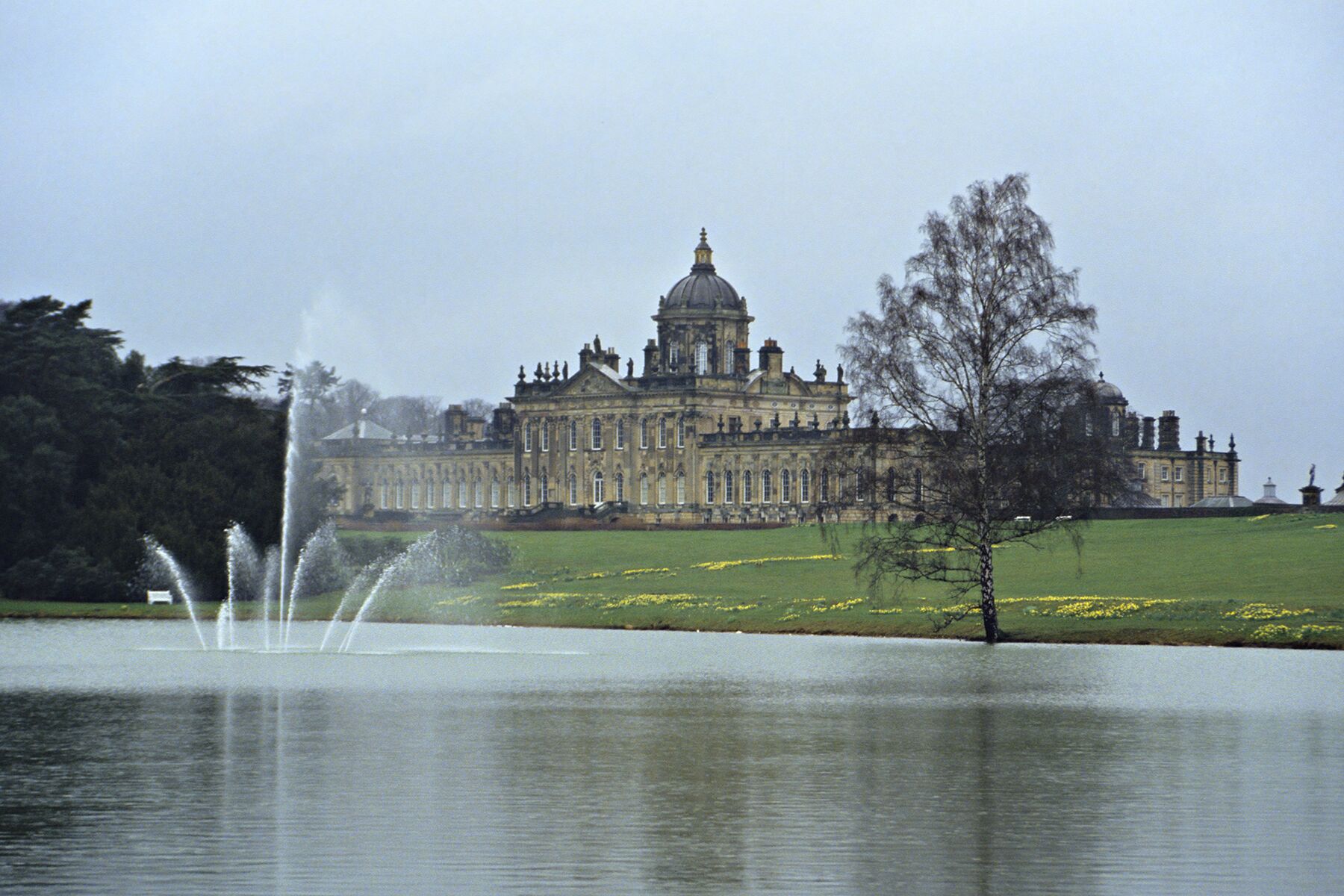 Yorkshire · Castle HowardCastle HowardWhere Castle Howard is, how to get there from York without a car, and the books, films and people behind the house you've probably already seen on screen.
- Yorkshire · Anne ListerAnne ListerThe Halifax landowner who wrote five million words, a sixth of them in code, and married a woman in a York church in 1834. Here's her story, and where you can still follow it.
Sources
- Wikipedia: Behind the Scenes at the Museum (published 2 March 1995, 13 chapters 1951–1992, main characters, Whitbread)
- Kate Atkinson: Chapter One excerpt (1951, Conception), author's site
- Kate Atkinson: Behind the Scenes at the Museum (book page and description)
- The Guardian book club: Kate Atkinson on the origins of Behind the Scenes at the Museum (2008)
- Book Companion: Behind the Scenes at the Museum characters by chapter
- BookRags: Behind the Scenes at the Museum study guide (plot summary)
- BookRags: chapter titles and years (chapters 4, 7, 10)
- BookRags: objects and places in the novel
- SuperSummary: Behind the Scenes at the Museum plot summary
- Art Kavanagh: Rereading Behind the Scenes at the Museum
- Karissa Reads Books: review (Ruby born 1952; Nell youngest of six)
- The Book Trail: Behind the Scenes at the Museum locations (Stonegate, Castle Museum; Lillian and Pete Donner excerpt)
- Bookey: chapter summaries (Chapter 3, the 1953 coronation)
- Wikipedia: Kate Atkinson (born York 20 December 1951, Dundee, novels, Costa awards, adaptations)
- York Castle Museum: Visitor information
- Wikipedia: York Castle Museum (opened 1938, Kirkgate)
- York Museum Gardens: Visitor information (open daily 9am–6pm)
- York Museum Gardens: St Mary's Abbey
- York Minster: Plan your visit
- City of York Council: City walls
- Wikipedia: Festival of Britain (opened 3 May 1951)
- The Royal Family: 50 facts about the Coronation (2 June 1953)
- Wikipedia: 1966 FIFA World Cup final (30 July 1966, England 4–2 West Germany)
- Wikipedia: Baedeker Blitz (York raid, 29 April 1942)
- Wikipedia: Battle of the Somme (began 1 July 1916)
- Wikipedia: North Eastern Railway (headquartered in York)
- Wikipedia: Kodak camera (1888)
- Wikipedia: Married Women's Property Act 1882
- Wikipedia: Women's Social and Political Union (founded 1903)
- Wikipedia: Old-Age Pensions Act 1908 (first paid January 1909)
- UK Parliament: women and the vote (1918 and 1928 Acts)
- Wikipedia: Rationing in the United Kingdom (January 1940 to July 1954)
- Wikipedia: National Health Service (England), launched 5 July 1948
- Wikipedia: Combined oral contraceptive pill (NHS 1961)
- Wikipedia: 1973 enlargement of the European Communities
- Wikipedia: UK miners' strike (1984–85)
- OpenStreetMap (map data for the York and Yorkshire maps)
Get the reading list first.
Trip announcements, curated reading lists, and the occasional dispatch — before anyone else.