Caribbean · Dominica
Things to do in Dominica: a guide to the Caribbean's Nature Island
What's worth your time on Dominica, why it isn't the Dominican Republic, and what you can actually fit into one day when a ship calls at Cabrits.
- Where
- Eastern Caribbean, between Guadeloupe (north) and Martinique (south)
- Capital
- Roseau
- Size
- 750 km² (290 sq mi); about 72,000 people (2021 estimate)
- Language and money
- English (official) and Kwéyòl; East Caribbean dollar
- Independence
- 3 November 1978
- UNESCO site
- Morne Trois Pitons National Park, inscribed 1997
- Our ship calls at
- Cabrits, on the northwest tip, Monday 17 January 2028
The short answer
The best things to do in Dominica are the hand-rowed boat trip up the Indian River near Portsmouth, Fort Shirley in Cabrits National Park, the hike to the Boiling Lake in Morne Trois Pitons National Park (a UNESCO World Heritage Site since 1997), Trafalgar Falls, snorkeling at Champagne Reef, whale watching, and the Kalinago Territory on the east coast. Dominica is a small, mountainous English-speaking island of about 72,000 people. It is a separate country from the Dominican Republic.
Dominica is a steep, green volcanic island in the Eastern Caribbean, with more rivers and rainforest than beaches. Most of the things to do in Dominica are outdoors: rowing up a jungle river, walking to waterfalls and hot springs, snorkeling over volcanic bubbles, watching whales. There’s real history too, from an 18th-century British garrison to the Caribbean’s only territory set aside for its Indigenous people. If you came for white sand and a sun lounger, this isn’t that island. Below: the island as a whole, then what you can honestly fit into one day when a ship calls at Cabrits in the north.
Dominica island at a glance
Christopher Columbus sailed past on a Sunday, 3 November 1493, and named the island for the day: dies Dominica, Latin for “the Lord’s day.” The Kalinago, who lived here long before Europeans arrived, called it Wai’tu kubuli, usually translated as “tall is her body.” Fair enough. Morne Trois Pitons alone rises to 1,342 meters (about 4,400 feet).
France and Britain both held the island in the 1700s (the French occupied it again from 1778 to 1784). That’s why the official language is English but half the place names are French, and why many people also speak Kwéyòl, a French-based Creole. Dominica became independent on 3 November 1978, on the anniversary of Columbus’s sighting, so Independence and Creole celebrations fill the end of October and early November.
On 18 September 2017 Hurricane Maria hit the island directly as a Category 5 storm. Early estimates said about 90 percent of buildings were damaged or destroyed, and losses were put at more than twice the country’s yearly economic output. Rebuilding has gone on for years since.
A short history: Kalinago, colonists and sugar
The steep, forested interior made Dominica hard to conquer. In 1660 the French and English agreed that Dominica and St Vincent should not be settled, and left them to the Kalinago. That held until French settlers arrived from 1690 and started coffee plantations. Britain took the island under the 1763 Treaty of Paris. The same year, 232 acres around Salybia on the east coast were set aside for the Kalinago, the first step toward the Territory created in 1903.
Let’s be plain about the plantations. Coffee first and sugar later, they ran on the forced labor of enslaved Africans, as on every island in this guide. Jean Rhys’s mother’s family, the Lockharts, had owned one of those sugar estates. The 1802 revolt at Fort Shirley was by soldiers of the 8th West India Regiment, enslaved Africans serving in the British army. Slavery ended across the British Caribbean under the Abolition Act, which took effect on 1 August 1834.
In April 1782 the British and French fleets fought the Battle of the Saintes off Dominica, near the little Îles des Saintes, and the British won. On 22 February 1805 a French raid burned much of Roseau, though the invasion failed. The 20th century brought the labor and independence politics that Phyllis Shand Allfrey was part of, and independence in 1978.
Roseau, Dominica’s capital
Roseau sits on the southwest coast, and it’s where most south-coast trips start: Trafalgar Falls and the Roseau Valley inland, Champagne Reef down the coast, the Boiling Lake trail from Laudat, and whale-watching boats offshore. The World Creole Music Festival is held each October at Windsor Park. It’s also where Jean Rhys grew up, though her family house is gone (more below). If your ship calls at Cabrits instead, Roseau is about an hour’s drive south.
Dominican Republic vs Dominica: not the same place
This is one of the most searched questions about the island, and the answer is simple. Dominica (say dom-in-EE-ka) is a small, English-speaking country in the Eastern Caribbean, with about 72,000 people on 290 square miles. The Dominican Republic is a much larger Spanish-speaking country on the island of Hispaniola, which it shares with Haiti. Different countries, different parts of the Caribbean. The mix-ups happen often enough, mail sent to the wrong country included, that some Dominicans have argued for renaming the island Waitukubuli. (Double-check your flight booking. Seriously.)
The best things to do in Dominica
| What | Where | Time to allow | Good for |
|---|---|---|---|
| Indian River by rowed boat | Portsmouth, north | 1.5–2 hours | Everyone; Pirates fans |
| Fort Shirley and Cabrits trails | Cabrits National Park, north | 1–2 hours | History, easy walks |
| Boiling Lake hike | Morne Trois Pitons National Park, from Laudat | A full day | Fit hikers, with a guide |
| Trafalgar Falls | Roseau Valley, south | Half day with the drive | Short walk to twin falls |
| Champagne Reef | Southwest coast | 1–2 hours | Snorkeling over volcanic bubbles |
| Whale and dolphin watching | West coast, by boat | Half day | Sperm whales live here year-round |
| Kalinago Territory | East (Atlantic) coast | Half day | Indigenous history and crafts |
| Waitukubuli National Trail | Whole island, 14 segments | One segment = a day | Long-distance walkers |
For current opening days, fees and site passes, check the Discover Dominica Authority, the official tourism site, the week you go.
The Indian River
The Indian River runs into Prince Rupert Bay at Portsmouth, a few minutes from the Cabrits peninsula. Local guides row you upstream in brightly painted wooden boats, pointing out the mangroves and the tall Bwa Mang trees along the banks. No motor, so it’s slow and quiet, and that’s the point. About half an hour upriver there’s a small bush bar where the house drink is a rum cocktail called Dynamite, according to Uncommon Caribbean. (The name is a hint. Pace yourself.) The river is best known as the Pantano River in Pirates of the Caribbean: Dead Man’s Chest (2006), the route to the witch Tia Dalma’s shack.
Cabrits National Park and Fort Shirley
Cabrits National Park was set up in 1986 on a peninsula north of Portsmouth. It protects 1,313 acres of tropical forest and wetland on land, plus a marine area between Prince Rupert Bay and Toucar Bay. The peninsula is two old volcanic hills, East Cabrit and West Cabrit, joined by swamp.
Fort Shirley is why most people walk up. The British began building it in 1765 under Governor Thomas Shirley, and the French extended it while they held the island from 1778 to 1784. At its height the garrison had more than 50 buildings and over 600 men. In 1802 it saw a revolt by the 8th West India Regiment, a unit of enslaved African soldiers. The fort was abandoned in 1854, and restoration began in 1982 under the Dominican historian Dr Lennox Honychurch. Star Clippers’ port notes call it “a restored 18th-century British garrison.” The reward for the short uphill walk is the view over Prince Rupert Bay.
Morne Trois Pitons National Park and the Boiling Lake
The center of the island is Morne Trois Pitons National Park, a UNESCO World Heritage Site since 1997. It covers nearly 7,000 hectares around a volcano 1,342 meters high. UNESCO lists about 50 fumaroles, hot springs, three freshwater lakes, the Valley of Desolation (also called the Grand Soufrière) and the Boiling Lake.
The Boiling Lake is the world’s second-largest hot spring. Hikers report two and a half to four hours each way from the village of Laudat, often on tricky, muddy ground. Go with a licensed guide, start early, and don’t try to squeeze it into a cruise day. See Discover Dominica’s Boiling Lake page for the official details.
Trafalgar Falls, Titou Gorge and Champagne Reef
The Roseau Valley, inland from the capital, is the easiest place to see waterfalls. Trafalgar Falls is a pair of falls side by side, at the end of a short forest path. Nearby Titou Gorge is a narrow, water-filled gorge. Dead Man’s Chest used it for the chasm where Will Turner and his shipmates hang in cages made of bones.
On the southwest coast, Champagne Reef is a snorkeling spot where volcanic vents on the sea floor send up streams of bubbles. It’s right off the coast road, so it’s an easy add-on to a Roseau Valley day.
Whale watching
A group of sperm whales lives in the deep water off Dominica’s west coast all year. Spinner, pantropical spotted and bottlenose dolphins are common too. Humpbacks, killer whales, false killer whales and several smaller whale species turn up less often. That makes Dominica one of the best places in the Caribbean to go whale watching. Discover Dominica’s whale-watching page lists the official background.
The Kalinago Territory
The Kalinago are the Indigenous people of Dominica, once called “Caribs” by Europeans. More than 3,000 live today in the Kalinago Territory, a district of about 3,700 acres on the Atlantic coast. The British set it aside in 1903 as the “Carib Reserve,” and it was officially renamed the Kalinago Territory in 2015, because “Carib” is considered derogatory. Land is held in common, and the Territory has its own chief and council.
Kalinago Barana Autê, a cultural village on the Crayfish River, opened in 2006. Kalinago baskets woven from larouma reed are sold as souvenirs. Residents see little of the island’s tourism income, so buy straight from the makers. It’s the simplest way to make sure your money stays in the Territory.
One piece of colonial history ties three of our islands together, and it’s ugly. In 1674 Philip Warner, Governor of Antigua, murdered his half-brother, “Indian” Thomas Warner, at a Kalinago village on Dominica’s west coast that Thomas had founded. Thomas was the son of Sir Thomas Warner, founder of English St Kitts, and a Kalinago woman. Colonists then killed about 100 villagers. The French named the place Massacre, and the town still carries the name. Jean Rhys put Massacre into Wide Sargasso Sea.
The Waitukubuli National Trail
The Waitukubuli National Trail runs the length of the island in 14 segments, about 115 miles from Scott’s Head in the south to Cabrits in the north. It partly opened in 2011 and officially opened in 2013, and it’s often called the longest hiking trail in the Caribbean. Non-residents need a trail pass; check the Discover Dominica Authority for how to get one. Segment 14, the last, ends at Cabrits.
Things to do in Dominica from a cruise ship
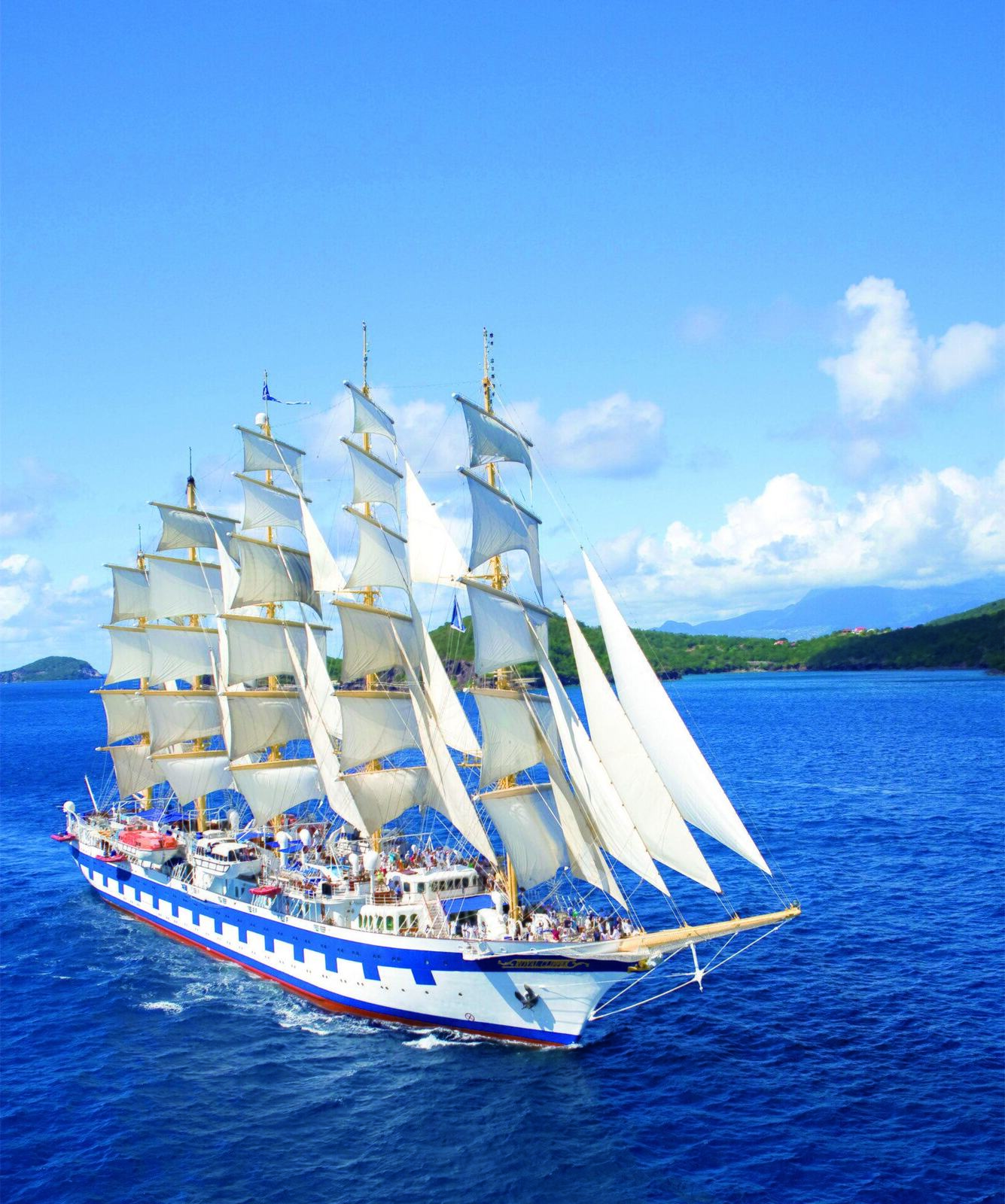
Ships call either at Roseau, the capital, in the south, or at Cabrits in the north. Roseau puts Trafalgar Falls, the Roseau Valley and Champagne Reef within easy reach. Star Clippers’ sailing ships use Cabrits. From Cabrits the natural half day is the Indian River and Fort Shirley, only a few minutes apart. Roseau is about an hour’s drive south, so the south-coast sights are a stretch from Cabrits in one day. My advice: pick the north and do it properly, rather than spending your day in a taxi.
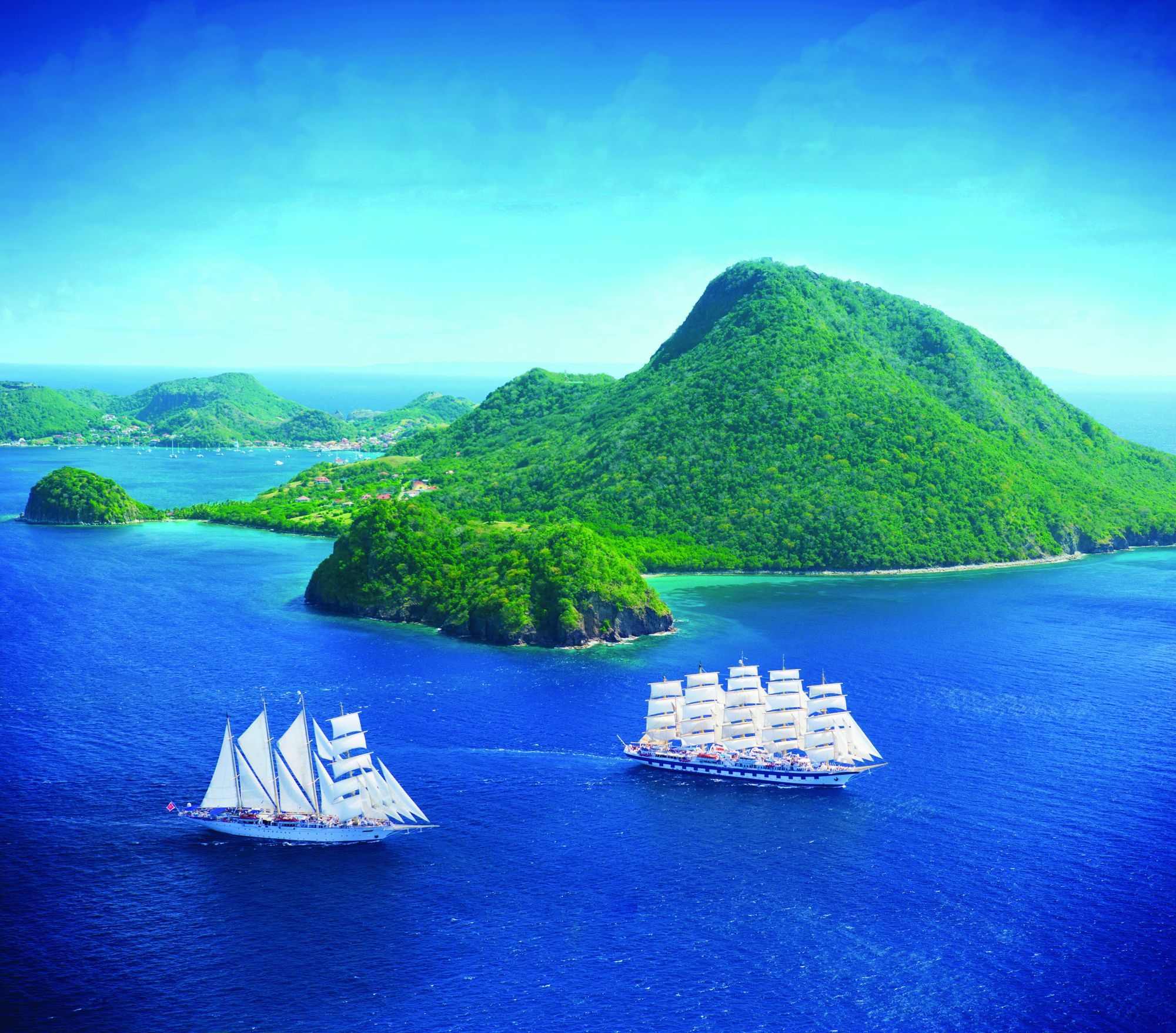 Royal Clipper (right) with a four-masted sister ship. On the way to Dominica island the itinerary has her sailing alongside Star Flyer. Photo: Star Clippers
The Royal Clipper, Star Clippers’ five-masted ship, calls at Cabrits on its Windward Islands route. On the 15 January 2028 sailing, the itinerary has her sailing alongside her four-masted sister, Star Flyer, on the way in to Dominica. Our trip, Mermaids, Pirates and Poets (Caribbean Sail), is on that sailing. The shore stop that day is a rowing boat up the Indian River and Fort Shirley. We won’t reach Roseau, the Boiling Lake or the Kalinago Territory that day, and I’d rather say so here than have you find out on the dock. I haven’t sailed this route yet, so everything here comes from published sources.
Jean Rhys’s island: books set in Dominica
Jean Rhys, author of Wide Sargasso Sea, was born Ella Gwendoline Rees Williams in Dominica on 24 August 1890. Her father was a Welsh doctor; her mother was a white Dominican Creole whose family had once owned a sugar estate worked by enslaved people. Rhys left for school in England at 16 and came back for a visit in 1936, the first time since she left. Her childhood home in Roseau, on the corner of Cork Street and Independence Street, was a guesthouse for years and was demolished in May 2020, as Polly Pattullo reported. So there’s no Rhys house to visit. Sorry.
Wide Sargasso Sea (1966) tells the story of the first Mrs Rochester from Charlotte Brontë’s Jane Eyre. Part Two, the honeymoon, takes place at a mountain estate on Dominica, near Massacre. Rhys’s unfinished memoir Smile Please (1979) opens with her Dominica childhood.
Other books worth knowing:
- Phyllis Shand Allfrey, The Orchid House (1953). A white Creole family’s three daughters in a thinly disguised Dominica, told by their Black nurse. Allfrey (1908–1986) was born in Roseau, founded the Dominica Labour Party in 1955, and became the only woman minister in the West Indies Federation. Channel 4 made it into a miniseries in 1991, directed by Horace Ové.
- Lennox Honychurch, The Dominica Story. A history of the island by the historian who led the Fort Shirley restoration.
- Jean Rhys, Smile Please (1979). Short chapters of memory, many of them set in Roseau.
Music in Dominica: bouyon and the Creole festival
Dominica’s own modern sound is bouyon, a fast, drum-heavy dance music. The band WCK (Windward Caribbean Kulture) is credited with starting it. The big event is the World Creole Music Festival, held in Roseau since 1997 in late October, around Independence. It brings in performers from across the Creole-speaking world and beyond, from soukous to zydeco. The 2026 festival ran 23 to 25 October at Windsor Park.
Dominica on film
- Pirates of the Caribbean: Dead Man’s Chest (2006). Filmed on Dominica from 18 April to 26 May 2005, along with scenes for At World’s End (2007). Locations included the Indian River, Hampstead Beach, Vieille Case, Titou Gorge and land south of Roseau where the cannibal village was built. Our Pirates of the Caribbean filming locations guide has the full list.
- The Kalinago objection. In 2005 the Kalinago chief, Charles Williams, publicly objected to the film casting his people as cannibals, a colonial myth the community has spent centuries pushing back against. Searchlight in St Vincent reported the row at the time. Worth knowing before you watch the island scenes.
- The Orchid House (1991). The Channel 4 miniseries of Allfrey’s novel.
Practical tips for visiting Dominica
- Getting there. Douglas-Charles Airport, on the northeast coast, is the main airport; Canefield, near Roseau, is small. A new international airport is being built at Wesley. Check current routes with the airlines before you book.
- Driving times. The island is mountainous and the roads wind round the peaks. Cabrits to Roseau takes about an hour, whatever the map makes you think.
- Rain. It’s a rainforest island. Bring a light rain jacket and shoes that can get wet.
- Guides. Use licensed guides for the Boiling Lake and the river trips. On the Indian River the guide rows; that’s part of the point.
- Money. The local currency is the East Caribbean dollar.
More on the islands of our route
Dominica is one stop on the Royal Clipper’s Windward route. The day before is St Lucia (see the St Lucia Pitons), and the day after is Antigua, where Nelson’s Dockyard is a short walk from the anchorage. Later in the week come St Kitts, the Îles des Saintes and a beach day on Martinique. If the Rhys connection is what brought you here, start with our guide to Wide Sargasso Sea.
Dominica's history: what else was happening
Dominica was one of the last islands Europeans managed to settle, because the mountains and the Kalinago kept them out. It went from French to British in 1763, ran on enslaved labor until 1834, and became independent in 1978, the same decade Jean Rhys, its best-known writer, died in England.
- French settlers 1690–1763
- British colony (French again 1778–1784) 1763–1978
- Plantation slavery 1690–1834
- Associated State 1967–1978
The story The Caribbean The wider world Other writers
- 1493 The story Columbus sails past on Sunday 3 November and names the island for the day, dies Dominica.
- 1624 The Caribbean Thomas Warner founds the first English colony in the Caribbean, on St Kitts.
- 1635 The Caribbean France claims Martinique and Guadeloupe, Dominica's neighbors to the south and north.
- 1660 The story France and England agree to leave Dominica and St Vincent to the Kalinago.
- 1674 The story Antigua's governor, Philip Warner, murders his half-brother "Indian" Thomas Warner at a Kalinago village; the place is named Massacre.
- 1690 The story French settlers start arriving and plant coffee, worked by enslaved Africans.
- 1763 The story The Treaty of Paris hands Dominica to Britain; 232 acres at Salybia are set aside for the Kalinago.
- 1765 The story The British start building Fort Shirley at Cabrits.
- 1776 The wider world The American colonies declare independence.
- 1778 The story France occupies Dominica again, until 1784.
- 1782 The Caribbean The Battle of the Saintes is fought off Dominica; Rodney's British fleet beats de Grasse.
- 1791 The Caribbean The revolution of the enslaved begins in Saint-Domingue, later Haiti.
- 1802 The story Soldiers of the 8th West India Regiment, enslaved Africans in British uniform, revolt at Fort Shirley.
- 1805 The story A French raid burns much of Roseau.
- 1807 The wider world Britain bans the slave trade; slavery itself carries on in its colonies.
- 1834 The Caribbean Britain's Abolition Act takes effect on 1 August; most of the formerly enslaved must work on as "apprentices."
- 1838 The Caribbean Apprenticeship ends on 1 August and full freedom follows across the British Caribbean.
- 1847 Other writers Charlotte Brontë publishes Jane Eyre, with its Creole first wife in the attic.
- 1854 The story Fort Shirley is abandoned.
- 1865 The wider world The 13th Amendment ends slavery in the United States.
- 1890 The story Jean Rhys is born in Roseau on 24 August.
- 1903 The story The British set up the "Carib Reserve," today's Kalinago Territory.
- 1953 Other writers Phyllis Shand Allfrey publishes The Orchid House.
- 1955 The story Allfrey founds the Dominica Labour Party.
- 1958 The Caribbean The West Indies Federation is formed; it breaks up in 1962.
- 1966 Other writers Jean Rhys publishes Wide Sargasso Sea.
- 1967 The story Dominica becomes an Associated State of Britain, running its own internal affairs.
- 1978 The story Independence, on 3 November, the anniversary of Columbus's sighting.
- 1979 The story Hurricane David hits the island at the end of August; Jean Rhys had died in England that May.
- 1997 The story Morne Trois Pitons National Park becomes a UNESCO World Heritage Site.
- 2017 The story Hurricane Maria strikes on 18 September as a Category 5 storm.
Questions people ask
Is Dominica the same as the Dominican Republic?
No. Dominica is a small English-speaking island nation in the Eastern Caribbean with about 72,000 people. The Dominican Republic is a much larger Spanish-speaking country that shares the island of Hispaniola with Haiti. The names get mixed up so often, mail included, that some Dominicans have suggested renaming the island Waitukubuli.
What is Dominica known for?
It's nicknamed the Nature Island of the Caribbean: rainforest, rivers and waterfalls, the Boiling Lake (the world's second-largest hot spring), sperm whales that live offshore all year, the Kalinago people, and the Indian River, where Pirates of the Caribbean filmed its river scenes.
What can you do in Dominica in one day from a cruise ship?
From Cabrits in the north, the easy half day is a rowed boat trip up the Indian River in Portsmouth plus a walk round Fort Shirley. From Roseau in the south, it's Trafalgar Falls, the Roseau Valley and Champagne Reef. The Boiling Lake hike takes most of a day, so it doesn't fit a short port call.
How do you fly to Dominica?
The main airport is Douglas-Charles, on the northeast coast; Canefield, near Roseau, is smaller. A new international airport is being built at Wesley. Routes change, so check with the airlines before you book.
How long is the hike to the Boiling Lake?
Give it a full day. Walkers report about two and a half to four hours each way from the village of Laudat, on steep, muddy ground, and a local guide is strongly advised.
Where was Jean Rhys from?
Jean Rhys was born in Dominica in 1890 and left for England at 16. Part Two of her novel Wide Sargasso Sea takes place on a mountain estate on Dominica, near the real village of Massacre.
In this guide
- Caribbean · Film locationsPirates of the Caribbean filming locationsWhich scenes were shot where, film by film, which real places you can still visit, and the one our ship actually stops at.
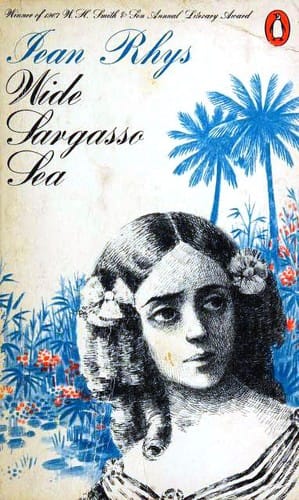 Caribbean · Dominica · BooksJean Rhys's Wide Sargasso SeaThe first Mrs Rochester's side of the story, by a novelist who grew up on Dominica. What happens, where, and why it changes how you read Jane Eyre.
Read next
- Caribbean · Dominica · BooksJean Rhys's Wide Sargasso SeaThe first Mrs Rochester's side of the story, by a novelist who grew up on Dominica. What happens, where, and why it changes how you read Jane Eyre.
- Caribbean · Film locationsPirates of the Caribbean filming locationsWhich scenes were shot where, film by film, which real places you can still visit, and the one our ship actually stops at.
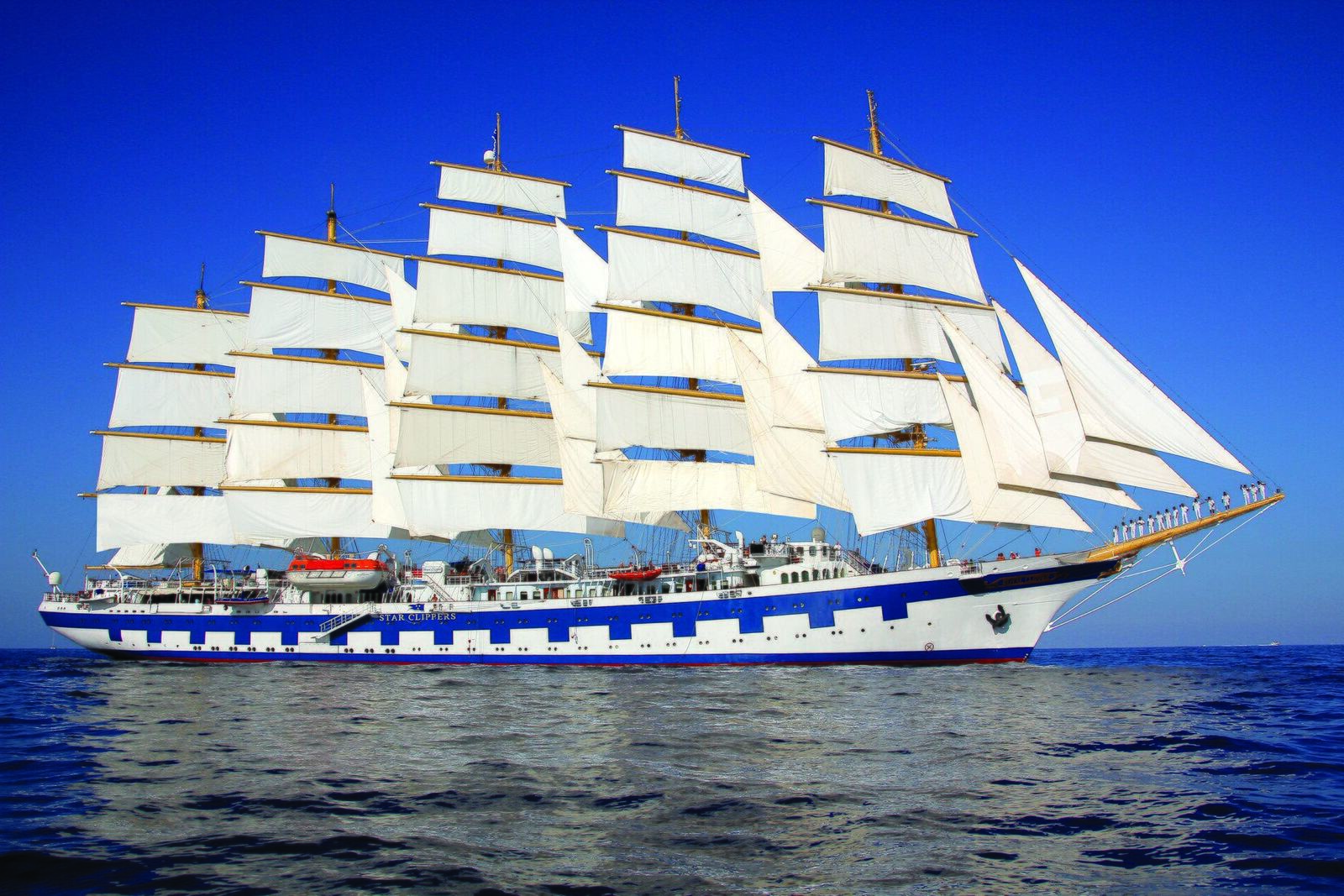 Caribbean · The Royal ClipperRoyal ClipperWhat the ship is, where her design came from, how a week on board works, and where she sails from Barbados. Straight answers, no brochure gloss.
- Caribbean · AntiguaThings to do in AntiguaWhat to see on Antigua in the Caribbean, how to fit it into a port day without spending it in a taxi, and the island's history told straight.
- Caribbean · MartiniqueThings to do in MartiniqueFrance in the Caribbean: a volcano that wiped out a city, an empress's birthplace, the only rum with its own appellation, and the poet who named Négritude.
Sources
- Wikipedia: Dominica
- UNESCO: Morne Trois Pitons National Park
- Wikipedia: Cabrits National Park
- Uncommon Caribbean: Indian River, Dominica
- Wikipedia: List of locations in Pirates of the Caribbean
- Wikipedia: Kalinago Territory
- Wikipedia: Massacre, Dominica
- Wikipedia: Waitukubuli National Trail
- Searchlight (St Vincent): Dominican Caribs in Pirates row, 2005
- Wikipedia: Jean Rhys
- Repeating Islands (Polly Pattullo): Jean Rhys house in Roseau demolished, 2020
- Wikipedia: Phyllis Shand Allfrey
- Caribbean Journal: World Creole Music Festival
- Wanderlust: How to spend a week in Dominica
- Star Clippers itinerary file RC150128 (port descriptions)
- Discover Dominica Authority (official tourism site)
- Discover Dominica: Boiling Lake
- Discover Dominica: Whale watching
- Wikipedia: West Indies Federation
- Wikipedia: Hurricane David
Get the reading list first.
Trip announcements, curated reading lists, and the occasional dispatch — before anyone else.