Yorkshire · The Brontës
Haworth village and the Brontë Parsonage Museum: what's worth your time
Haworth is one steep stone street on the edge of the West Yorkshire moors. At the top is the Brontë Parsonage, the house where Charlotte, Emily and Anne wrote their novels. Here's how to do it well.
- Address
- Brontë Parsonage Museum, Church Street, Haworth, Keighley BD22 8DR
- Open
- Wed–Sun, 10am–5pm, last entry 4pm; closed Mon and Tue (as of Nov 2026). Check current times
- Tickets
- £15 standard, £13 aged 65+, £7.50 ages 12–16, under-12s free with family (Apr 2026–Mar 2027). No timed entry
- Allow
- About 1½ hours for the museum, plus the church and an hour on the moor
- Nearest station
- Keighley (trains from Leeds), then bus, or the Keighley & Worth Valley Railway to Haworth
- Parking
- No museum car park. Pay-and-display at West Lane (BD22 8DS) and Sun Street (BD22 8BW)
- From Bradford
- About eight miles west; three miles south of Keighley
The short answer
The Brontë Parsonage Museum in Haworth, West Yorkshire, is the house where Charlotte, Emily and Anne Brontë lived and wrote all seven of their novels. As of November 2026 it's open Wednesday to Sunday, 10am to 5pm (last entry 4pm), and a standard ticket is £15. It sits at the top of Haworth's cobbled Main Street, behind St Michael and All Angels' Church, with the moor directly behind it.
Haworth village is one long, steep street of dark stone houses climbing a hill in West Yorkshire, with a church at the top and open moor behind it. The Brontë family moved into the parsonage next to that church in 1820, and Charlotte, Emily and Anne wrote every one of their novels there. Today the house is the Brontë Parsonage Museum, run by the Brontë Society. I lived in Killinghall, near Harrogate, for three years in the mid-90s, and I spent a day in Haworth in October 2026 planning our trip. Below: what’s inside the museum, the church, Main Street, the moor, how to get there without a car, and what we do there on our own trip.
Elizabeth Gaskell, who wrote the first biography of Charlotte, described the approach from Keighley in 1857:
Right before the traveller on this road rises Haworth village; he can see it for two miles before he arrives, for it is situated on the side of a pretty steep hill, with a back-ground of dun and purple moors, rising and sweeping away yet higher than the church, which is built at the very summit of the long narrow street.
— Elizabeth Gaskell, The Life of Charlotte Brontë, Vol. 1, Chapter I (1857), Project Gutenberg
Where is Haworth, England?
Haworth is in the Bradford district of West Yorkshire, in the north of England. It’s about eight miles west of Bradford and three miles south of Keighley, on the edge of the South Pennine moors. Leeds is the nearest big railway station, and Keighley the nearest local one.
Here’s the bit people miss: it wasn’t a pretty village when the Brontës lived there. The Brontë Society notes that mills were built along the river from 1790, people moved in for the work, and the village became overcrowded, with very little sanitation. When the family arrived in 1820, Haworth was a working mill village. The tea rooms came later.
The Brontë Parsonage Museum: what you’ll see
The Parsonage is a Georgian house, built in 1778–79, behind a small front garden. Patrick Brontë lived here as Haworth’s clergyman from 1820 until he died in 1861, and after that the contents were sold at auction. The Brontë Society, founded in 1893, opened its first museum in 1895 in a room above a bank in the village (not the grandest start). In 1928 a local businessman, Sir James Roberts, bought the Parsonage and gave it to the Society, and it opened as a museum on 4 August 1928.
Inside are the family’s period rooms and exhibition space for the Society’s collection. What to look for:
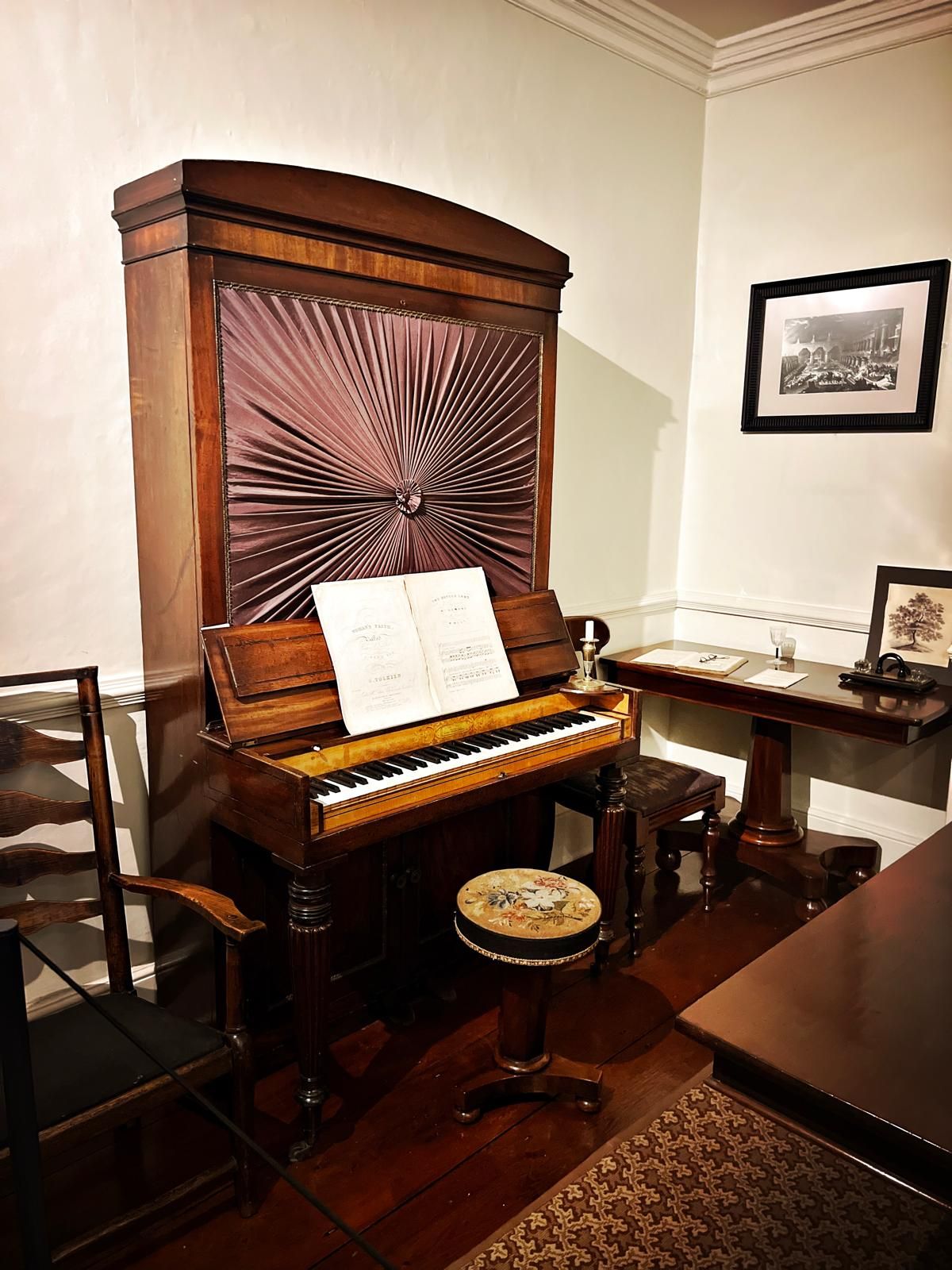
- The period rooms, including Mr Brontë’s study, with the family’s cabinet piano. Emily played it.
- The first floor. If stairs are hard for you, there’s a cheaper ground-floor ticket (£7.50).
- Charlotte’s mahogany desk, bought anonymously in 2009 and given to the museum in 2011.
- Changing exhibitions. A recent one marks ten years since the BBC drama To Walk Invisible.
There’s a free room-by-room guide on the Bloomberg Connects app. Download it at your hotel, not on the hill, where the signal is patchy.
Gaskell describes Emily in the Parsonage kitchen, and it’s the scene a lot of people picture when they walk in:
When at home, she took the principal part of the cooking upon herself, and did all the household ironing; and after Tabby grew old and infirm, it was Emily who made all the bread for the family; and any one passing by the kitchen-door, might have seen her studying German out of an open book, propped up before her, as she kneaded the dough; but no study, however interesting, interfered with the goodness of the bread, which was always light and excellent.
— Elizabeth Gaskell, The Life of Charlotte Brontë, Vol. 1, Chapter VIII (1857), Project Gutenberg
(Tabby was the family’s servant. And yes, Emily learned German over the bread dough. Most of us can’t manage a podcast while we cook.)
Where did the Brontë sisters sleep?
Here’s something that caught me out on my visit in October 2026. Upstairs at the Parsonage you see Mr Brontë’s bedroom. You see Branwell’s studio. When I got to the end, I asked “where was their bedroom??” and the answer was “we’re really not sure.”
That’s an honest answer, and once you dig in, it’s the right one. Here’s what the sources actually say, and where they stop.
Gaskell, who knew Charlotte, described the upstairs as it was when the family moved in:
Upstairs were four bed-chambers of similar size, with the addition of a small apartment over the passage, or “lobby” as we call it in the north.
— Elizabeth Gaskell, The Life of Charlotte Brontë, Vol. 1, Chapter III (1857), Project Gutenberg
She goes on to say that small room “was appropriated to the children,” that it had no fireplace, and that the servants called it the “children’s study.” So four bedrooms and a box room, for two parents (then one), six children, an aunt and the servants. Nobody had a room to themselves for long.
Here’s how the rooms upstairs are named in the museum today, and what’s known about each:
| Room (the museum’s name) | What the sources say |
|---|---|
| Mr Brontë’s Bedroom | Patrick’s room. Near the end of Branwell’s life, Gaskell says, Branwell “slept in his father’s room.” |
| Branwell’s Studio | Shown today as the room where Branwell painted. |
| The Children’s Study | The tiny room over the front hall. The children played and wrote their little books here. It’s usually linked with Emily as her bedroom when they grew up, though one account says it may have been Branwell’s for a while. |
| Charlotte’s Room | Accounts of the museum’s room history say this was first Patrick and Maria’s room (Maria died in 1821), then Aunt Branwell’s, shared with Anne, the youngest. Gaskell says the girls sewed in “their aunt’s bedroom,” which had once been their schoolroom. After Aunt Branwell died in 1842, Charlotte took it, sharing with one of her sisters. After 1849 it was hers alone, then hers and Arthur Bell Nicholls’s after they married in 1854. She died here in 1855. Today it has Victorian clothing in glass cases. |
| The Servants’ Room | A small room the museum labels as the servants’. It was originally reached by stairs from the yard. |
So why can’t the museum just tell you? A few reasons, and none of them is a cover-up:
- The rooms kept changing hands. People died, went away to school, left to work as governesses, went to Brussels and came home. Who shared with whom in 1835 wasn’t true in 1845.
- Nobody wrote it down. There’s no family floor plan with names on it. What we have is letters, a few remarks in Gaskell, and the memories of servants and villagers, collected after the fact.
- The house itself changed. Charlotte enlarged her room in the early 1850s, which made the children’s study smaller. After Patrick died in 1861, the contents were sold and his successor, the Rev John Wade, altered the house and added a two-storey gabled wing in the 1870s (Country Life dates it to 1878; other writers give other years).
- The witnesses came late. Gaskell’s own visit was in September 1853, when only Charlotte and her father were left. She wrote that Charlotte “sits alone in her parlour.”
Different books will give you slightly different versions of the table above. Where they disagree, treat it as a good guess, not a fact.
Was that because their father and brother counted for more? I asked exactly that. The honest answer is partly, and it’s more complicated than a yes. Patrick had his own study and bedroom because the house came with his job, and he held that job for 41 years. The sisters’ arrangements moved with their lives, so they’re harder to pin down. That’s not proof anyone thought the women mattered less. But the sisters did write about how women were treated, and Charlotte said plainly why they hid behind men’s names. That story, with her own words, is in our guide to the Brontë sisters and their books.
Why so much of their life is still here
I was amazed that so many of their artifacts had been preserved. Writing desks, letters, clothes, furniture, the tiny handmade books: the Brontë Society says the museum now holds the world’s largest collection of Brontë items. Here’s how that happened, because it very nearly didn’t.
- They were famous before they were dead. The Brontë Society says that even before Charlotte died in 1855, a steady stream of visitors came to Haworth hoping to catch a glimpse of her. People kept things because they already knew they mattered.
- Patrick stayed put. He lived in the house until he died in 1861, aged 84, so the household stayed together for six years after Charlotte.
- Then it scattered. The furniture and household contents were auctioned on 1 October 1861. Charlotte’s widower, Arthur Bell Nicholls, took manuscripts and personal things home to Ireland. Friends and servants were given keepsakes; Martha Brown, the family’s servant, ended up with one of the biggest collections.
- Collectors circled. In 1895 Nicholls sold most of his manuscripts and letters, including the tiny childhood books, to Clement Shorter, who was buying for the collector Thomas J. Wise. Wise resold much of it at auction. After Nicholls died in 1906, his widow sold more at Sotheby’s in 1907 and 1914, with a final sale in 1916. The Brontë Society bought what it could. The 1914 sale is where Branwell’s painting of his three sisters (the one where his own figure was painted over with a pillar) surfaced; the National Portrait Gallery in London bought it.
- The Society brought it home. It was founded in 1893 to keep the collection together, opened a one-room museum in the village in 1895, and in 1926 received a large bequest from the American collector Henry Houston Bonnell. In 1928 the Church put the Parsonage up for sale at £3,000, and Sir James Roberts bought it and handed the deeds to the Society.
The Society is still buying things back. Charlotte’s writing desk, mentioned above, only came home in 2011.
Brontë Parsonage Museum tickets and opening times
These are from the Brontë Society, as of November 2026:
| Open | Wednesday to Sunday, 10am to 5pm |
| Closed | Mondays and Tuesdays |
| Last entry | 4pm |
| Standard ticket | £15 |
| Aged 65+ | £13 |
| Students, disabled visitors, local residents | £9 |
| Ages 12–16 | £7.50 |
| Ground floor only | £7.50 |
| Children 11 and under (with family) | Free |
| Arrive by bus or train | £12 standard entry, with proof of travel, at the desk |
| Booking | No timed entry. Book online or buy at the door |
Two tips. Keep your train or bus ticket, because it saves you £3. And check the opening days the week you go: they’ve shifted with the seasons before, and a locked door on a Tuesday is a long way to come for a photo of the gate.
The church and the Brontë family vault
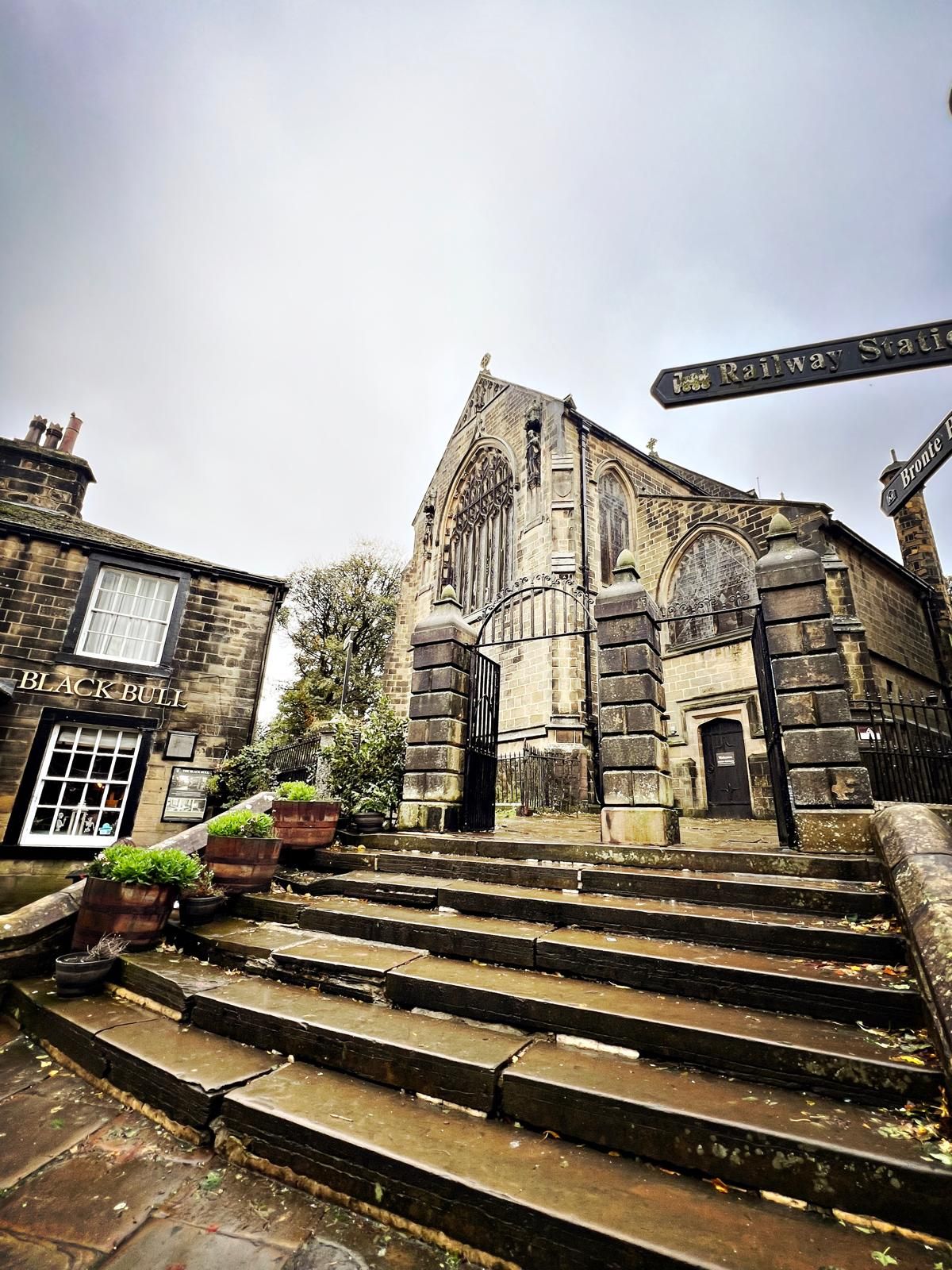
The church in front of the Parsonage is St Michael and All Angels. Don’t expect the church the Brontës knew: most of today’s building is from a rebuild in 1879–81. The old tower is the part that survives from their time. Every member of the family except Anne is buried in the family vault inside. Anne is buried in Scarborough, where she died. A memorial chapel was added in 1963.
Gaskell saw the family’s memorial tablet in the old church and noticed the lettering getting smaller as each death was added. It’s one of the saddest details in the whole biography:
But as one dead member of the household follows another fast to the grave, the lines are pressed together, and the letters become small and cramped. After the record of Anne’s death, there is room for no other.
— Elizabeth Gaskell, The Life of Charlotte Brontë, Vol. 1, Chapter I (1857), Project Gutenberg
The graveyard between the church and the house is packed with stones. Give it ten minutes on your way to the Parsonage door.
Main Street, the Black Bull and the old school
Main Street is cobbled and steep, just as it was in the 1850s. Gaskell even made a joke about it:
Haworth is a long, straggling village one steep narrow street—so steep that the flag-stones with which it is paved are placed end-ways, that the horses’ feet may have something to cling to, and not slip down backwards; which if they did, they would soon reach Keighley.
— Elizabeth Gaskell, The Life of Charlotte Brontë, Vol. 2, Chapter XII (1857), Project Gutenberg
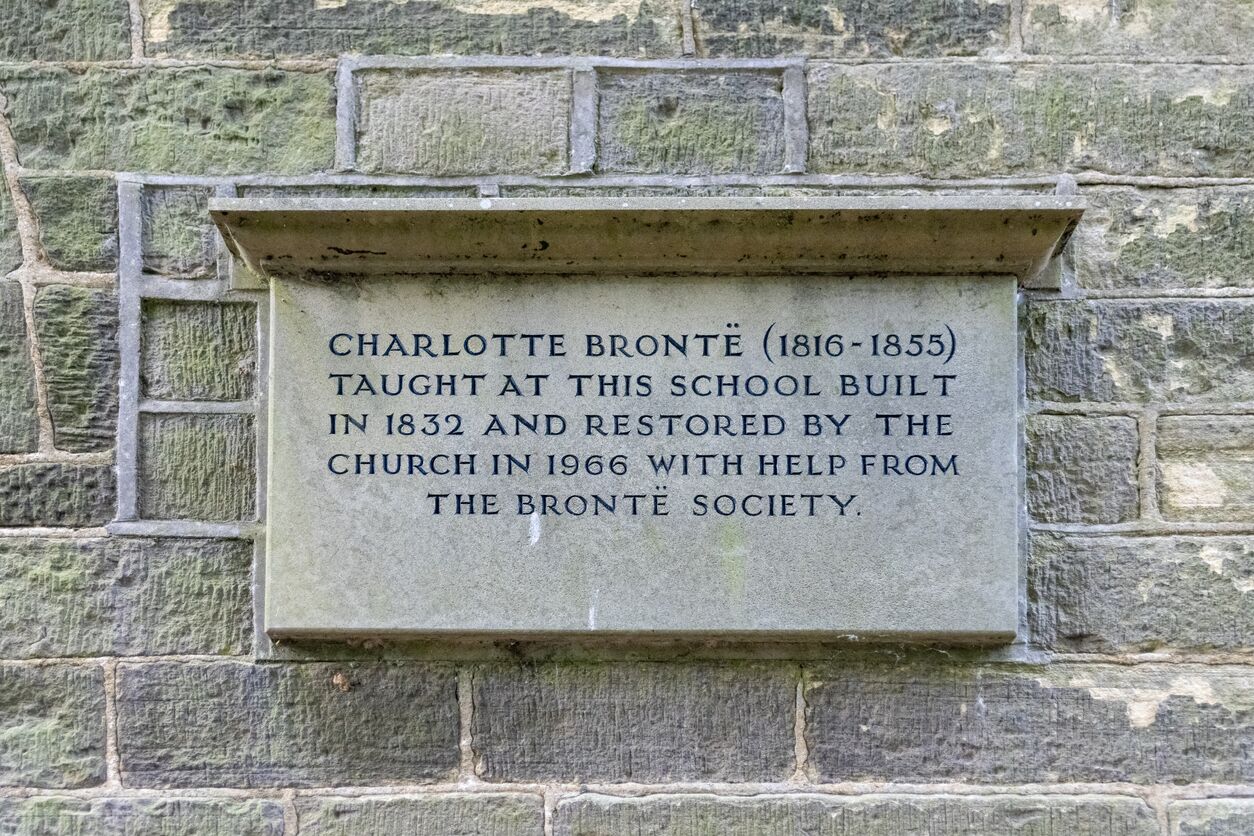
At the top, next to the church steps, is the Black Bull. The Brontë Society describes it as a favorite pub of Branwell Brontë’s, and it’s still open. Near the church is the school building where Charlotte taught. A plaque on its wall says it was built in 1832 and restored in 1966 with help from the Brontë Society.
Main Street has cafés and shops. The walk up from the bottom of the village, or from the railway station, takes about 15 minutes and it’s steep the whole way. Wear proper shoes. Your calves will thank you.
The moor behind the Parsonage: Penistone Hill and beyond
The moor starts a few minutes’ walk from the Parsonage. Gaskell wrote that from the day they arrived, the children walked up onto the moors behind the house, not down into the village. If you only see the house, you’ve seen half of it. Go out the back.
Most people choose one of three walks:
| Walk | Roughly | Notes |
|---|---|---|
| Penistone Hill Country Park | About 1 hour | Gentle paths just west of the Parsonage. Good in poor weather. |
| Brontë Waterfall | About 2–2½ miles each way from Haworth | The waterfall the sisters walked to, with a small stone bridge. |
| Top Withens | About 6–7 miles round trip, 3 hours or more | The ruined farm often linked to Wuthering Heights. Exposed, boggy in places. |
My honest advice: Penistone Hill is plenty for most people on a museum day. Only take on Top Withens if you’ve got three-plus hours, good boots and a map, because it’s exposed and boggy. Distances vary by route; the figures above are from published walk guides, including the Bradford 2025 leaflet. For Top Withens, Ponden Kirk and the film locations, see our guide to Wuthering Heights locations.
In Parson’s Field, next to the Parsonage, is the Anne Stone, a standing stone carved with a poem for Anne by the poet Jackie Kay. It’s one of four Brontë Stones put up in 2018, and it’s easy to walk straight past.
The Keighley & Worth Valley Railway and The Railway Children
The Keighley & Worth Valley Railway is a heritage line about five miles long, from Keighley up the valley to Oxenhope, with a station at Haworth. It first opened in 1867 and volunteers reopened it in 1968. Oakworth, one stop before Haworth, is where the station scenes of the 1970 film The Railway Children were shot. The Brontë Society says the railway runs to Haworth at weekends, on bank holidays and daily in summer. Some days are steam, some diesel, so check the railway’s own timetable if you’ve got your heart set on steam.
Haworth on screen
- To Walk Invisible (BBC, 2016). Sally Wainwright’s drama about the sisters built a full-size replica of the Parsonage on Penistone Hill for the outdoor scenes. The interiors were filmed in a studio in Manchester.
- The Railway Children (1970). The Worth Valley line and Oakworth station.
The 2026 Wuthering Heights film didn’t shoot in Haworth; its moor scenes are in the Yorkshire Dales. Details are in the Wuthering Heights locations guide.
When to visit Haworth
- Avoid school holidays and summer weekends if you can. I went in late October 2026, during English school half-term, and Main Street and the museum were very busy. (Half-term also sold me out of a booking later that same week. Lesson learned: book ahead.)
- Go early. The museum opens at 10am. The graveyard and Main Street are quiet before then, and that’s when to take your photos.
- Late summer is when the heather on the moor flowers purple.
- Wednesday to Sunday only for the museum, based on current hours.
- Weather: Haworth sits high on a hillside, so it’s often colder, windier and wetter than the towns below. Bring a waterproof and shoes with grip, whatever the forecast says.
Where to stay near Haworth
There are inns and B&Bs in Haworth itself, but plenty of people stay in Leeds, Harrogate, Skipton or York and come for the day. Skipton is about half an hour away by car, so it pairs easily with Skipton Castle and Bolton Abbey. I did exactly that on my October 2026 scouting trip: a friend drove me to Skipton Castle, Haworth and Bolton Abbey in one day. Long, but doable. Saltaire, the Victorian mill village with the Hockney gallery, is also close by.
What our trip does in Haworth
Haworth is the heart of the Wednesday on our October 2027 Yorkshire trip, and it’s the reason one of the group’s five books is a Brontë. Here’s the plan as it stands:
- We take the Keighley & Worth Valley Railway from Keighley to Haworth, through Oakworth.
- We walk up through the park and Main Street to the Parsonage (about 15 minutes, steep).
- About 1½ hours in the Brontë Parsonage Museum as a group.
- Twenty minutes in the church.
- A short walk onto Penistone Hill behind the house, weather allowing. We don’t walk to Top Withens. (See above. Boots, bogs, three hours.)
- A packed ploughman’s lunch on the bus, then on to Skipton Castle and Bolton Abbey.
For the sisters’ lives and all seven books, start with our pillar guide, Books by the Brontë sisters.
Haworth through time: what else was happening
The Brontës arrived in a Georgian mill village and left it a Victorian place of pilgrimage. Here's how Haworth changed around them, and after them.
- Georgian 1714–1837
- Victorian 1837–1901
The story Britain The wider world Other writers
- 1778 The story The Parsonage is built, in 1778–79.
- 1820 The story Patrick Brontë brings his wife and six children to the Parsonage.
- 1820 Britain George IV becomes king.
- 1837 Britain Victoria becomes queen.
- 1847 Other writers Jane Eyre, Wuthering Heights and Agnes Grey are all published, written at the Parsonage dining table.
- 1848 The wider world In the US, the Seneca Falls women's rights convention.
- 1850 Britain A government inspector, Benjamin Herschel Babbage, reports on Haworth's dirty water supply and shockingly high death rate.
- 1851 Britain The Great Exhibition opens in London.
- 1855 The story Charlotte dies at the Parsonage, aged 38.
- 1857 Other writers Elizabeth Gaskell publishes The Life of Charlotte Brontë, and visitors start coming to Haworth.
- 1861 The story Patrick dies; the household contents are auctioned that October.
- 1861 The wider world The American Civil War begins.
- 1867 Britain The Keighley and Worth Valley Railway opens, bringing visitors by train.
- 1879 The story The old church is pulled down and rebuilt (1879–81); only the tower survives from the Brontës' day.
- 1893 The story The Brontë Society is founded to collect the family's belongings.
- 1904 Other writers A young Virginia Woolf visits and writes about Haworth for The Guardian.
- 1928 The story The Parsonage opens as the Brontë Parsonage Museum on 4 August.
- 1968 Britain The Worth Valley line reopens as a heritage railway.
- 1970 Other writers The Railway Children is filmed on the Worth Valley line.
Questions people ask
Is the Brontë Parsonage Museum worth visiting?
Yes, if you've read any of the Brontës. It's the actual house where all seven novels were written, with the family's furniture and belongings, and the moor they walked on starts at the back gate. Allow about 1½ hours inside.
Do you need to book Brontë Parsonage Museum tickets in advance?
No. As of November 2026 the museum says it doesn't have timed entry, and you can buy tickets online or at the door. Last entry is 4pm, so don't leave it late.
What days is the Brontë Parsonage closed?
As of November 2026 it's closed on Mondays and Tuesdays and open Wednesday to Sunday, 10am to 5pm. Opening days change with the seasons, so check the Brontë Society's visit page the week you travel.
Where did the Brontë sisters sleep?
Nobody knows for certain, and the museum says so. The house had four bedrooms and a tiny room over the hall, and the sisters moved between them over the years: Anne shared with Aunt Branwell, Emily is usually linked with the small 'children's study,' and Charlotte later had the room now called Charlotte's Room, which she shared with her husband after 1854.
Why are so many Brontë belongings preserved?
The sisters were famous before Charlotte died in 1855, so people kept their things. After Patrick's death in 1861 the belongings were scattered by auction, gifts and sales, and the Brontë Society, founded in 1893, spent decades buying them back. It now holds the world's largest Brontë collection at the Brontë Parsonage Museum.
Where is Haworth, England?
Haworth is in West Yorkshire, about eight miles west of Bradford and three miles south of Keighley, on the edge of the South Pennine moors. Leeds is the nearest big rail station; from Keighley it's a short bus ride or a heritage train.
How long do you need in Haworth?
Half a day covers the Parsonage, the church and Main Street. Add an hour for a short walk on Penistone Hill, or most of a day if you want the Brontë Waterfall and Top Withens, which is about six to seven miles there and back.
Can you get to Haworth without a car?
Yes. Take a train from Leeds to Keighley, then a bus to Haworth, or the Keighley & Worth Valley Railway, which runs to Haworth at weekends, on bank holidays and daily in summer. Show your bus or train ticket at the museum desk and entry is £12 instead of £15.
What is the weather like in Haworth?
Haworth sits high on a hillside below open moor, so it's often windier, wetter and colder than York or Leeds on the same day. Bring a waterproof and shoes with grip in any season; the cobbles and moor paths get slippery.
Read next
- Yorkshire · The BrontësWuthering Heights filming locations, and Top WithensEmily Brontë set Wuthering Heights on the moors above Haworth. Most of the films went somewhere else. Here's which is which, and how to walk to the ruin everyone calls the real thing.
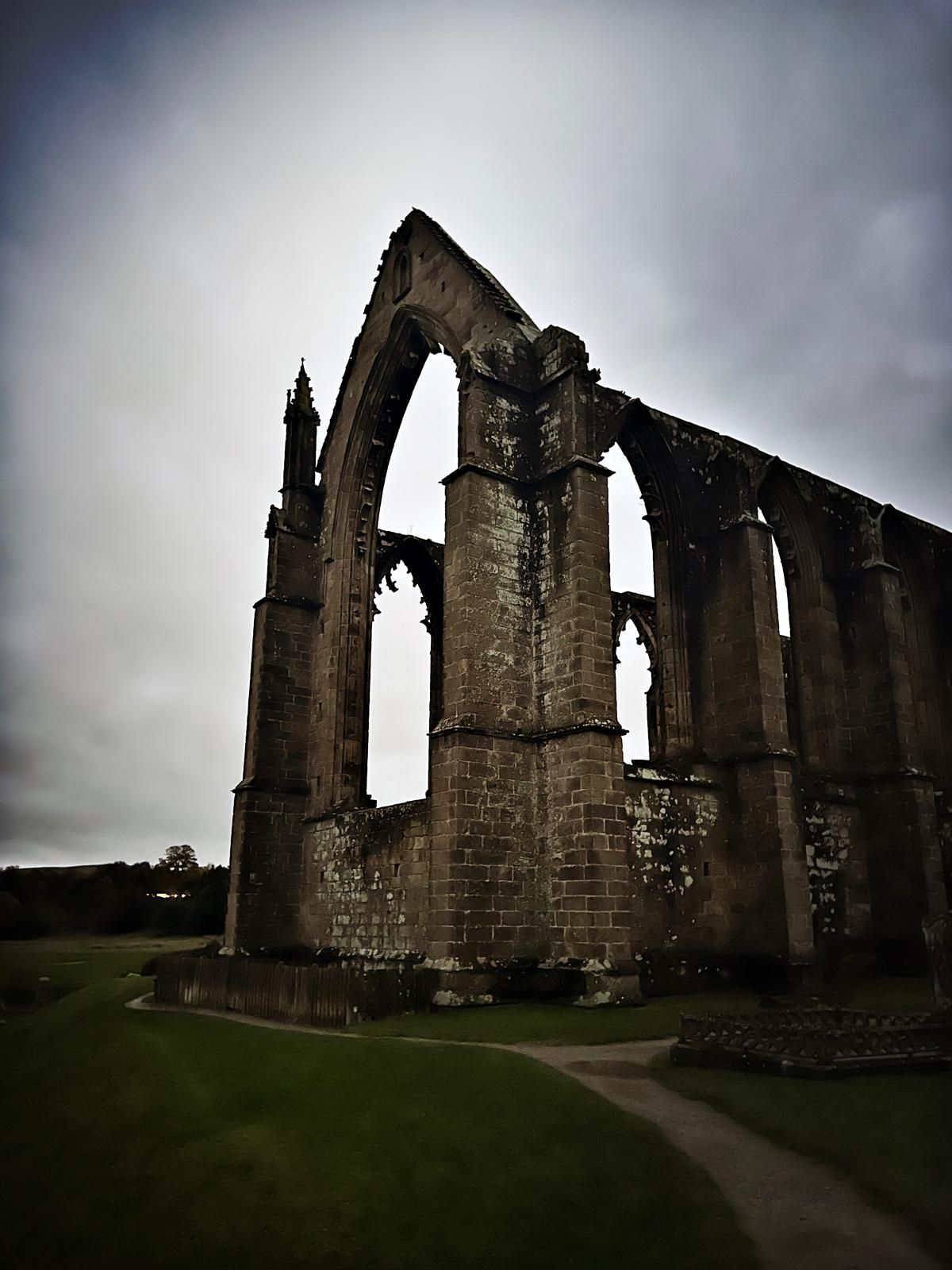 Yorkshire · The DalesBolton Abbey to SkiptonA ruined priory on the River Wharfe and one of England's most complete medieval castles, a few miles apart at the bottom edge of the Yorkshire Dales. Easy to pair, and easy to pair with Haworth too.
 Yorkshire · Mills and moorsSaltaire, EnglandOne mill owner built a whole village for his workers. The mill is now full of David Hockney's art and one of the biggest bookshops you'll ever wander round. I nearly skipped it. Don't.
Sources
- Brontë Society: Plan your visit (hours, tickets, no timed entry)
- Brontë Society: Getting here
- Brontë Society: The Brontës' Haworth
- Brontë Society: History of the museum
- Wikipedia: Brontë Parsonage Museum (built 1778–79; 1928 gift; Charlotte's desk)
- Wikipedia: St Michael and All Angels' Church, Haworth
- Wikipedia: Keighley & Worth Valley Railway
- KWVR: The Railway Children line
- Wikipedia: To Walk Invisible
- Brontë Society: 10 years of To Walk Invisible
- Bradford 2025: Penistone Hill and Top Withens walk leaflet
- Sunrise Radio: Final stone to commemorate Brontës installed (Anne Stone, Parson's Field)
- Project Gutenberg: Gaskell, The Life of Charlotte Brontë, Vol. 1
- Project Gutenberg: Gaskell, The Life of Charlotte Brontë, Vol. 2
- Project Gutenberg: Gaskell, Life of Charlotte Brontë, Vol. 1, plain text (upstairs rooms, children's study, aunt's bedroom, Branwell in his father's room)
- Brontë Society: Inside the Museum (room names: Charlotte's Room, Children's Study, Mr Brontë's Bedroom, Branwell's Studio)
- Brontë Society: The Museum (writing desks, letters, clothes, furniture)
- Brontë Society: Our collections (largest variety of original Brontë items)
- Brontë Society: A new chapter (Parsonage gifted 4 August 1928)
- The Sisters' Room: Virtual tour, Charlotte's Room (room use over time)
- The Sisters' Room: Virtual tour, the Children's Study (Emily; enlarged Charlotte's room)
- Malcolm Bull's Calderdale Companion: Brontë family (Parsonage rooms)
- Country Life: Inside Haworth (Wade's gabled extension, 1878)
- The Yorkshire Journal: The Brontë museums and collections at Haworth (1861 auction, Nicholls, 1907/1914/1916 sales, Bonnell, Wade wing)
- Wikipedia: Arthur Bell Nicholls (1861 auction; sales 1907, 1914, 1916)
- Keighley & Worth Valley Railway: Timetable
Get the reading list first.
Trip announcements, curated reading lists, and the occasional dispatch — before anyone else.