Ireland · The Burren
Poulnabrone dolmen: the Burren's 5,000-year-old portal tomb
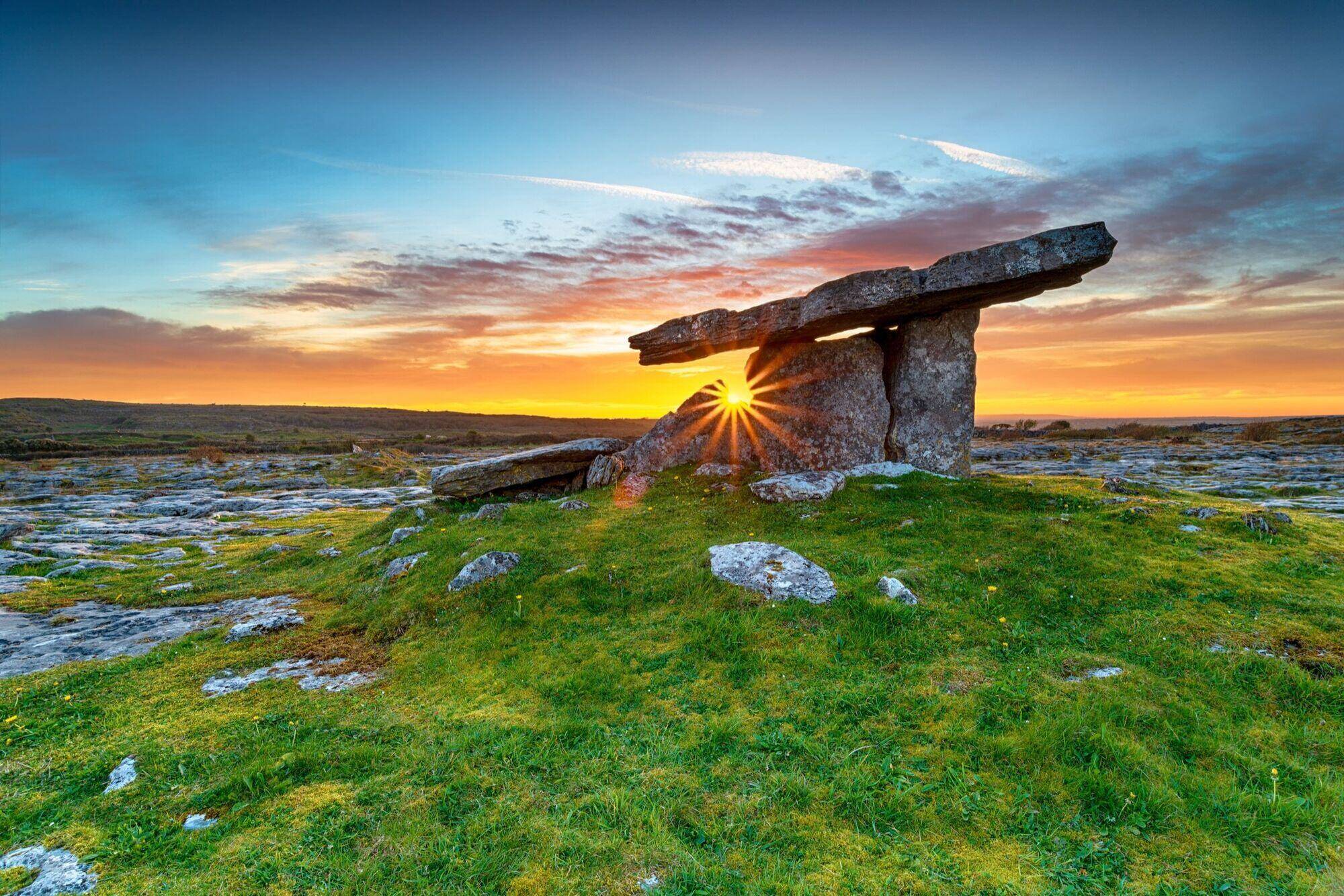
A Neolithic portal tomb on the limestone of the Burren, County Clare, where the remains of more than 30 people were found. It's older than Stonehenge's stone circle, and you can walk right up to it.
- What
- Portal tomb (dolmen), a single-chamber Neolithic tomb
- Where
- Kilcorney townland, the Burren, County Clare
- Date of burials
- About 3800–3200 BC, plus one infant about 1750–1420 BC
- People found
- About 33 (estimates range from at least 28 to about 36)
- Capstone
- About 3.9 m long, 2–3 m wide, 0.3 m thick
- Name
- Poll na Brón, 'hole of the quernstone'
The short answer
Poulnabrone dolmen is a Neolithic portal tomb in the Burren, County Clare, Ireland. Excavations in 1986 and 1988 found the remains of about 33 people, dated by radiocarbon to between about 3800 and 3200 BC. It is a state-owned National Monument in the care of the Office of Public Works, open to visitors as an unguided site.
Poulnabrone dolmen is a Neolithic tomb on the limestone of the Burren in County Clare. It’s a portal tomb: two tall stones at the front and side stones behind, holding up a single tilted capstone, standing on bare limestone pavement. It was excavated in the 1980s with modern methods, so we know a surprising amount about the people buried in it. Below: how old Poulnabrone dolmen is, who was buried there, what the name means, the stories attached to tombs like it, and how to visit without the coach crowd.
Where is Poulnabrone dolmen?
Poulnabrone is in the townland of Kilcorney, in the high central part of the Burren in north-west County Clare. Heritage Ireland describes it as standing at one of the highest points of the Burren. It sits beside the R480, the road that runs north–south through the Burren between Ballyvaughan and Leamaneh Castle.
It’s about 8 km south of Ballyvaughan, and a few minutes’ drive from Caherconnell stone fort. Doolin and the Cliffs of Moher are further south-west, beyond Lisdoonvarna.
How old is Poulnabrone?
Radiocarbon dates from the bones show the tomb was used for burial between about 3800 and 3200 BC, in the early Neolithic. That makes it more than 5,000 years old. To put that in perspective: people were already being buried here centuries before the great stone circle went up at Stonehenge.
The tomb was then used again, much later. An infant was buried just outside the entrance in the Early Bronze Age, between about 1750 and 1420 BC.
What the excavation found
In the 1950s a survey spotted a crack in the eastern portal stone, and by the early 1980s it looked likely to bring the whole tomb down. Ann Lynch, Senior Archaeologist at the National Monuments Service, led conservation and excavation work in 1986 and 1988. During the 1986 work the capstone was raised on a wooden scaffold to take the pressure off the cracked stone. (So the reason we know so much is that it nearly fell over.)
What she found, according to Heritage Ireland and the published summary on Wikipedia:
The people
- The remains of about 33 people. The detailed bone count gives a minimum of 28, and more likely about 36.
- At least 17 were adolescents or younger.
- Wear on the teeth points to a coarse, mostly plant-based diet with little meat.
- One young or middle-aged man had a healed, oval dent in his skull, possibly from a sling stone.
- Another person had the tip of a triangular stone arrowhead lodged in the right hip bone, probably shot from behind.
The objects
- A polished stone axe
- A bone pendant and part of a mushroom-headed bone pin
- Two stone disc beads
- Two large quartz crystals
- Flint and chert scrapers and arrowheads
- About 60 shards of coarse pottery
Lynch published the full report in 2014, if you want the detail.
How Poulnabrone was built
| Part | Size |
|---|---|
| Capstone | About 3.9 m long, 2–3 m wide, 0.3 m thick |
| Chamber | About 2.8 m long, narrowing to the east |
| Surviving cairn | Extends an average of about 3 m from the chamber |
The side stones stand directly on the bedrock. The capstone slopes upward toward the west. A low cairn of stones once surrounded the chamber, and the whole tomb was probably covered with soil. Only the stone frame and part of the cairn are left. A large slab lying behind the tomb may have been a second capstone.
That’s the part most photos don’t tell you: what you see is the skeleton of the tomb, not how it looked when it was in use.
Poulnabrone dolmen in Ireland’s family of portal tombs
Ireland has about 172 recorded dolmens, spread across the island. The basic plan is the same: tall portal stones forming an entrance, side stones making a chamber, and one heavy capstone laid across the top. Two things make Poulnabrone stand out. It stands on bare limestone, so the whole structure is visible against the sky from a distance. And it’s been excavated with modern methods and radiocarbon dating, so we know roughly when it was used, how many people were placed in it, what they ate and how some of them were hurt. At Poulnabrone the portal stones are at the lower, eastern end, and the capstone rises toward the west.
What does Poulnabrone mean?
The name comes from the Irish Poll na Brón. The usual translation is “hole of the quernstone,” a quern being a hand-mill for grinding grain. You’ll also see “hole of sorrows,” because brón can also mean sorrow in Irish. Guess which one the postcards prefer.
Poulnabrone in myth and story
Portal tombs and wedge tombs are part of the old story-landscape of Ireland, and people have told stories about them for a long time.
Diarmuid and Gráinne’s beds. In the medieval tale The Pursuit of Diarmuid and Gráinne, Gráinne, promised to the aging Fionn mac Cumhaill, runs away with Fionn’s young warrior Diarmuid. They’re chased across Ireland and sleep somewhere different every night. Across Ireland, many flat-roofed Neolithic monuments, including dolmens and wedge tombs, carry the local name “Diarmuid and Gráinne’s Bed” (Leaba Dhiarmada agus Ghráinne). You’ll see websites attach that name to Poulnabrone. We couldn’t find any local record calling Poulnabrone by that name, so treat it as a general tradition about tombs like this one, not a fact about this one.
The old gods in the hills. In Irish myth, the Tuatha Dé Danann went into the hills and ancient mounds and became the Sídhe, the fairy folk. Our guide to fairies in Irish folklore goes further into those beliefs.
How to visit Poulnabrone dolmen
- Access. It’s an unguided outdoor site in the care of the Office of Public Works, and there’s no ticket. Heritage Ireland asks visitors to take care at all times on the uneven ground.
- Parking. Clare County Council opened a car park in 2007 to take cars and coaches off the narrow road. From there it’s a short walk over uneven ground to the tomb.
- The ground. The tomb stands on limestone pavement with deep cracks (grikes). Wear shoes with a good grip, especially when the rock is wet.
- Respect the monument. It’s a protected National Monument. Don’t climb on it, sit on it or move stones. Yes, even for the photo.
- Best time. Early morning or evening is usually quieter than the middle of the day, when the coaches come through. In late June the sun sets after 10pm, so there’s plenty of evening light.
- Combine it. Caherconnell stone fort, which dates back to the 10th century and runs sheepdog demonstrations, is a few minutes away. Aillwee Cave is on the same road, the R480, toward Ballyvaughan.
The Burrenbeo Trust’s Burren Archaeology Festival, held in Ballyvaughan on 20–21 June in 2026, included talks by Dr Ann Lynch, the archaeologist who excavated Poulnabrone. If a future festival falls on your dates, go. It’s not often you can hear about a dig from the person who led it.
Other tombs and monuments in the Burren
Poulnabrone is one of about 70 megalithic tombs in the Burren, and about 90 percent of those are wedge tombs. The region also has almost 500 stone ring forts. Our Burren guide covers the main ones, including Caherconnell, Cahercommaun and Corcomroe Abbey, plus the geology and the June flowers on the pavement around the tomb.
Poulnabrone on our trip
On our Midsummer in the Burren trip in June 2028, Poulnabrone comes after a guided folklore and fairy-fort walk on the Burren, followed by Caherconnell stone fort. By then the group has spent months reading the stories of the Tuatha Dé Danann, so it isn’t just a photo stop.
How we came to know Poulnabrone: what else was happening
The tomb was in use from about 3800 to 3200 BC, so it was already old when the first stones went up at Stonehenge and when the pyramids at Giza were built. Everything we know about it comes from much later: the antiquarians of the 1890s, Ireland's tomb surveys, and the 1986 dig, the same year Stonehenge became a World Heritage Site.
- Union with Britain 1801–1922
- Irish Free State 1922–1949
- Republic of Ireland 1949–2026
The story Ireland and Britain The wider world Other writers
- 3800 BC The story Around this time people begin placing their dead at Poulnabrone; burials continue for about 600 years, to about 3200 BC.
- 1898 The story Thomas Westropp publishes his survey of the prehistoric forts and dolmens of north Clare.
- 1904 Other writers Lady Gregory publishes Gods and Fighting Men, with the story of Diarmuid and Gráinne on the run.
- 1922 Ireland and Britain The Irish Free State is founded.
- 1922 The wider world Howard Carter finds Tutankhamun's tomb in Egypt in November.
- 1949 Ireland and Britain Ireland becomes a republic.
- 1961 The story De Valera and Ó Nualláin publish the megalithic tomb survey for County Clare.
- 1962 Ireland and Britain Michael O'Kelly begins excavating Newgrange, the passage tomb in County Meath.
- 1966 Other writers Seamus Heaney publishes Death of a Naturalist.
- 1967 Ireland and Britain On 21 December, O'Kelly sees the midwinter sunrise light up the chamber at Newgrange.
- 1986 The story With the cracked portal stone threatening collapse, Ann Lynch excavates and conserves the tomb. It passes into State guardianship.
- 1986 The wider world Stonehenge and Avebury become a UNESCO World Heritage Site.
- 1988 The story The second season of excavation and conservation. Lynch publishes 'Poulnabrone: A Stone in Time'.
- 1991 Ireland and Britain Burren National Park opens, a few miles to the south-east.
- 1993 Ireland and Britain Brú na Bóinne, with Newgrange, becomes a UNESCO World Heritage Site.
- 2005 The story An estimate puts annual visitors at about 200,000.
- 2007 The story Clare County Council opens a car park, taking cars and coaches off the narrow road.
- 2011 Ireland and Britain The Burren and the Cliffs of Moher become a UNESCO Global Geopark.
- 2014 The story Lynch publishes the full excavation report, Poulnabrone: An Early Neolithic Portal Tomb in Ireland.
- 2026 The story Lynch speaks at the Burren Archaeology Festival in Ballyvaughan, 20–21 June.
Questions people ask
How old is Poulnabrone dolmen?
Radiocarbon dates from the human remains show the tomb was used for burial between about 3800 and 3200 BC, in the early Neolithic. That makes it more than 5,000 years old. An infant was also buried at the entrance much later, between about 1750 and 1420 BC.
What does Poulnabrone mean?
Poulnabrone comes from the Irish Poll na Brón, usually translated as 'hole of the quernstone'. It is sometimes translated as 'hole of sorrows'.
Who was buried at Poulnabrone?
Excavation found the remains of about 33 people, men, women and children, with at least 17 of them adolescents or younger. Their teeth point to a mostly plant-based diet, and two individuals show injuries, including a stone arrowhead tip lodged in one hip bone.
Can you visit Poulnabrone dolmen?
Yes, and it's free. Poulnabrone is an unguided site in the care of the Office of Public Works, and a car park was opened near it in 2007. Don't climb on the stones, and check Heritage Ireland for any current notices.
Is Poulnabrone a dolmen or a portal tomb?
Both terms are used. Dolmen is the general word for a tomb of upright stones with a capstone. Portal tomb is the archaeologists' term for this type, which has two tall portal stones at the entrance supporting a sloping capstone.
Is Poulnabrone called Diarmuid and Gráinne's bed?
Many dolmens and wedge tombs in Ireland carry the local name Diarmuid and Gráinne's Bed, from the story of the lovers who slept in a different place each night while Fionn chased them. We found no record of Poulnabrone itself being called that.
Read next
- Ireland · The BurrenAillwee Cave, Ballyvaughan, County ClareA show cave under Aillwee hill in the Burren, found by a farmer and his dog in 1944, with a Birds of Prey Centre on the same site. Good for a wet morning.
- Ireland · The BurrenBallyvaughan, County ClareA small village on Galway Bay at the north edge of the Burren, and the country house hotel 5 km to the south where we spend our week.
- Ireland · Irish MythThe Tuatha Dé DanannThe old gods of Ireland, from their arrival in a cloud to their retreat into the hills, with Lugh, Balor and the Children of Lir.
- Ireland · County ClareDoolin, IrelandA spread-out village on the Clare coast between the Burren and the Cliffs of Moher. People come for the music, the shortest ferry to the Aran Islands, and the walk to the cliffs.
Sources
- Heritage Ireland: Poulnabrone Portal Tomb
- Wikipedia: Poulnabrone dolmen (1898 Westropp, 1961 survey, 1986 guardianship, 2005 visitor estimate, 2014 report)
- Wikipedia: The Burren
- Wikipedia: The Pursuit of Diarmuid and Gráinne
- Burrenbeo Trust: Burren Archaeology Festival 2026
- Caherconnell Stone Fort
- The Irish Road Trip: Poulnabrone Dolmen
- Gregans Castle Hotel: directions (R480 past Aillwee)
- Wikipedia: Newgrange (O'Kelly excavation from 1962; 1967 solstice; 1993 World Heritage)
- Wikipedia: Stonehenge (World Heritage Site 1986)
Get the reading list first.
Trip announcements, curated reading lists, and the occasional dispatch — before anyone else.