Ireland · Irish Myth
Irish mythology: the gods, creatures and stories, and where they happened
The main stories, the gods and creatures, who's who, the books worth reading, and the real places in Ireland where it all happens.
- Main written sources
- Lebor Gabála Érenn (compiled late 11th century), Cath Maige Tuired, Táin Bó Cúailnge
- Oldest manuscript in Irish
- Lebor na hUidre (Book of the Dun Cow), written at Clonmacnoise before 1106
- Four cycles
- Mythological, Ulster, Fenian, Cycles of the Kings
- The old gods
- The Tuatha Dé Danann, who in the stories withdraw into the hills and become the Sídhe (fairy folk)
- Free to read
- Lady Gregory, Gods and Fighting Men (1904), on Project Gutenberg
- Best region for myth places
- The west: Clare, Galway, the Aran Islands, Sligo, Roscommon, Mayo
- Our trip
- Midsummer in the Burren, 17 to 25 June 2028
The short answer
Irish mythology is the body of stories written down by Irish monks and scholars in the Middle Ages about the old gods (the Tuatha Dé Danann), the hero Cú Chulainn, Fionn mac Cumhaill and the Fianna, and Ireland's early kings. Scholars group it into four cycles: the Mythological Cycle, the Ulster Cycle, the Fenian Cycle and the Cycles of the Kings. Alongside it runs Irish folklore, the beliefs about fairies, banshees, selkies and fairy forts that country people still told in the 20th century.
Irish mythology is two things at once. There are the stories about gods, heroes and kings that Irish monks wrote down in the Middle Ages, and there are the folk beliefs about fairies and the dead that country people were still telling when Yeats, Lady Gregory and the 1930s Schools’ Collection wrote them down. This guide covers both: the four story cycles, the gods, a who’s who of the names you’ll keep meeting, the creatures and animals, and the books worth your time. Then it does the part most guides skip. It maps the stories to the real places in Ireland where they’re set, with the most detail for County Clare and the west, where our June 2028 trip is based.
What is Irish mythology?
The stories survive because medieval Christian scholars copied them into manuscripts. (Yes, monks. We owe the pagan gods to the people who’d replaced them.) The most important are:
- Lebor Gabála Érenn (“The Book of the Taking of Ireland”), compiled late in the 11th century and preserved in the Book of Leinster (about 1150) and later manuscripts. It tells how a series of peoples invaded Ireland, ending with the Gaels. Most scholars read it as myth dressed up as history.
- Cath Maige Tuired (“The Second Battle of Moytura”), the main story of the old gods’ war with the Fomorians. Whitley Stokes published an English translation in 1891, and you can read it free through CELT at University College Cork.
- Táin Bó Cúailnge (“The Cattle Raid of Cooley”), the great epic of the Ulster hero Cú Chulainn.
Scholars sort the stories into four groups, called cycles:
| Cycle | What it’s about | Best-known stories |
|---|---|---|
| Mythological Cycle | The Tuatha Dé Danann (the old gods) and the peoples who came before and after them | The two battles of Moytura, the Children of Lir, the Wooing of Étaín |
| Ulster Cycle | The heroes of King Conchobar’s court in Ulster | The Táin, Deirdre of the Sorrows, the death of Cú Chulainn |
| Fenian Cycle | Fionn mac Cumhaill and his war band, the Fianna | The Salmon of Knowledge, Diarmuid and Gráinne, Oisín in Tír na nÓg |
| Cycles of the Kings | Legendary and semi-historical kings of Ireland | Stories running up to Brian Boru |
The cycles overlap, and some stories don’t fit any of them neatly. The labels are a modern convenience; the medieval writers didn’t use them.
How old is Irish mythology?
Older than the paper it’s on. The oldest surviving manuscript in Irish, Lebor na hUidre (the Book of the Dun Cow), was written at Clonmacnoise before 1106, the year one of its scribes was killed there. Scholars date the language of some of the stories, including the earliest version of the Táin, to around the 8th century. And some of the gods go back further still: Lugh is the Irish form of Lugus, a god known across the Celtic world, whose name is probably in Lugdunum, the Roman name for Lyon.
Are Irish and Celtic mythology the same?
Irish mythology is one part of Celtic mythology, and by far the biggest part that survives in writing. “Celtic” also covers the Welsh stories collected as the Mabinogion and the Gaelic stories of Scotland, and the gods sometimes match up: Lugh in Ireland is Lleu in Wales.
Irish vs Scottish mythology? They’re close cousins, because Gaelic Scotland and Ireland shared a language and a stock of stories. Fionn mac Cumhaill turns up in Scotland as Fingal (Fingal’s Cave on Staffa is named after him), and in 1760 James Macpherson made Fionn’s son Oisín famous across Europe as “Ossian,” a Scottish bard. Scotland has more selkies; Ireland has more written-down gods. Our page on the selkie myth covers the stories the two coasts share.
The invasions: who came to Ireland in the myths
Lebor Gabála Érenn says Ireland was settled six times. In order: Cessair, Partholón, Nemed, the Fir Bolg, the Tuatha Dé Danann, and finally the Milesians, the ancestors of the Gaels.
The Tuatha Dé Danann arrive, in Lady Gregory’s 1904 retelling, “in a mist … through the air and the high air to Ireland.” The written sources explain the mist: they burned their ships on landing so they couldn’t retreat. (Practical people, gods.) They beat the Fir Bolg at the First Battle of Moytura, then fought the Fomorians at the Second. When the Milesians came, the poet Amergin divided the land, giving the Milesians the surface and the Tuatha Dé the world under the hills. That’s where the fairy folk come from. For the full story, the four treasures and a family tree, see our guide to the Tuatha Dé Danann.
Irish mythology gods and goddesses
| Name | Known for |
|---|---|
| The Dagda | ”The great god”; owner of the cauldron that no company left unsatisfied; father of Aengus Óg and Bodb Dearg |
| Lugh | Master of every art; kills his grandfather Balor at the Second Battle of Moytura |
| Nuada | King of the Tuatha Dé; loses his arm and gets a silver one from Dian Cécht |
| The Morrígan | Battle goddess and shape-shifter, often a crow; meets the Dagda at Samhain; prophesies the end of the world |
| Brigid | Goddess of poetry, healing and smithwork |
| Manannán mac Lir | Sea god; hides the Tuatha Dé in the hills after their defeat |
| Aengus Óg | Son of the Dagda and Boann; lives at Brú na Bóinne |
| Dian Cécht, Miach and Airmed | The healers; Dian Cécht kills his son Miach out of jealousy |
| Ériu, Banba, Fódla | Three goddesses who ask that the island be named for them; Ériu gives us Éire |
The Morrígan gets her own page: who the Morrígan is, her symbols, and how she turns up in fantasy books.
Who’s who in Irish mythology
The same dozen names come up again and again, and half of them are spelled three ways. Here’s who they are:
| Name | Who they are |
|---|---|
| Aengus (Aengus Óg) | Son of the Dagda and Boann, god of love and youth, living at Brú na Bóinne. In The Dream of Aengus he falls for Caer, a girl he sees only in dreams, who turns out to be a swan every other year; at Samhain he becomes a swan too and flies off with her |
| Maeve (Medb) | Queen of Connacht at Rathcroghan. She starts the Táin to take the Brown Bull of Cooley, so she’ll own a bull as good as her husband Ailill’s. Tradition puts her grave in the cairn on Knocknarea, County Sligo |
| Cú Chulainn (Setanta) | The Ulster hero. As the boy Setanta he kills the hound of the smith Culann and offers to guard the house himself, so he’s renamed “Culann’s hound” |
| Fionn mac Cumhaill | Leader of the Fianna; gets his wisdom from the Salmon of Knowledge |
| Oisín | Fionn’s son by Sadhbh, the deer-woman. He rides to Tír na nÓg with Niamh and comes back 300 years later; the moment he touches Irish ground he’s an old man |
| Niamh | Niamh of the Golden Hair, from Tír na nÓg, who takes Oisín away |
| Oscar | Oisín’s son, Fionn’s grandson, killed at the Battle of Gabhra |
| Lugh | The god of every skill; see the Tuatha Dé Danann |
| Balor | The Fomorian with the eye that destroys whatever it looks at; Lugh’s grandfather and killer |
| Lir | Father of the Children of Lir, turned into swans for 900 years |
| Aoife | Two of them: the jealous stepmother of the Children of Lir, and the warrior woman who bears Cú Chulainn’s son |
| Macha | One of the Morrígan’s sisters; also the woman who races the king’s horses while pregnant and curses the men of Ulster. Emain Macha, the Ulster capital, carries her name |
| Deirdre | Deirdre of the Sorrows, promised to King Conchobar, who runs away with Naoise; it ends badly |
| Emer | Cú Chulainn’s wife |
| Fergus mac Róich | A former king of Ulster who fights for Maeve in the Táin |
What is heaven in Irish mythology?
There’s no single heaven. The stories have an Otherworld, and it has several addresses: inside the fairy mounds, or across the western sea in places like Tír na nÓg (the Land of Youth) and Mag Mell (the Plain of Delight). Nobody gets old there, which is exactly what goes wrong for Oisín when he comes home.
What is Tara in Irish mythology?
The Hill of Tara, County Meath, is the seat of the high kings in the stories. It’s where the Tuatha Dé kept the Lia Fáil, the Stone of Destiny, which Stokes’s translation says “used to roar under every king that would take the realm of Ireland,” and it’s where Lugh talks his way into Nuada’s court by being master of every art at once. You can walk the hill today, and a standing stone there carries the Lia Fáil name. It’s on the east side of the country, about an hour from Dublin; our trip doesn’t go there.
Irish mythology by place: what happened where
Much of Irish mythology is attached to real hills, lakes, cliffs and stones. The medieval writers loved place-name stories (the dindsenchas), and later country people pointed out which field or rock belonged to “the Others.” Save this table. More detail on Clare and the west below it.
| Place | County | What the stories say happened there |
|---|---|---|
| Cliffs of Moher (Hag’s Head, Aill na Searrach) | Clare | The hag Mal chases Cú Chulainn and falls to her death; seven foals of the Tuatha Dé gallop off the cliff |
| Craglea (Craig Liath), near Killaloe | Clare | Home of Aoibheall, fairy queen of north Munster |
| Lough Graney | Clare | Setting for the opening of Brian Merriman’s The Midnight Court, where Aoibheall holds court |
| Latoon, near Newmarket-on-Fergus | Clare | A fairy bush kept in a new road scheme in 1999 |
| Corcomroe Abbey, the Burren | Clare | Yeats set his ghost play The Dreaming of the Bones here |
| Dún Aonghasa, Inis Mór | Galway | Cliff-edge stone fort said to have been built by Aonghus of the Fir Bolg |
| Lough Gur | Limerick | Lake of Áine, fairy queen of Munster; the Grange stone circle |
| Moytura, near Cong | Mayo | By tradition, the First Battle of Moytura (Tuatha Dé against the Fir Bolg) |
| Moytura, Lough Arrow | Sligo | By tradition, the Second Battle of Moytura (Tuatha Dé against the Fomorians) |
| Rathcroghan and Oweynagat | Roscommon | Queen Medb’s royal seat; the cave the Morrígan comes out of |
| Tara (Teamhair) | Meath | The Lia Fáil, which roared under the rightful king |
| Brú na Bóinne and the River Boyne | Meath | Home of Aengus Óg; where Fionn burns his thumb on the Salmon of Knowledge |
| Lough Derravaragh | Westmeath | The first 300 years of the Children of Lir as swans |
| Ben Bulben (Beinn Gulbain) | Sligo | The boar hunt where Diarmuid dies |
County Clare and the Burren
The Cliffs of Moher. The Cliffs of Moher Experience tells four local legends. The witch Mal fell for Cú Chulainn, who didn’t return her feelings, and chased him across Ireland. At the cliffs he leapt to a sea stack and back; she tried the same jump, fell short and died on the rocks. Hag’s Head is said to carry her profile, and Malbay (Miltown Malbay) her name. In the second, after Christianity came, the Tuatha Dé turned themselves into horses and hid in caves; seven foals came out, were blinded by the light and galloped off the edge, which is why one stretch is called Aill na Searrach, the Cliff of the Foals. The third is the mermaid of Moher, whose cloak a fisherman hid so she’d marry him (the same plot as the selkie stories). The fourth is the sunken city of Kilstiffin, said to rise every seven years. Our guide to the Cliffs of Moher covers the visiting part: tickets, parking, the walk.
Craglea and Lough Graney, east Clare. Aoibheall (also spelled Aibell or Eevul) was the fairy queen of Thomond, north Munster. Her home was the grey rock of Craig Liath, about two miles north of Killaloe, and a holy well on the slopes, Tobar Aoibheail, still carries her name (Clare Heritage). In 1780 the Clare poet Brian Merriman made her the judge of Cúirt an Mheán Oíche (The Midnight Court), a long comic poem in Irish about love and marriage, in which the women of Ireland bring their complaints against the men to her fairy court. It opens on the shore of Lough Graney. (A fairy queen hearing women’s complaints about men, in 1780. It holds up.) Lady Gregory has Aoibheall at Craig Liath too, falling for a young man of Munster before the Battle of Clontarf.
The Burren and Corcomroe. Corcomroe Abbey is a ruined Cistercian abbey in the north Burren. Yeats set The Dreaming of the Bones (published 1919) on the road to it: two ghosts wander the Burren hills, and they turn out to be Diarmait Mac Murchada and Derbforgaill, the pair blamed in Irish tradition for bringing the Normans to Ireland.
Feakle and Latoon. Two pieces of Clare fairy belief are well documented. Biddy Early (1798–1874) was a healer at Feakle whose power, people said, came from the fairies through a bottle. Lady Gregory went looking for her house near Feakle and was told she’d died about twenty years before. And in 1999 the storyteller Eddie Lenihan led a campaign to save a whitethorn fairy bush at Latoon, on the line of the new Ennis bypass. The council agreed in May 1999 to keep the bush within the road scheme, and the story made the international papers. More on both in our guide to fairies in Irish folklore.
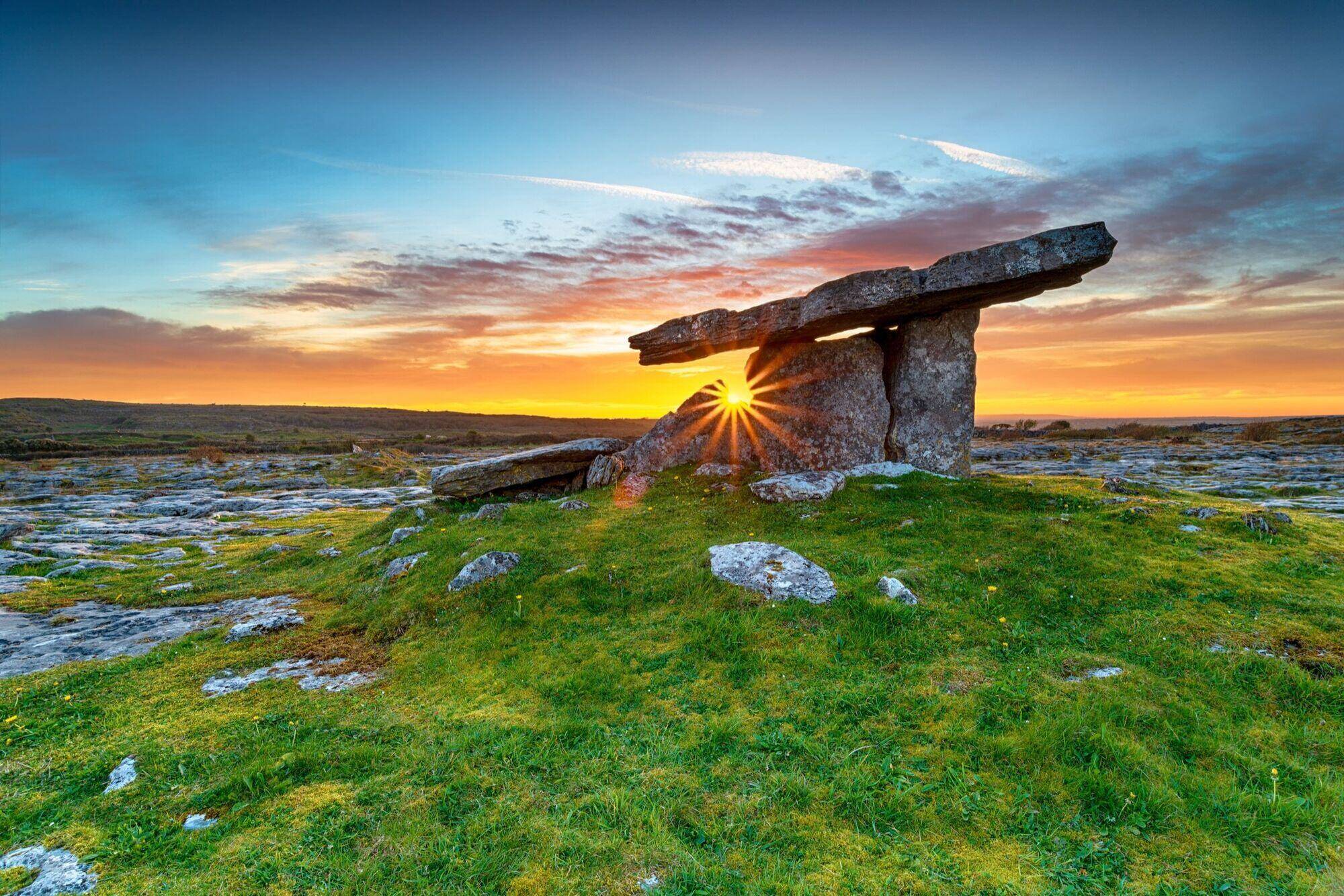
Poulnabrone. The famous portal tomb in the Burren is about 5,000 years old, much older than any of these stories. No medieval tale is set there, whatever the tour leaflets imply. See our guide to the Burren, which covers Poulnabrone.
Galway and the Aran Islands
Dún Aonghasa, Inis Mór. A huge stone fort on the edge of a sea cliff. Tradition says Aonghus mac Úmhór of the Fir Bolg built it. Archaeology puts its first phase in the Late Bronze Age, around 1100 BC, with the outer walls added later.
Coole Park and Kiltartan, near Gort. This is where Lady Gregory lived and where she collected fairy beliefs from her neighbors, which became Visions and Beliefs in the West of Ireland (1920). One old man told her: “There’s some places of their own we should never touch such as the forths.” (A “forth” is a fairy fort.)
Limerick: Lough Gur
Lough Gur is linked to Áine, the fairy queen of Munster, whose hill, Cnoc Áine, is nearby. Lady Gregory notes that some said Áine “was the Morrigu herself.” The Grange stone circle beside the lake is the largest in Ireland, with 113 stones, and the Lough Gur site says it lines up with the Midsummer sunrise. That’s why we’re there on Midsummer.
Elsewhere in the west and midlands
- Moytura. Tradition puts the First Battle near Cong, County Mayo (Mayo.ie), and the Second on the ridge by Lough Arrow, County Sligo. Some scholars think both were in Sligo.
- Rathcroghan, County Roscommon. The royal center of Connacht and Queen Medb’s home in the Táin. Its cave, Oweynagat (“cave of the cats”), was called a gate to the Otherworld, and the Morrígan comes out of it.
- Tara, County Meath. The Lia Fáil, the Stone of Destiny, was brought by the Tuatha Dé. See the Tara section above.
Irish folklore creatures
Irish folklore is the younger, spoken layer: what people believed about the world just past their own fields. Yeats’s Fairy and Folk Tales of the Irish Peasantry (1888) split the creatures into “trooping” fairies, who live and travel in groups, and “solitary” ones. The main Irish folklore creatures are:
- The Sídhe (aos sí, the “good people,” “the gentry”). The fairy folk, said to be the Tuatha Dé Danann living inside the hills.
- The banshee (bean sí, “woman of the fairy mound”). A woman whose keening warns that someone in a particular family is about to die.
- The púca. A solitary spirit abroad on November Eve (Samhain); Yeats says the blackberries are no longer fit to eat after that night, “for the pooka has spoiled them.”
- The leprechaun. A solitary fairy shoemaker. Yeats quotes Douglas Hyde that the name comes from leith brog, “one-shoemaker.”
- The far darrig (fear dearg, “red man”). A solitary prankster.
- The dullahan. A headless phantom, sometimes driving a coach, counted among the omens of death.
- The merrow or mermaid (maighdean mhara). Sea women who could come ashore and marry.
- The selkie. Seal people who take off their skins on land. See the selkie myth.
- The changeling. A fairy left in place of a stolen baby or bride.
Are leprechauns Irish mythology?
Barely. The earliest known mention is in a medieval tale, Echtra Fergusa maic Léti, in which King Fergus wakes on a beach to find three lúchorpáin, small water spirits, dragging him into the sea. He catches them, and they give him three wishes to let them go. That’s about it for leprechauns in the old stories; as the Wikipedia summary puts it, they only became prominent in later folklore. And the green suit is modern. Older accounts dressed him in red.
Are there dragons in Irish mythology?
Not the fire-breathing, winged sort you’d find in English or Norse stories. Ireland has the péist or ollphéist (“great worm”), a serpent-like monster living in a lake or river. The best known is the Caoránach, said to be driven into Lough Derg in Donegal by St Patrick; the lake’s name, “red lake,” is explained by its blood. If you’re after dragons in a book, you want romantasy, not the Táin.
Irish mythology animals
Animals are everywhere in the old stories, often as people under a spell.
| Animal | Story |
|---|---|
| Salmon | The Salmon of Knowledge in the Boyne; Fionn burns his thumb cooking it and gets its wisdom |
| Swans | The Children of Lir, turned into swans by their stepmother Aoife for 900 years |
| Hounds | Bran and Sceólan, Fionn’s dogs, born to his aunt Tuiren while she was under a spell as a hound |
| Deer | Sadhbh, Fionn’s wife, put under a spell as a fawn; mother of Oisín |
| Crow | The Morrígan’s battle shape; a crow or raven on Cú Chulainn’s shoulder shows his enemies he is dead |
| Bull | The Brown Bull of Cooley, the prize in the Táin |
| Boar | The boar of Ben Bulben, which kills Diarmuid |
| Horses | The seven foals of the Tuatha Dé at the Cliffs of Moher |
| Seals | Selkies; one of Lady Gregory’s storytellers warned it is “not right to touch” a seal |
Amergin’s song on landing in Ireland, as Lady Gregory gives it, runs through several of them: “I am the bull of seven battles; / I am the eagle on the rock … I am a strong wild boar; / I am a salmon in the water.”
Books on Irish folklore and mythology
If you only read one, make it Lady Gregory’s Gods and Fighting Men. It’s free, it’s plain, and it’s the one most later retellings lean on.
| Book | Author | Year | Why read it |
|---|---|---|---|
| Fairy and Folk Tales of the Irish Peasantry | W. B. Yeats (ed.) | 1888 | The classic sorting of Irish fairies; free on Project Gutenberg |
| Gods and Fighting Men | Lady Gregory | 1904 | The Tuatha Dé Danann and the Fianna in plain prose; free online |
| Visions and Beliefs in the West of Ireland (two volumes) | Lady Gregory | 1920 | Fairy beliefs from Galway and Clare, in the speakers’ own words |
| The Táin | Thomas Kinsella (trans.) | 1969 | A landmark modern translation of the Cattle Raid of Cooley |
| Over Nine Waves: A Book of Irish Legends | Marie Heaney | 1994 | The main legends retold for adults in one volume |
| Meeting the Other Crowd | Eddie Lenihan | 2003 | Fairy stories from a County Clare storyteller |
For beginners: start with Heaney’s Over Nine Waves if you want everything in one modern volume, or Gregory if you’d rather not spend anything. Save Kinsella’s Táin for second; it’s brilliant and it’s blunt.
For translations of the medieval texts themselves, R. A. S. Macalister’s five-volume Lebor Gabála Érenn (Irish Texts Society, 1938–56) is the standard, and CELT at University College Cork hosts many texts online.
Irish myth in today’s romantasy
A lot of current fae romance borrows from these stories: courts of fairy folk who live under hills, bargains that can’t be broken, stolen humans and changelings. Sarah J. Maas gave the name Morrigan to a character in her A Court of Thorns and Roses series; Karen Marie Moning’s Fever novels make the Tuatha Dé Danann the fae. Our list of fae romance books ties each book to the myth behind it, including what The Cruel Prince does and doesn’t take from Ireland.
Seeing the places: our trip
Our Midsummer in the Burren trip is for up to 15 women, 17 to 25 June 2028, staying all eight nights at Gregans Castle Hotel in the Burren. One hotel, so you unpack once. From January to May 2028 the group reads fae romance and the Irish myths behind it, including Lady Gregory’s Gods and Fighting Men. In June we visit Poulnabrone and Caherconnell stone fort on a guided folklore and fairy-fort walk, walk to the Cliffs of Moher from Doolin with the legends of the mermaid and Hag’s Head, take the ferry to Dún Aonghasa, see Corcomroe, walk in Lady Gregory’s garden at Coole Park, and spend Midsummer at Lough Gur. A Clare storyteller tells fairy stories one evening at the hotel. For more books set in the region, see the Departure Shelf for the west of Ireland.
Irish myth on paper: from the monks to the Revival
The stories are far older than the books they survive in. Monks were copying them down around 1100, just before the Normans arrived, and 800 years later Yeats, Lady Gregory and the Gaelic League dug them back out, in the same years Bram Stoker was writing Dracula.
- Before the Normans 1014–1169
- Norman and English rule 1169–1801
- Union with Britain 1801–1922
- Independent Ireland 1922–1999
The story Ireland and Britain The wider world Other writers
- 3200 BC Ireland and Britain Around this time Newgrange is built in the Boyne valley, thousands of years before the stories made it the home of Aengus Óg.
- 1100 BC Ireland and Britain Around this time the first phase of Dún Aonghasa goes up on Inis Mór, long before legend gave it to the Fir Bolg.
- 1014 Ireland and Britain Brian Boru wins the Battle of Clontarf and is killed there. The Cycles of the Kings run up to him.
- 1106 The story Máel Muire mac Céilechair, one of the scribes of Lebor na hUidre, the oldest surviving manuscript in Irish, is killed at Clonmacnoise. The book holds the earliest version of the Táin.
- 1169 Ireland and Britain Anglo-Norman forces land in County Wexford. Irish tradition blamed Diarmait Mac Murchada and Derbforgaill, the ghosts in Yeats's Burren play.
- 1636 Ireland and Britain The Annals of the Four Masters are finished in Donegal; they record the 1106 killing at Clonmacnoise.
- 1760 Other writers James Macpherson publishes Fragments of Ancient Poetry, turning Fionn's son Oisín into the Scottish bard "Ossian."
- 1780 The story Brian Merriman, a Clare poet, writes The Midnight Court, with the fairy queen Aoibheall as judge.
- 1812 The wider world The Brothers Grimm publish the first volume of their fairy tales in Germany.
- 1825 Other writers Thomas Crofton Croker publishes Fairy Legends and Traditions of the South of Ireland.
- 1845 Ireland and Britain The Great Famine begins. Millions die or emigrate, and with them go many of the Irish-speaking storytellers.
- 1878 Other writers Standish O'Grady's History of Ireland: Heroic Period retells Cú Chulainn for English readers and helps start the Revival.
- 1888 The story W. B. Yeats edits Fairy and Folk Tales of the Irish Peasantry.
- 1891 The story Whitley Stokes publishes his English translation of Cath Maige Tuired, the Second Battle of Moytura.
- 1893 Ireland and Britain Douglas Hyde and others found the Gaelic League to keep the Irish language alive.
- 1897 Other writers Bram Stoker, born in Dublin, publishes Dracula.
- 1902 The story Lady Gregory publishes Cuchulain of Muirthemne, the Ulster stories in plain English.
- 1904 The story Lady Gregory publishes Gods and Fighting Men, the Tuatha Dé Danann and the Fianna.
- 1904 Ireland and Britain The Abbey Theatre opens in Dublin in December, founded by Yeats and Lady Gregory among others.
- 1916 Ireland and Britain The Easter Rising in Dublin.
- 1920 The story Lady Gregory publishes Visions and Beliefs in the West of Ireland, fairy belief from Galway and Clare.
- 1922 Ireland and Britain The Irish Free State is founded.
- 1922 Other writers James Joyce publishes Ulysses in Paris.
- 1935 Ireland and Britain The Irish Folklore Commission is set up, and Oliver Sheppard's statue of the dying Cú Chulainn, with a raven on his shoulder, is unveiled in Dublin's GPO.
- 1937 The story The Schools' Collection begins: until 1939, schoolchildren write down the stories their families tell.
- 1954 Other writers J. R. R. Tolkien publishes The Fellowship of the Ring.
- 1969 The story Thomas Kinsella's translation, The Táin, comes out from the Dolmen Press.
- 1971 Ireland and Britain Oisín Kelly's bronze of the Children of Lir is unveiled in Dublin's Garden of Remembrance.
- 1999 The story Clare County Council agrees to keep the Latoon fairy bush in the line of a new road.
Questions people ask
What are the main stories in Irish mythology?
The best-known are the battles of the Tuatha Dé Danann against the Fir Bolg and the Fomorians (Cath Maige Tuired), the Children of Lir, the Táin Bó Cúailnge (the Cattle Raid of Cooley) with Cú Chulainn, the tales of Fionn mac Cumhaill and the Fianna, Diarmuid and Gráinne, and Oisín in Tír na nÓg.
Who are the gods and goddesses of Irish mythology?
The gods are the Tuatha Dé Danann. The main figures are the Dagda, Lugh, Nuada, Brigid, the Morrígan, Dian Cécht the healer, Goibniu the smith, Ogma, Aengus Óg and Manannán mac Lir. Ériu, Banba and Fódla gave their names to Ireland.
How old is Irish mythology?
The oldest surviving manuscript in Irish, Lebor na hUidre, was written at Clonmacnoise before 1106. Scholars date the language of some stories, including the earliest Táin, to around the 8th century, and some of the gods are older still: Lugh is the Irish form of Lugus, a god known across the Celtic world.
Are Irish and Celtic mythology the same?
Irish mythology is one part of Celtic mythology, and the largest part that survives in writing. Celtic mythology also covers the Welsh stories of the Mabinogion and the Gaelic stories of Scotland, which share many heroes with Ireland: Fionn mac Cumhaill is Fingal in Scotland.
Are there dragons in Irish mythology?
Not the fire-breathing, winged kind. Irish stories have the péist or ollphéist, a serpent-like monster that lives in lakes and rivers. The best known is the Caoránach of Lough Derg in Donegal, which legend says St Patrick drove into the lake.
Are leprechauns part of Irish mythology?
Only just. The earliest known mention is the medieval tale of Fergus mac Léti, where three lúchorpáin, small water spirits, drag a king into the sea and grant him three wishes to let them go. The shoemaker with a pot of gold belongs to much later folklore, and the green suit is modern: older accounts dressed him in red.
What is Tara in Irish mythology?
The Hill of Tara in County Meath is the seat of the high kings in the stories. It's where the Tuatha Dé Danann's Lia Fáil, the Stone of Destiny, was said to roar under the rightful king, and where Lugh came to Nuada's court. You can visit the hill; a standing stone there carries the Lia Fáil name.
What creatures are in Irish folklore?
The main ones are the Sídhe or fairy folk, the banshee (bean sí), the púca, the leprechaun, the far darrig, the dullahan, the merrow or mermaid, the selkie, and the changeling, a fairy left in place of a stolen person.
What animals are important in Irish mythology?
The salmon of knowledge, the swans of the Children of Lir, Fionn's hounds Bran and Sceólan, the deer-woman Sadhbh, the crow that is the Morrígan's shape, the boar of Ben Bulben that kills Diarmuid, the brown bull of the Táin, and the seals of the selkie stories.
Where can you see places from Irish mythology?
Tara in County Meath (the Lia Fáil), Brú na Bóinne (home of Aengus Óg), Rathcroghan in Roscommon (the Morrígan's cave), Moytura near Cong and Lough Arrow (the two battles), Dún Aonghasa on Inis Mór (the Fir Bolg), and Clare's Cliffs of Moher, Craglea and Lough Gur over the border in Limerick.
What is a good book to start with on Irish mythology?
Lady Gregory's Gods and Fighting Men (1904) is free online and retells the Tuatha Dé Danann and Fianna stories in plain prose. For the Táin, read Thomas Kinsella's translation (1969). Marie Heaney's Over Nine Waves (1994) is a single-volume retelling for adults.
In this guide
- Ireland · Irish MythThe Tuatha Dé DanannThe old gods of Ireland, from their arrival in a cloud to their retreat into the hills, with Lugh, Balor and the Children of Lir.
- Ireland · Irish MythThe MorríganThe shape-shifting war goddess of Irish myth, from the medieval texts to Sarah J. Maas, and which of her symbols actually come from the sources.
- Ireland · Irish MythThe selkie mythSeal people who take off their skins on land, and the families on both sides of the sea who claimed them as ancestors.
- Ireland · Irish FolkloreFairies in Irish folkloreWho the "good people" are, why farmers plough around fairy forts, and what happened when a road met a fairy bush in Clare.
Read next
- Ireland · Irish MythThe Tuatha Dé DanannThe old gods of Ireland, from their arrival in a cloud to their retreat into the hills, with Lugh, Balor and the Children of Lir.
- Ireland · Irish MythThe MorríganThe shape-shifting war goddess of Irish myth, from the medieval texts to Sarah J. Maas, and which of her symbols actually come from the sources.
- Ireland · Irish FolkloreFairies in Irish folkloreWho the "good people" are, why farmers plough around fairy forts, and what happened when a road met a fairy bush in Clare.
- Ireland · Irish MythThe selkie mythSeal people who take off their skins on land, and the families on both sides of the sea who claimed them as ancestors.
- Ireland · RomantasyFae romance books, and the Irish and Scottish myths behind themTen fae romance books, with the author, year and series, and the old story each one draws on.
Sources
- Lady Gregory, Gods and Fighting Men (1904), Project Gutenberg #14465
- The Second Battle of Moytura, trans. Whitley Stokes (Revue Celtique 12, 1891), CELT, University College Cork
- Lady Gregory, Visions and Beliefs in the West of Ireland, First Series (1920), Project Gutenberg #43973
- Lady Gregory, Visions and Beliefs in the West of Ireland, Second Series (1920), Project Gutenberg #43974
- W. B. Yeats (ed.), Fairy and Folk Tales of the Irish Peasantry (1888), Project Gutenberg #33887
- Lebor Gabála Érenn (date, manuscripts, invasions, Macalister translation)
- Lebor na hUidre (before 1106, Clonmacnoise, oldest extant manuscript in Irish)
- Tuatha Dé Danann (name, arrival, battles, members)
- Lugh (Lugus, Lugdunum, Lughnasadh)
- Leprechaun (Echtra Fergusa maic Léti, lúchorpáin, red coat)
- Oilliphéist (péist, Caoránach of Lough Derg)
- Hill of Tara
- Newgrange (built about 3200 BC)
- Medb (Queen of Connacht)
- Aengus (The Dream of Aengus)
- Oisín (Tír na nÓg)
- Cú Chulainn (Setanta; Sheppard statue, GPO)
- Garden of Remembrance, Dublin (Children of Lir statue, 1971)
- Cliffs of Moher Experience: Myths and Legends
- Clare Heritage: Tobereevul, Tobar Aoibheail, Craglea
- Aibell (Aoibheall), Craig Liath and The Midnight Court
- Latoon fairy bush
- Corcomroe Abbey and Yeats's The Dreaming of the Bones
- Dún Aonghasa (dating, Fir Bolg tradition)
- Lough Gur: Grange Stone Circle
- Mayo.ie: The Battle of Moytura
- Rathcroghan and Oweynagat
- Thomas Kinsella's The Táin (Dolmen Press, 1969)
- Marie Heaney, Over Nine Waves (Faber, 1994), WorldCat
- Eddie Lenihan
- Biddy Early
- Four cycles of Irish mythology (overview)
Get the reading list first.
Trip announcements, curated reading lists, and the occasional dispatch — before anyone else.