Ireland · Irish Myth
The Tuatha Dé Danann: who they were, how to say it, and their four treasures
The old gods of Ireland, from their arrival in a cloud to their retreat into the hills, with Lugh, Balor and the Children of Lir.
- Say it
- TOO-ah day DAN-un (Irish: Tuatha Dé Danann)
- Meaning
- "Tribe(s) of the gods"; Danann is usually read as the goddess Danu, though not all scholars agree
- Main sources
- Lebor Gabála Érenn (late 11th century) and Cath Maige Tuired
- Four treasures
- Lia Fáil, Spear of Lugh, Sword of Nuada, the Dagda's Cauldron
- Enemies
- The Fir Bolg, then the Fomorians, then the Milesians
- Afterwards
- Into the hills and mounds; the Sídhe of Irish folklore
The short answer
The Tuatha Dé Danann are the old gods of Irish mythology. The name means roughly "the tribe of the gods of Danu" and is said TOO-ah day DAN-un. In the medieval stories they arrive in Ireland with four treasures, defeat the Fir Bolg and the Fomorians at the two battles of Moytura, are beaten in turn by the Milesians, and withdraw into the hills, where later folklore knows them as the Sídhe, the fairy folk.
The Tuatha Dé Danann are the gods of the old Irish stories: the Dagda with his cauldron, Lugh who could do every art, Nuada of the silver arm, Brigid, the Morrígan. Medieval monks recast them as one of the peoples who invaded Ireland long ago, and later country people knew them as the fairies living inside the hills. Below: what the name means and how to say it without wincing, where the stories come from, the four treasures, the two battles of Moytura, Lugh and Balor, the Children of Lir, a family tree, and where to see the places today. It’s part of our guide to Irish mythology.
How to pronounce Tuatha Dé Danann
Say it TOO-ah day DAN-un. Some speakers say TOO-ha for the first word. The academic transcription of the modern Irish is [ˈt̪ˠuə(hə) dʲeː ˈd̪ˠan̪ˠən̪ˠ]: stress on the first syllable of Tuatha and of Danann, and Dé rhymes with “day.” Older English books spell it “Tuatha de Danaan” (Lady Gregory) or “Tuath Dé Danonn” (Whitley Stokes), so don’t panic when the spelling changes from book to book.
What does Tuatha Dé Danann mean?
Túath means a people or tribe; Dé means “of the god(s).” The earliest name was just Túath Dé, “the tribe of the gods.” Later writers added Danann, which is generally read as “of Danu,” a mother goddess. That reading is common but not settled: Danann is reconstructed as the genitive of a female name, and some scholars link it instead to dán, “craft” or “skill.” Lady Gregory calls them “the people of the gods of Dana” and calls Dana “the Mother of the Gods.”
Where the stories come from
Two medieval texts carry most of what we know:
- Lebor Gabála Érenn (“The Book of the Taking of Ireland”), compiled late in the 11th century, slots the Tuatha Dé into a list of six invasions: Cessair, Partholón, Nemed, the Fir Bolg, the Tuatha Dé Danann and the Milesians.
- Cath Maige Tuired (“The Second Battle of Moytura”), from a manuscript now in the British Library (Harleian MS 5280). Whitley Stokes translated it in 1891, and it’s on CELT at University College Cork.
If you want to read the stories rather than read about them, start with Lady Gregory’s Gods and Fighting Men (1904). It retells the whole sequence and it’s free on Project Gutenberg.
How the Tuatha Dé Danann came to Ireland
They came from four cities in the north, where they learned “lore and science.” Lebor Gabála says they arrived “in dark clouds” and landed on Sliabh an Iarainn in Connacht. The texts give the dark clouds a practical explanation: they burned their ships when they landed so they couldn’t turn back, and the smoke became the “cloud” of the story. Lady Gregory’s version opens: “It was in a mist the Tuatha de Danaan … came through the air and the high air to Ireland.”
The four treasures of the Tuatha Dé Danann
Each of the four cities gave one treasure. Stokes’s 1891 translation of Cath Maige Tuired lists them like this:
| Treasure | City | What it did (Stokes, 1891) |
|---|---|---|
| The Stone of Fál (Lia Fáil) | Falias | ”It used to roar under every king that would take the realm of Ireland.” It was kept at Tara. |
| The Spear of Lugh | Gorias | ”No battle was ever won against it or him who held it in his hand.” |
| The Sword of Nuada | Findias | ”When it was drawn from its deadly sheath, no one ever escaped from it.” |
| The Dagda’s Cauldron | Murias | ”No company ever went from it unthankful.” |
Lady Gregory gives the same four but swaps the spear and the sword between Gorias and Finias, so you’ll see both versions in books. Neither is wrong; they’re just following different sources. Each city also had a wise teacher. In Stokes: Morfesa in Falias, Esras in Gorias, Uscias in Findias and Semias in Murias.
The two battles of Moytura
The First Battle of Moytura. The Tuatha Dé defeat the Fir Bolg, who held Ireland before them. Their king Nuada loses his arm, struck off by the Fir Bolg champion Sreng. Tradition puts this battle near Cong, County Mayo, where the plain east of the village is still called Moytura (Mayo.ie).
Bres and the silver arm. A king had to be unblemished, so Nuada stepped down. The kingship went to Bres, son of a Tuatha Dé woman, Ériu, and the Fomorian king Elatha. Bres was a terrible king. He taxed the gods so hard that, in Stokes’s translation, there was “not a smoke from a roof” free of tribute, and he was stingy with guests: the chiefs complained that “their knives were not greased by him.” (In early Ireland, a mean host was about the worst thing you could be.) Meanwhile Dian Cécht the healer made Nuada an arm of silver, and Dian Cécht’s son Miach did better, growing flesh back onto the real arm. Dian Cécht killed his son out of jealousy. Herbs grew from Miach’s grave, and his sister Airmed sorted them by their cures until her father scattered them.
The Second Battle of Moytura. Bres went to the Fomorians for an army. The Tuatha Dé, led again by Nuada and now joined by Lugh, fought them on the ridge by Lough Arrow in County Sligo. Before the battle, at Samhain, the Dagda met the Morrígan washing in the river Unius, and she promised to help. Balor of the Fomorians killed Nuada with his poisonous eye; then Lugh, Balor’s own grandson, killed Balor. After the victory the Morrígan announced it to “the royal heights of Ireland and to its fairy hosts,” and then prophesied the end of the world. Our page on the Morrígan has more on both scenes.
Who is Lugh?
Lugh is the Tuatha Dé god who can do everything, and the stories make sure you know it. His Irish names are Lámhfhada, “long arm” (possibly for his spear, possibly for his reach as a ruler), and Samildánach, “skilled in many arts.” His father is Cian of the Tuatha Dé; his mother is Ethniu, daughter of the Fomorian Balor. So he’s half-enemy by birth, which matters later.
His best scene is his arrival at Tara. The doorkeeper won’t let anyone into Nuada’s court without a skill the court doesn’t already have. Lugh offers one after another: wright, smith, champion, harper, poet, sorcerer and more. Each time the doorkeeper says they’ve already got one. So Lugh asks whether anyone at court has all of them. Nobody does, and he’s in.
He leads the gods at the Second Battle of Moytura and kills his grandfather there. The harvest festival Lughnasadh, on 1 August, is named for him, and Lúnasa is still the Irish word for August. Outside Ireland he’s the Irish form of a god the Gauls called Lugus and the Welsh call Lleu (Wikipedia: Lugh).
Who is Balor?
Balor is a leader of the Fomorians, the old enemies of the gods, and his trademark is the eye. In Cath Maige Tuired it destroys whatever it looks at, and it’s so heavy that four men lift the lid with a polished handle; the text says it got its power from the fumes of a potion his father’s druids were brewing. At the Second Battle of Moytura, Lugh puts a sling-stone through it.
There’s also a later folk version from Tory Island, off Donegal, printed in John O’Donovan’s notes to the Annals of the Four Masters in the 1840s. A prophecy says Balor will be killed by his grandson, so he locks his daughter Ethniu in a tower. Cian gets in anyway (they always do), Ethniu has three sons, and Balor orders them drowned. One survives, is fostered by a smith, and grows up to be Lugh. You can see where this is going.
Who is Lir, and what is the Children of Lir story?
Lir is a lord of the Tuatha Dé. His name means “sea,” which is why Manannán mac Lir, the sea god, is “son of Lir”; whether the swan story’s Lir is the same figure depends on who’s telling it.
The Children of Lir (Oidheadh Chlainne Lir) is one of the saddest stories in Irish, and that’s saying something. Lir’s wife Aoibh dies after giving birth to twins. He marries her sister Aoife, who grows jealous of his love for the four children, Fionnuala, Aodh, Fiachra and Conn, and turns them into swans for 900 years:
- 300 years on Lough Derravaragh, in County Westmeath.
- 300 years on the Sea of Moyle, the cold strait between Ireland and Scotland.
- 300 years off Erris and Inis Gluaire, in County Mayo.
They keep their human voices and sing. When the 900 years end, they turn back into people, but very, very old ones. A monk, Mochaomhóg, baptizes them on Inis Gluaire at Fionnuala’s request, and they die soon after. Compared with the battle stories it’s a late tale; the scholar Robin Flower thought it might go back to a 14th-century writer.
You can see them in Dublin: Oisín Kelly’s big bronze of the four children turning into swans has stood in the Garden of Remembrance on Parnell Square since 1971. And Juliet Marillier’s novel Daughter of the Forest is often linked to the story; see our fae romance books list.
Tuatha Dé Danann family tree
The genealogies differ between texts, so treat this as the most common version from Cath Maige Tuired and Lady Gregory:
- Dian Cécht (healer) → sons Cian and Miach, daughter Airmed
- Cian + Ethniu, daughter of the Fomorian Balor → Lugh
- Ériu (of the Tuatha Dé) + Elatha (Fomorian king) → Bres
- The Dagda → Aengus Óg (with Boann, the river Boyne), Bodb Dearg; in Lady Gregory, also Ériu, Banba and Fódla
- Ernmas → in Cath Maige Tuired and Lebor Gabála, mother of the Morrígan, Badb and Macha
- Ogma, brother of the king; Goibniu the smith, Credne the brazier and Luchta, the three craft gods
- Manannán mac Lir, the sea god; Brigid, goddess of poetry, healing and smithwork
(Notice how many of the gods are half Fomorian. The “enemies” married in constantly.)
Tuatha Dé Danann gods: who’s who
| God | Role |
|---|---|
| Nuada | King; the Silver Hand |
| The Dagda | ”The great god”; the cauldron and the harp |
| Lugh | Master of all arts; killer of Balor |
| Ogma | Champion; linked to the ogham alphabet |
| Brigid | Poetry, healing, smithwork |
| The Morrígan | War, prophecy, crows |
| Dian Cécht | Healing |
| Goibniu | Smithing; his ale keeps the gods from age |
| Aengus Óg | Love and youth; lives at Brú na Bóinne |
| Manannán mac Lir | The sea; hides the gods after their defeat |
What happened to the Tuatha Dé Danann
The last invaders, the Milesians, came from Iberia. Three goddesses, Ériu, Banba and Fódla, each met them and asked that the island be named after her; Éire comes from Ériu. The Tuatha Dé raised a storm to keep the ships off, and the poet Amergin calmed it. The Milesians won at Tailtiu, and Amergin divided Ireland: the surface for the Milesians, the underground for the Tuatha Dé.
So the gods went into the hills. In Lady Gregory’s telling, Manannán “chose out the most beautiful of the hills and valleys of Ireland for them” and “put hidden walls about them, that no man could see through.” Each god got a síd, a fairy mound: Bodb Dearg at Sídhe Femen, Lir at the Hill of the White Field, Aengus Óg at Brú na Bóinne. That’s the bridge to later Irish fairy belief. When Yeats sorted Irish fairy lore in 1888, he noted that antiquarians called the fairies “the Tuatha De Danan, who, when no longer worshipped and fed with offerings, dwindled away in the popular imagination, and now are only a few spans high.” From gods to a few spans high. See fairies in Irish folklore.
Where to see Tuatha Dé Danann places
- Tara, County Meath: where the stories set the Lia Fáil; a standing stone on the hill carries the name today.
- Brú na Bóinne, County Meath: Newgrange and the mounds linked to Aengus Óg. Newgrange is the one where the midwinter sunrise lights the passage.
- Moytura, near Cong (Mayo) and Lough Arrow (Sligo): the two battlefields of tradition.
- The Cliffs of Moher, County Clare: the Cliffs of Moher Experience tells how the Tuatha Dé turned into horses to hide, and seven foals galloped off the cliff at Aill na Searrach. See our guide to the Cliffs of Moher.
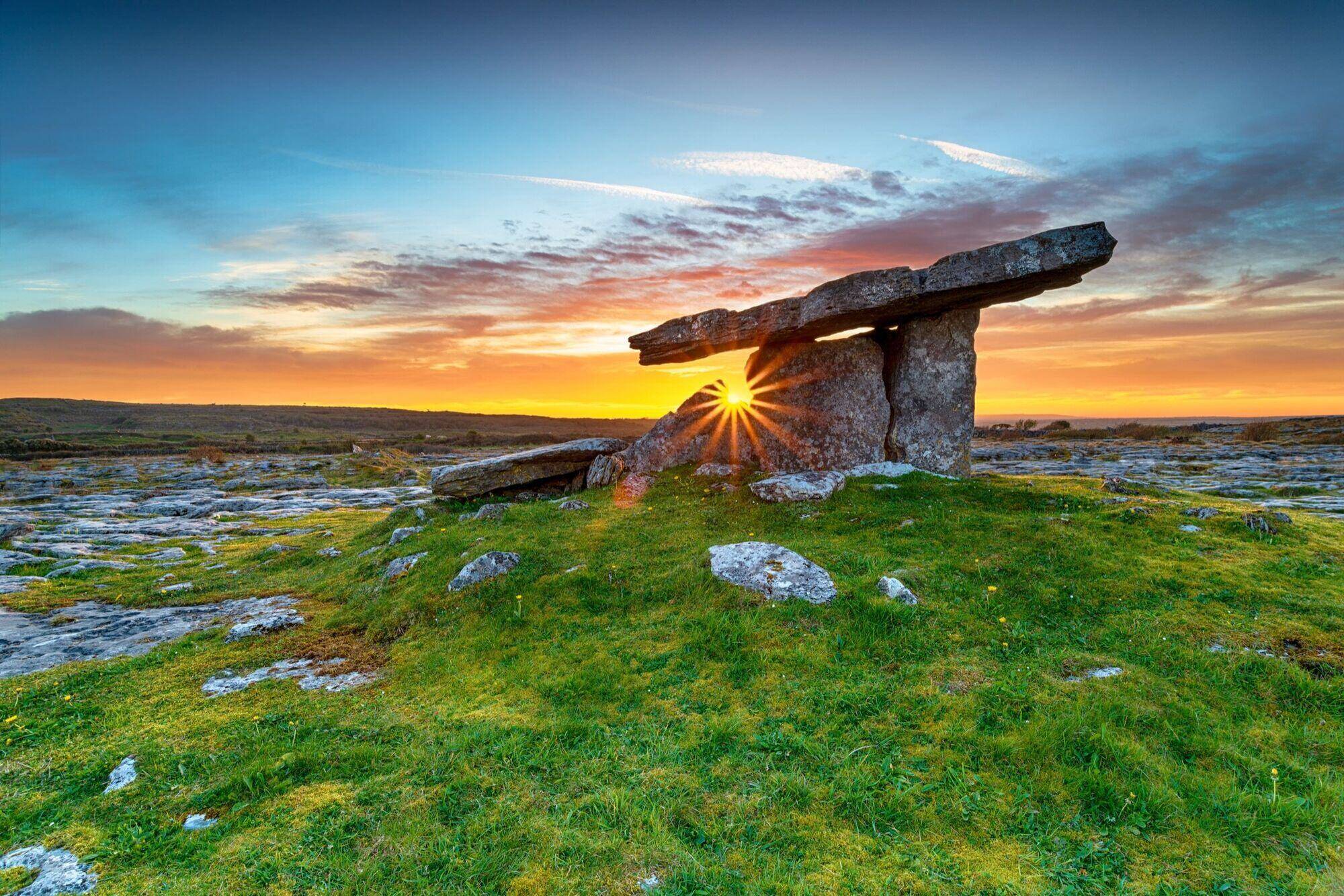
- The Burren, County Clare: the stones are far older than the stories (Poulnabrone dates to about 3500 BC), but this is the landscape of tombs and forts that folklore handed to the fairy folk. See the Burren.
- Garden of Remembrance, Dublin: the Children of Lir statue, if you’re passing through the city.
The Tuatha Dé Danann in fae romance
Modern fae romance leans hard on this story: an old race of gods who went under the hills and became the fair folk. Karen Marie Moning’s Fever series makes its fae the Tuatha Dé Danann outright. Our list of fae romance books traces each book back to the myth it uses.
On our Midsummer in the Burren trip (17 to 25 June 2028, up to 15 women), the group reads Lady Gregory’s Gods and Fighting Men during the reading months, January to May, and then we go to Poulnabrone, the Cliffs of Moher and Dún Aonghasa, the fort the legends say the Fir Bolg built.
The Tuatha Dé Danann on paper, in stone and in bronze
The gods were written down by monks around 1100, then picked up again 800 years later by Yeats and Lady Gregory, while archaeologists elsewhere were digging up Troy and Tutankhamun. Here's how the old gods got from the manuscripts to Dublin's Garden of Remembrance.
- Before the Normans 1106–1169
- Norman and English rule 1169–1801
- Union with Britain 1801–1922
- Independent Ireland 1922–2006
The story Ireland and Britain The wider world Other writers
- 3200 BC Ireland and Britain Around this time Newgrange is built in the Boyne valley; the stories later make it Aengus Óg's home.
- 1106 The story Lebor na hUidre, the oldest surviving manuscript in Irish, is written at Clonmacnoise before this year. It holds Tochmarc Étaíne, with Aengus and Midir.
- 1169 Ireland and Britain Anglo-Norman forces land in County Wexford.
- 1636 Ireland and Britain The Annals of the Four Masters are finished in Donegal, starting their history of Ireland with the invasions of Lebor Gabála.
- 1760 Other writers James Macpherson's "Ossian" poems begin to appear and make Gaelic heroes fashionable across Europe.
- 1812 The wider world The Brothers Grimm publish the first volume of their fairy tales.
- 1845 Ireland and Britain The Great Famine begins.
- 1848 The story John O'Donovan's English edition of the Annals of the Four Masters begins to appear; its notes include a Tory Island folk tale of Balor and Lugh.
- 1871 The wider world Heinrich Schliemann starts digging at Hissarlik in Turkey, looking for Homer's Troy.
- 1888 The story Yeats records that antiquarians called the fairies the Tuatha Dé Danann, "dwindled away in the popular imagination."
- 1891 The story Whitley Stokes translates Cath Maige Tuired into English, four treasures and all.
- 1893 Ireland and Britain The Gaelic League is founded in Dublin.
- 1904 The story Lady Gregory publishes Gods and Fighting Men, the whole Tuatha Dé story in plain English.
- 1920 Other writers James Stephens publishes Irish Fairy Tales, retelling the Fianna stories.
- 1922 Ireland and Britain The Irish Free State is founded.
- 1922 The wider world Howard Carter finds Tutankhamun's tomb in Egypt.
- 1937 Other writers J. R. R. Tolkien publishes The Hobbit.
- 1966 Ireland and Britain Dublin's Garden of Remembrance opens for the 50th anniversary of the Easter Rising.
- 1967 The story At Newgrange, in Brú na Bóinne, the home of Aengus Óg in the stories, archaeologist Michael O'Kelly sees the midwinter sunrise light the passage on 21 December.
- 1971 The story Oisín Kelly's bronze of the Children of Lir is unveiled in the Garden of Remembrance.
- 1993 Ireland and Britain Brú na Bóinne becomes a UNESCO World Heritage Site.
- 2006 Other writers Karen Marie Moning publishes Darkfever, whose Fae are the Tuatha Dé Danann.
Questions people ask
How do you pronounce Tuatha Dé Danann?
In English it is usually said TOO-ah day DAN-un. The first word can also be heard as TOO-ha. In Irish the stress falls on the first syllable of Tuatha and of Danann.
What does Tuatha Dé Danann mean?
Tuath means a people or tribe and Dé means of the god or gods. The earlier name was simply Túath Dé, "tribe of the gods." Danann is usually taken as the name of a mother goddess, Danu, but that reading is not universally accepted.
What are the four treasures of the Tuatha Dé Danann?
The Stone of Fál (Lia Fáil) from Falias, which roared under the rightful king; the Spear of Lugh from Gorias; the Sword of Nuada from Findias; and the Dagda's Cauldron from Murias, which no company left unsatisfied.
Who are the main gods of the Tuatha Dé Danann?
Nuada the king, the Dagda, Lugh, Ogma, Brigid, the Morrígan, Dian Cécht the healer, Goibniu the smith, Aengus Óg, Manannán mac Lir, and Ériu, Banba and Fódla, who gave their names to Ireland.
Who is Lugh in Irish mythology?
Lugh is the Tuatha Dé god of every skill, called Lámhfhada ("long arm") and Samildánach ("skilled in many arts"). Son of Cian and of Ethniu, daughter of the Fomorian Balor, he talks his way into Nuada's court at Tara by being master of every art at once, and kills Balor at the Second Battle of Moytura. The harvest festival Lughnasadh, on 1 August, carries his name.
Who is Balor in Irish mythology?
Balor is a leader of the Fomorians, the enemies of the Tuatha Dé, with an eye that destroys whatever it looks at. In Cath Maige Tuired it takes four men to lift the lid. His grandson Lugh kills him with a sling-stone through that eye at the Second Battle of Moytura.
Who is Lir, and what is the story of the Children of Lir?
Lir is a lord of the Tuatha Dé. His jealous second wife, Aoife, turns his four children, Fionnuala, Aodh, Fiachra and Conn, into swans for 900 years: 300 on Lough Derravaragh, 300 on the Sea of Moyle and 300 off Erris in Mayo. When the spell ends they turn into very old people, are baptized by a monk on Inis Gluaire, and die.
What happened to the Tuatha Dé Danann?
The Milesians beat them at the battle of Tailtiu. The poet Amergin gave the Milesians the land above ground and the Tuatha Dé the land below, so they went into the hills and mounds. In later Irish folklore they are the Sídhe, the fairy people.
Are the Tuatha Dé Danann fairies?
In later folklore, yes: Yeats wrote in 1888 that Irish antiquarians saw the fairies as the Tuatha Dé Danann who had "dwindled away in the popular imagination." In the medieval texts they are gods and kings, not small fairies.
Read next
- Ireland · Irish MythThe MorríganThe shape-shifting war goddess of Irish myth, from the medieval texts to Sarah J. Maas, and which of her symbols actually come from the sources.
- Ireland · Irish FolkloreFairies in Irish folkloreWho the "good people" are, why farmers plough around fairy forts, and what happened when a road met a fairy bush in Clare.
- Ireland · RomantasyFae romance books, and the Irish and Scottish myths behind themTen fae romance books, with the author, year and series, and the old story each one draws on.
- Ireland · Irish MythThe selkie mythSeal people who take off their skins on land, and the families on both sides of the sea who claimed them as ancestors.
Sources
- The Second Battle of Moytura, trans. Whitley Stokes (Revue Celtique 12, 1891), CELT, University College Cork
- Lady Gregory, Gods and Fighting Men (1904), Project Gutenberg #14465
- W. B. Yeats (ed.), Fairy and Folk Tales of the Irish Peasantry (1888), Project Gutenberg #33887
- Tuatha Dé Danann (name, IPA pronunciation, arrival, members)
- Lebor Gabála Érenn (date, manuscripts, invasions)
- Lebor na hUidre (before 1106, Clonmacnoise, Tochmarc Étaíne)
- Lugh (epithets, Tara doorkeeper, parents, Lughnasadh)
- Balor (eye, sling-stone, Tory Island tale, O'Donovan 1848)
- Children of Lir (names, three waters, Inis Gluaire, Robin Flower on date)
- Garden of Remembrance, Dublin (opened 1966; Children of Lir statue 1971)
- Newgrange (winter solstice, O'Kelly 1967; Brú na Bóinne World Heritage 1993)
- Mayo.ie: The Battle of Moytura
- Lough Arrow (Moytura, Second Battle)
- Cliffs of Moher Experience: Myths and Legends
- Poulnabrone dolmen (dating)
- Lia Fáil (stone at Tara)
Get the reading list first.
Trip announcements, curated reading lists, and the occasional dispatch — before anyone else.